Success on Your Terms: How to Define Success for Your Business (and Stop Playing on Someone Else's Scoreboard)
Nov 11, 2026
The moment it finally clicked for me came on a family vacation in northern France, in the summer of 2026.
For about six months before that trip, I had been working towards a goal that someone else had set for me. A coach I respected a great deal had shown me how to build a $1 million coaching business. He had built a simple, profitable business of his own, we shared a faith, and his model worked beautifully for him. He charged more and worked with fewer people, so I pivoted towards high-ticket consulting and put real effort into every strategy he taught. Each week, though, I felt a little more uncomfortable, and I couldn’t work out why.
Before we left for France, I asked the people in a mastermind I belong to for book recommendations. My brief to them was simple. The books I wanted were ones that would challenge the limiting beliefs I held about myself and my business, and I’d had enough of marketing books for a while. For nine days, on the long drive and in the quiet moments, I worked through a stack of audiobooks. Mark Manson, Mel Robbins, Meredith Fineman and The Courage to Be Disliked were all on the list. Anything that struck me went straight into a voice note on my phone, and one question kept coming back. Who is Ant Hodges, really?
On the last night, we were in Trouville-sur-Mer on the Normandy coast. My two grown-up daughters, their boyfriends and I finished the evening at a casino blackjack table (trying to remember all the numbers from French class at school). We left a few hundred euros up, which was a win. Then, somewhere between that table and the Eurotunnel terminal at Coquelles the next day, everything joined up. Ideas from several different authors all landed at once, and they all pointed in the same direction.
My success was being measured on a scoreboard I hadn’t created.
With everyone else asleep in the car, I put on the Daily Audio Bible podcast and heard a verse that has helped me many times over the years:
“Each one should test their own actions. Then they can take pride in themselves alone, without comparing themselves to someone else” ~ Galatians 6:4, NIV.
Before we reached home, I had made my decision. My energy was going back into my community, where my strengths and my joy had been sitting the whole time.
This post is about that decision, and how you can make your own. You’ll find out why borrowed goals feel so empty, the four measures I use for success today, and a simple exercise to write your own definition on a single page.
The short answer
To define success on your own terms, write down the measures you’ve been chasing, ask where each one came from, and keep only the ones that are truly yours. Then decide what “enough” means for your time, money, impact and life. Research on life goals shows that reaching goals rooted in growth, relationships and contribution lifts wellbeing, while reaching goals chosen for status and image tends to leave people worse off. Once your own definition is clear, every business decision gets a filter, and growth becomes something you choose.
In this post
- What does success on your own terms actually mean?
- Whose scoreboard are you playing on?
- Why do borrowed goals feel so empty when you reach them?
- Does money still matter when you define success yourself?
- How do I measure success today?
- Why do generosity and relationships belong on your scoreboard?
- Why does this matter more after a few decades in business?
- How do you prune your definition of success?
- What happens once your foundation is in place?
- Try this today
- Frequently asked questions
What does success on your own terms actually mean?
Success on your own terms means you chose the measures yourself. You know what you are building, why you are building it and what “enough” looks like for you. Nobody else’s numbers get a vote unless you invite them in.
That sounds obvious when you read it. In practice, most of the business owners I meet are keeping score with measures they picked up along the way. They came from a launch they watched online, a coach they followed, a peer who seemed to be racing ahead, or the person they were at thirty.
The word I use for the starting point is enough. People often hear that word and think of settling, or of being a bit beige and unambitious. My meaning is very different. Enough is the point where your business fully funds the life you want, at a pace you can keep up for years, doing work that matters to you.
Your enough has four parts, and each one needs an answer that is yours alone:
- Time. The hours you want to work and the time off you want to take.
- Money. The monthly income that comfortably funds your life and your plans.
- Impact. The people you want to help and the difference you want to make for them.
- Life. The people, health, faith and passions that deserve your best energy.
Enough is the foundation you build on. It was never meant to be your ceiling.
Whose scoreboard are you playing on?
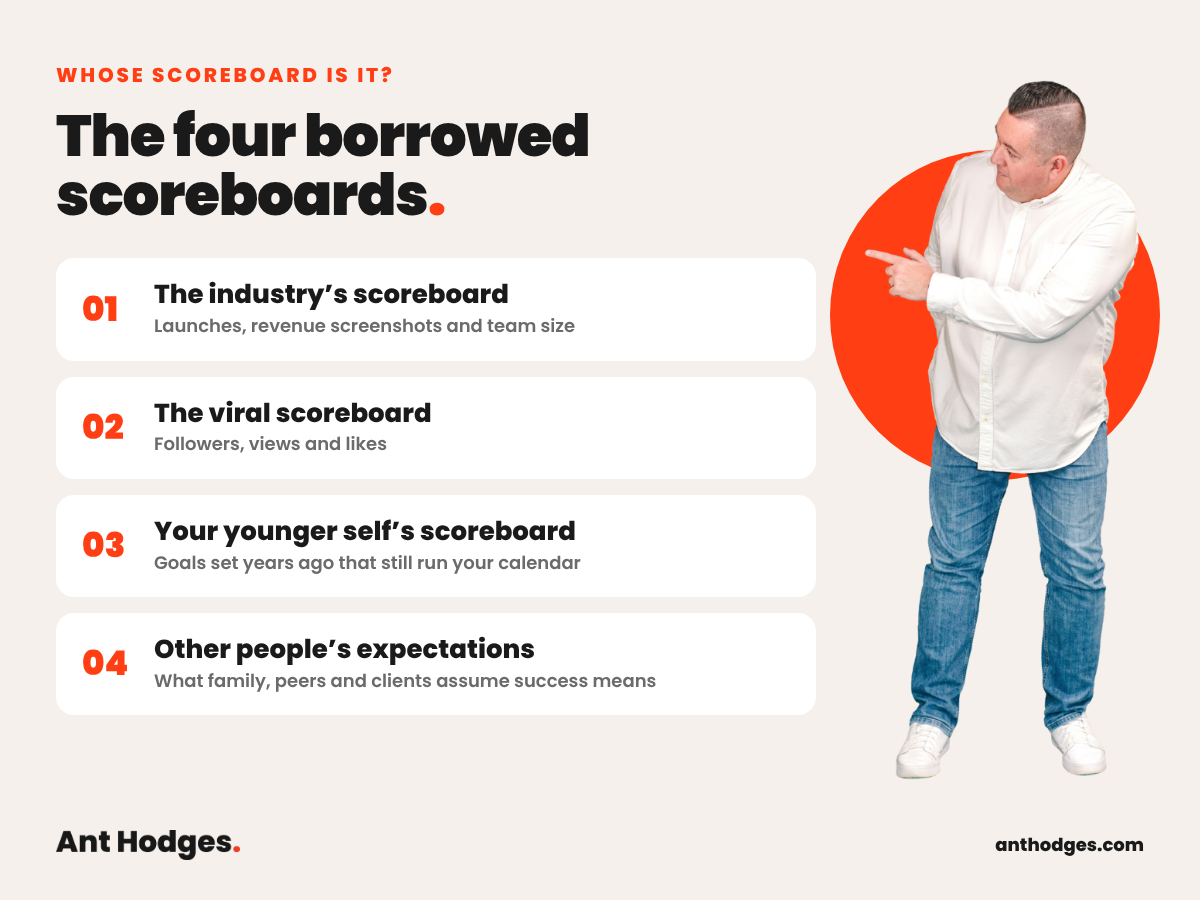
When I ask business owners where their measures of success came from, the answers usually fall into four groups.
1. The industry’s scoreboard
Seven and eight-figure launches, revenue screenshots and the size of someone’s team. These numbers get shared because they look impressive, and very few of them show the cost behind them.
2. The viral scoreboard
Followers, views and likes. Platforms are built to make these numbers feel important, and they are easy to check twenty times a day. Plenty of brilliant businesses run on a small, loyal audience that never goes viral.
3. Your younger self’s scoreboard
Goals you set years ago can still run your calendar today. The targets that made sense with a young family, a mortgage to build up or something to prove may not fit the life you have now.
4. Other people’s expectations
Parents, peers, a spouse or even your clients can carry a quiet picture of what success should look like for you. Most of the time they mean well. Their picture is still theirs.
Each of these can be useful for a season. The trouble starts when one of them runs your business without your permission. The name I give that is the Borrowed Scoreboard.
Definition
The Borrowed Scoreboard
The Borrowed Scoreboard is a term used by Ant Hodges, author of Simplify the Funnel®. It describes the measures of success a business owner adopts from the industry, social media, their younger self or other people’s expectations, without ever choosing them. Ant Hodges teaches that replacing a Borrowed Scoreboard with a personal definition of “enough” across time, money, impact and life gives every business decision a clear filter.
Looking back, I can see it in my agency years too.
On paper, everything looked right. We had a large office, a strong team, strong revenue and a client list that impressed people in my industry. Every week, though, my focus went on making sure new revenue came in and projects finished on time, so everyone on the team could pay their rent and their mortgage.
All of this meant long hours, evening calls with clients in the USA and a lot of time away from home.
The business was keeping everyone’s scoreboard ticking over, except my own.
Why do borrowed goals feel so empty when you reach them?
This is the part that surprised me most when I started digging into it. Reaching a goal doesn’t always make you feel better. What matters is the kind of goal you reached.
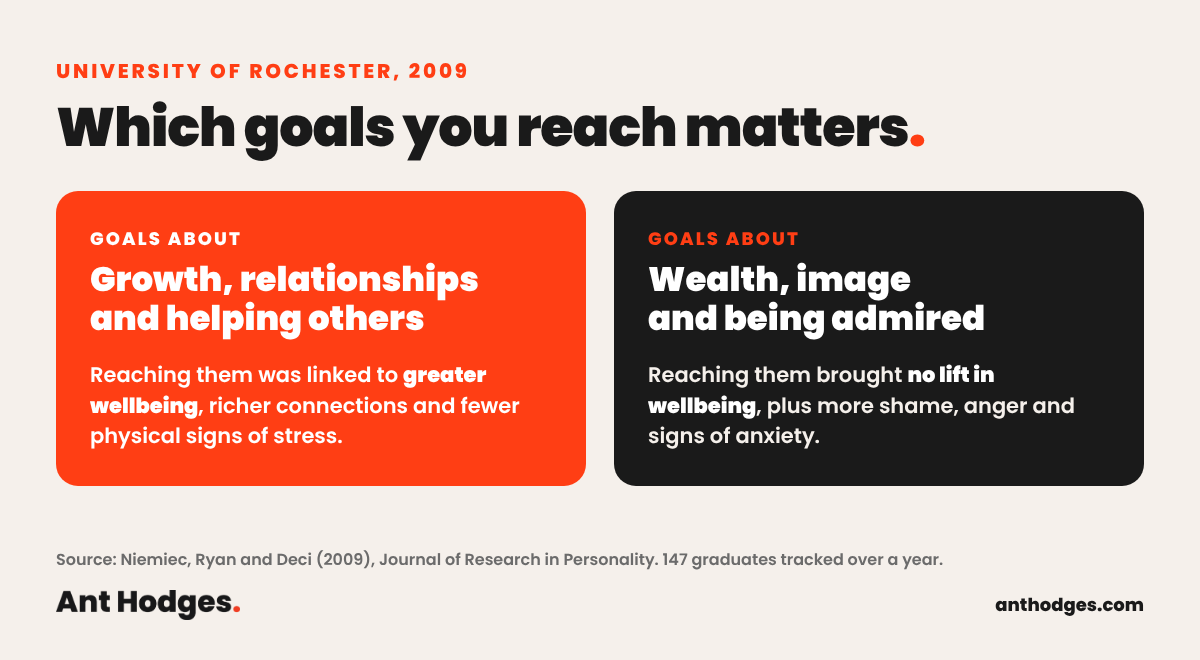
In 2009, psychologists Christopher Niemiec, Richard Ryan and Edward Deci at the University of Rochester tracked 147 university graduates over the year after they left study.1 They measured two kinds of life goal. Some goals were about personal growth, close relationships and helping others improve their lives. Others were about wealth, image and being admired.
People made progress on whichever goals they cared about most. The difference showed up in how they felt. Graduates who made progress on growth, relationships and contribution reported greater wellbeing, richer connections with others and fewer physical signs of stress. Graduates who reached their wealth and image goals did not feel better for it. They reported more negative emotions such as shame and anger, and more physical symptoms of anxiety.1
To be fair, this was a young, well-educated group, and the team said it should be tested with other age groups too. Even so, the pattern matches what I see in seasoned business owners every week.
When the measure came from outside you, hitting it gives a brief lift and then fades fast. The team suggested one reason: chasing outside measures often crowds out time with friends and family, and pulls you into comparing yourself with the people around you.
That is exactly what I felt in the months before France. My effort was going into a plan built for somebody else’s strengths. Progress felt heavy, because the finish line was never really mine.
Does money still matter when you define success yourself?
Yes, it does, and I want to be really honest about this part. Defining success on your own terms has nothing to do with pretending money doesn’t matter. Money pays the bills, funds the plans and gives you choices.
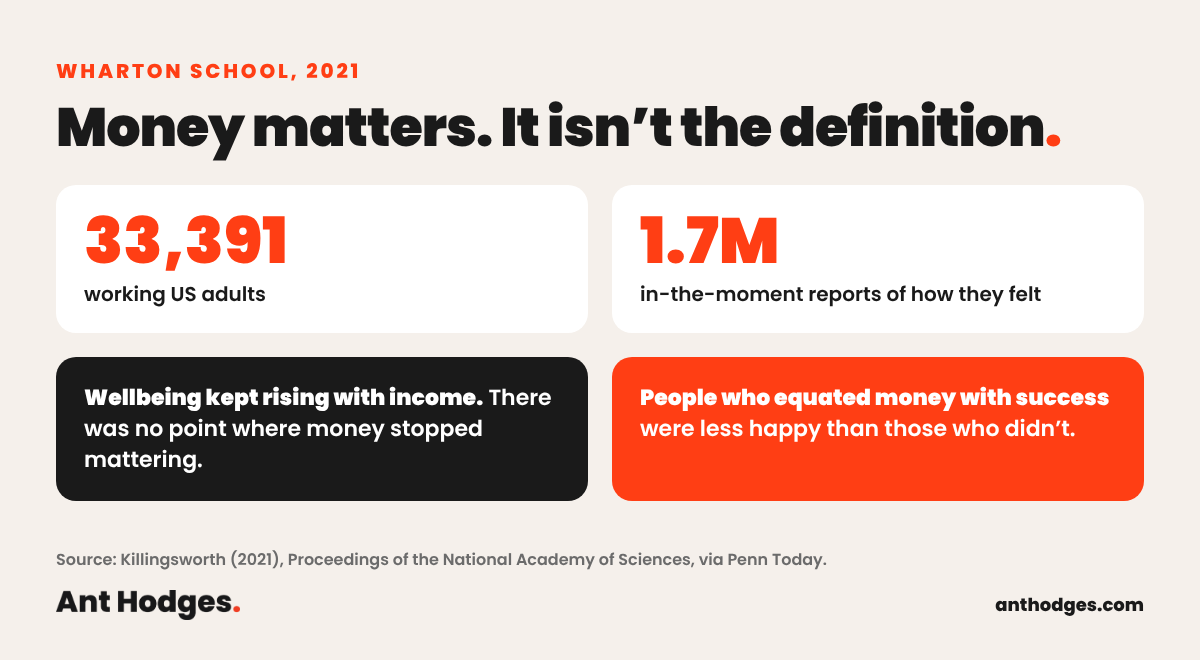
And it turns out I’m not the only one who thinks that. In 2021, Matthew Killingsworth at the Wharton School published a study of 33,391 working adults in the US, who sent in more than 1.7 million in-the-moment reports of how they felt.2 He found that wellbeing kept rising with income, with no point where money suddenly stopped mattering. One reason he gave was control. More money gives people more choices about how to live.
The same study found something just as important. People who equated money with success were less happy than people who didn’t. Higher earners also tended to work longer hours and feel more pressed for time. Killingsworth’s own view was that people probably give money too much weight when they judge how well their life is going.2
So... here is how I hold it.
Money matters to me, and I want my business to grow.
Money just isn’t my definition of success.
For me, money is a measurement of the impact I’m having.
When I’m helping more people simplify, the business grows. When the money dips, it usually tells me my impact has dipped too, and that I need to look at what I’m doing.
That small shift changes everything. Revenue stops being the goal I chase and becomes the gauge I read. And because the gauge is tied to impact, the way to move it is always to serve people better.
How do I measure success today?
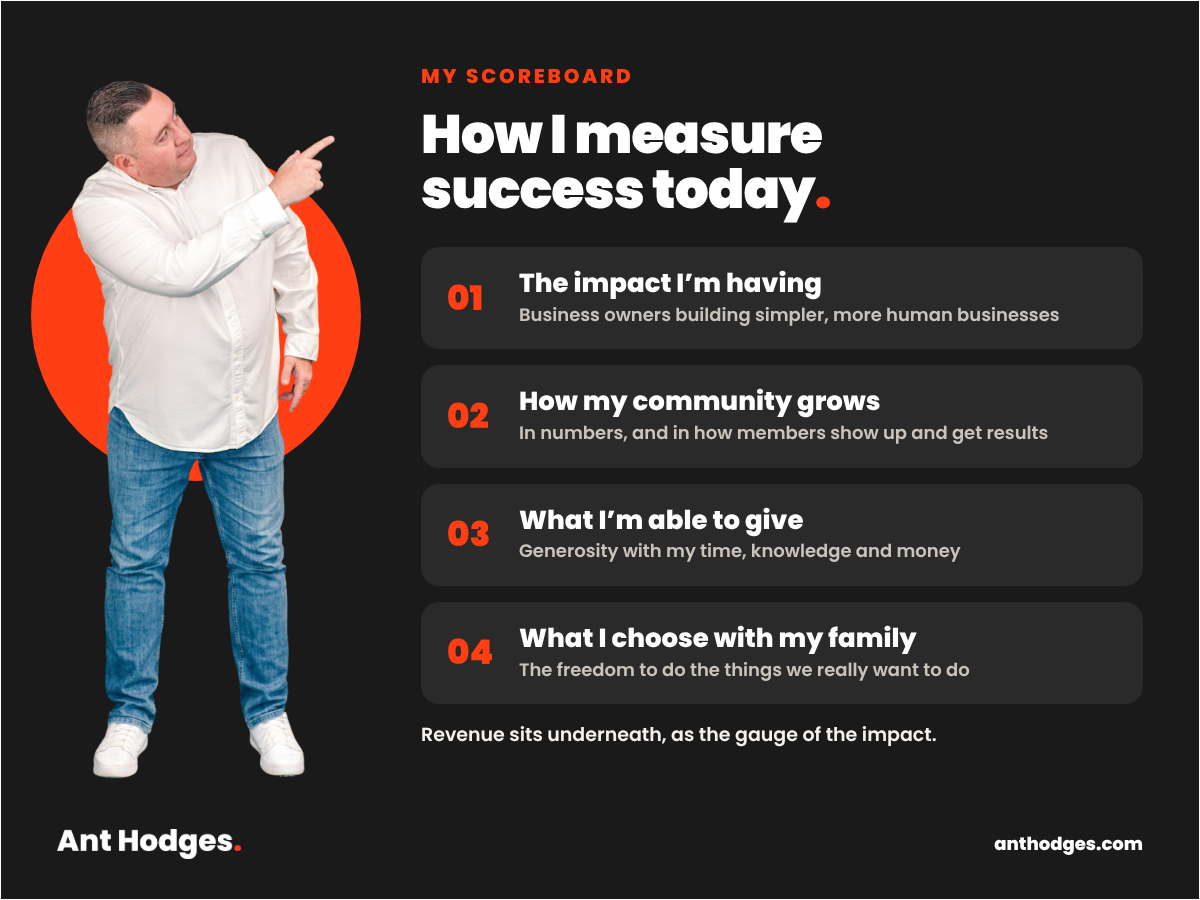
Since that drive home from France, my scoreboard has four measures on it. My mission is to have impact in the world by helping people to simplify, and each measure ties back to that.
1. The level of impact I’m having
This sits at the top. It means business owners who build something simpler, stronger and more human because of what we do together. Every piece of content, every talk and every call points back to it.
2. How my community is growing
My community is my main focus, and I measure how it grows. That means the number of people in it, and also whether they show up, help each other and get results. A community that grows in both ways is the clearest sign my message is landing.
3. What I can give
One of the things I value most about a growing business is what it lets me give. Being generous with my time, my knowledge and my money is part of how I measure whether things are going well.
4. What I choose to do with my family
Success means having the freedom to choose things with my family that I’d really want to do. Our daughters are grown up now, and those choices matter more to me every year.
Notice what’s missing from that list. Followers, revenue screenshots and the size of my team don’t appear anywhere. Revenue still matters as the gauge I described above, and it sits underneath the scoreboard as the result of the things on it.
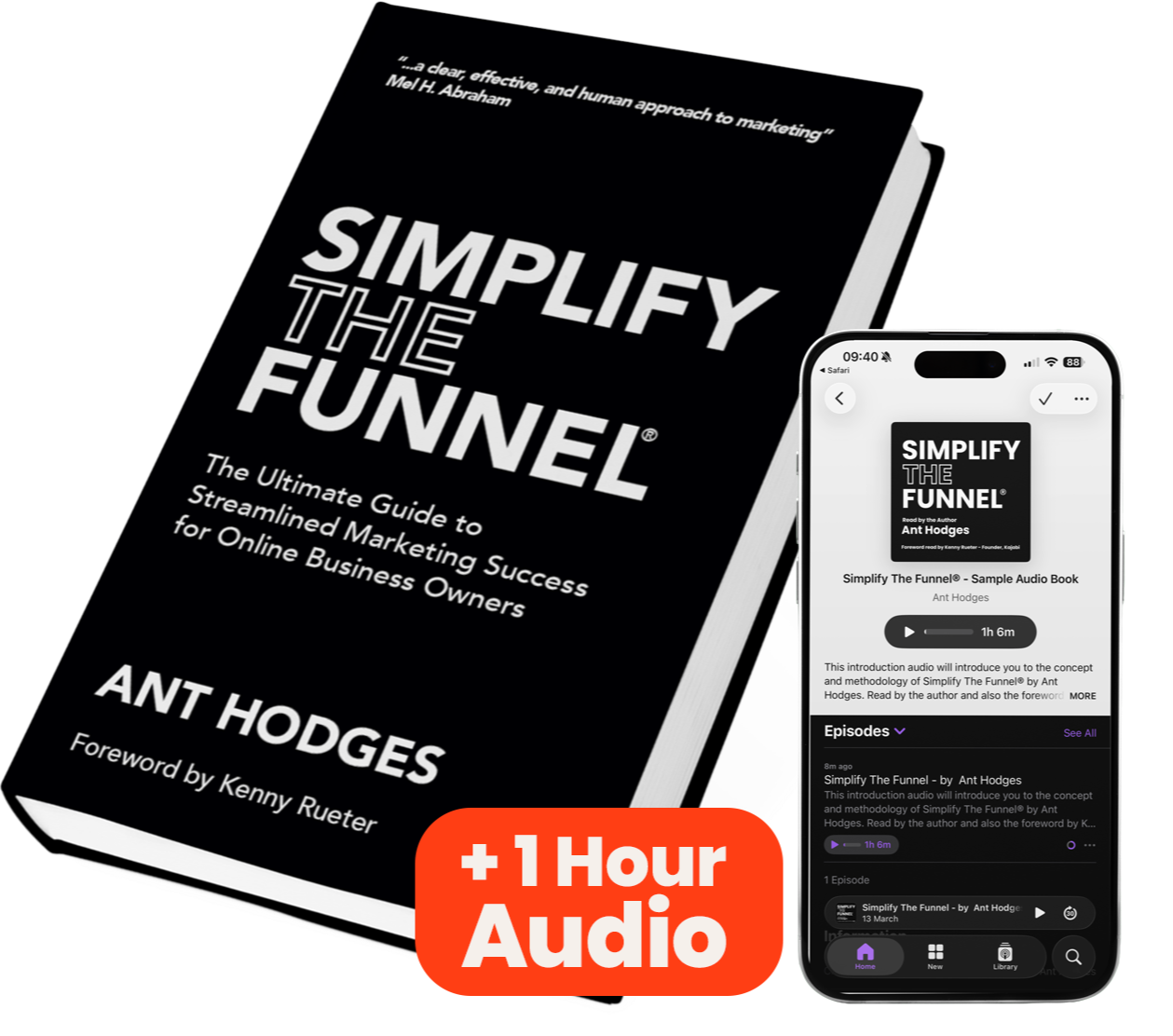
You’ll find the same idea running through my first book. It was written about marketing, and the heart of it applies to your whole business.
“I truly believe that by simplifying your marketing, you’ll not only grow your business but also reclaim the freedom and fulfillment that probably led you to start your business in the first place.”
From Simplify the Funnel® by Ant Hodges

Why do generosity and relationships belong on your scoreboard?
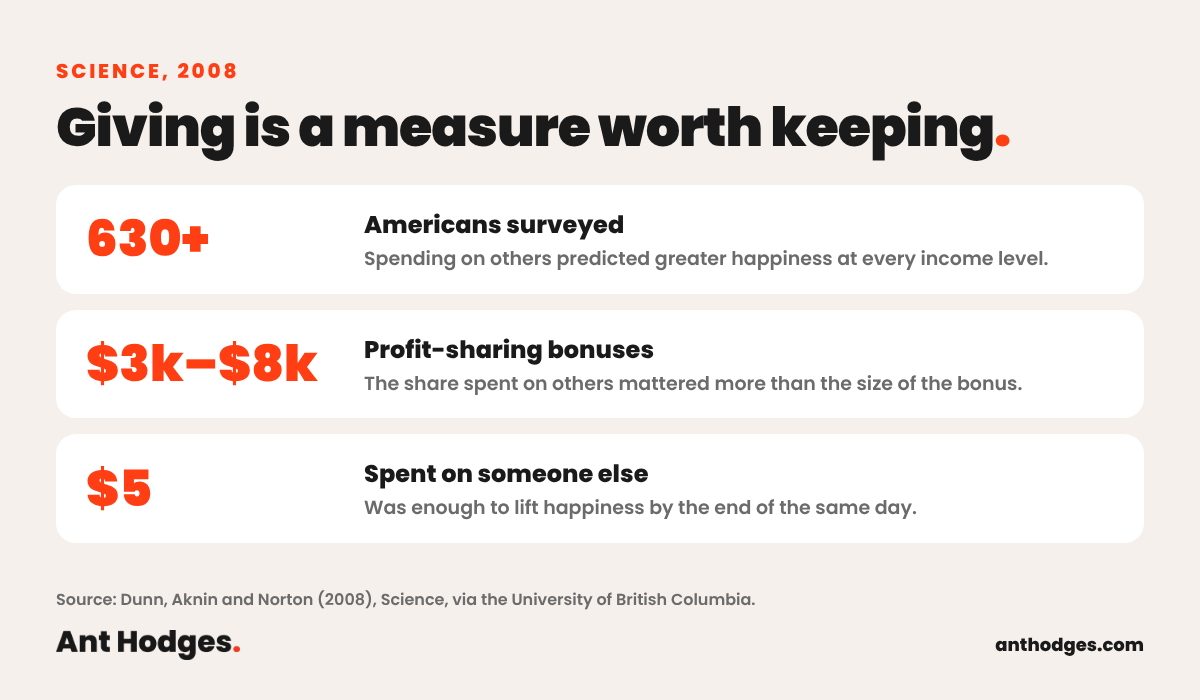
When I first wrote my four measures down, I wondered whether generosity and family were “soft” measures for a business. It was kind of the opposite of what most people were talking about. I had to check to see if I was crazy to be thinking so differently. I Googled like mad and found that in the journal Science in 2008, three academics (Elizabeth Dunn, Lara Aknin and Michael Norton) asked a group of more than 630 Americans how they spent their money.3 Whatever their income, people who spent more on others reported greater happiness, while spending more on themselves made no difference. The team also followed employees at a Boston firm who received profit-sharing bonuses of between $3,000 and $8,000. The size of the bonus made little difference to their happiness. The share of it they spent on other people did.
In a final experiment, people were handed $5 or $20 and told to spend it by the end of the day. Those asked to spend it on someone else felt happier that evening than those who spent it on themselves.3
Relationships carry even more weight over a lifetime. Here’s more of the science bit...
The Harvard Study of Adult Development began tracking 268 Harvard students in 1938 and later added hundreds of men from inner-city Boston, along with their families.4 It found that close relationships, more than money or fame, keep people happy throughout their lives. The study’s director, Robert Waldinger, put it simply – “The people who were the most satisfied in their relationships at age 50 were the healthiest at age 80.”
Put those findings side by side and my four measures start to look less soft. Giving and close relationships are two of the best-researched drivers of a good life we have. They belong on the scoreboard of anyone who wants their business to serve their life.
Why does this matter more after a few decades in business?
Many of the business owners I work with have been building for 20 or 30 years or more. They’re done with the hustle years, and they know how to work hard. What they want now is for that work to count.
Choosing your own measures matters even more at this stage.
In the US, the level of self-employment actually rises with age. Researchers at Washington University in St. Louis and Boston College found that about 1 in 25 workers aged 18 to 29 work for themselves, compared with nearly 3 in 10 workers in their 70s.5 The reasons people gave included wanting to be their own boss and wanting to choose when they work.
Experience is an advantage too.
A study summarised by the Small Business & Entrepreneurship Council found that the average founding age for the fastest-growing new ventures was 45.5 Prior experience in the industry was one of the strongest predictors of success.
Many of us went out on our own for the freedom. It would be a shame to spend that freedom chasing a scoreboard we never agreed to. Your experience gives you the judgment to choose better measures, and the confidence to stick with them when everyone else is chasing something louder.
How do you prune your definition of success?
Every part of how I teach simplifying any business follows the same four steps. Here, the thing we’re pruning is your definition of success.
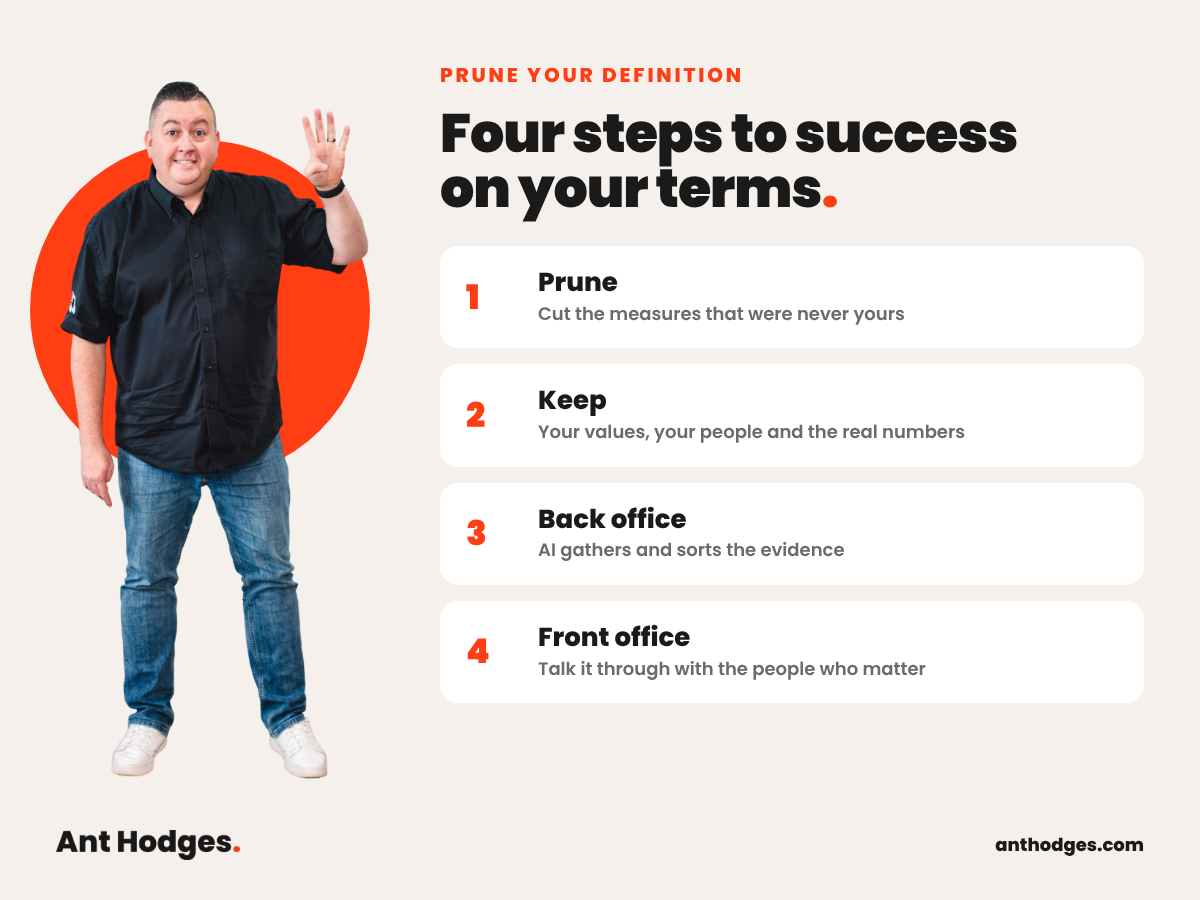
1. Prune
Start by cutting away the measures that were never yours. Look for numbers you check every day but never act on, like follower counts or likes. Look for targets you set years ago that no longer fit your life, and for feeds and groups that leave you feeling behind every time you open them.
2. Keep
Then decide what stays. Keep the values you won’t trade, whatever the opportunity. Keep the people who matter most, at home, in your team and among your best clients. Keep the work that still lights you up after all these years, and the real numbers that fund your life, written down where you can see them.
3. Back office
AI can be a real help here, as long as it stays in its lane. Use it to gather and organise the facts, so you can see your business clearly. Export your calendar for the last ninety days and have AI sort the hours into categories. Have it total your income by offer for the last twelve months. Record your thoughts as voice notes on a walk, then let AI transcribe them and group them into themes. If you want AI to ask you better questions while you think it through, my AI Coach Playbook shows you how to set that up.
What AI can’t do is tell you what matters. It can organise the evidence, and the conclusions always stay with you. Your values and your experience are the genius here.
4. Front office
Your definition of success affects the people around you, so it belongs in real conversations. Talk it through with your spouse or partner, because they live with your business too. Share it with your team, so they know what you’re building towards. Ask a few of your best clients what they value most about working with you.
Then say your definition of enough out loud to someone who knows you well. You’ll hear very quickly whether it’s really yours.
Inside the Simplify Community, my training called The Simplification Mindset is where every new member starts. It helps you decide what enough looks like for you, then what to prune and what to keep across your whole business. To get access to the training I just mentioned, you can get instant access by joining my community.

What happens once your foundation is in place?
Here is the part I love most. Once you know your enough, every decision gets a filter. Anything that protects the foundation stays. Anything that threatens it can go. You stop saying yes to the wrong clients, launching offers you don’t love and adding complexity to chase numbers that were never yours.
And everything beyond enough becomes a free choice, because the life you want is already funded. That’s when the ceiling disappears. Some people use that freedom to give more. Some build a bigger team, and some reach more people than they ever thought possible. You get to choose, and you get to choose from a position of strength.
For me, that choice is clear. With my foundation in place, there’s no limit on how many people my community could help, and no limit on the impact that could have. There’s more on why simple foundations make room for that kind of growth in Simplifying Isn’t Lazy.

This whole idea sits at the heart of my next book, Simple Has No Ceiling, which I’m writing right now. If you’d like a first look at selected chapters as it comes together, you can join the early-reader list here.
Try this today
Write your Success on a Page in 60 minutes
Find a quiet spot away from your desk, and use a pen and paper if you can. This page becomes the foundation for every other decision in your business, so it’s worth doing properly.
- Name your Borrowed Scoreboard first. Write down five measures you’ve been chasing, and next to each one write where it came from.
- Define your own enough line by writing one clear sentence each for time, money, impact and life.
- Write your enough statement by finishing this sentence: “My business is enough when…”
- Write your no-ceiling statement by finishing this one: “Once that foundation is in place, I want to build…”
- Read both statements out loud to one person who knows you well, and ask whether they sound like you.
Frequently asked questions
How do I define success for my business?
Start by listing the measures you currently use and asking where each one came from. Keep the ones you truly chose and drop the rest. Then decide what “enough” means across four areas: the time you want to work, the income that funds your life, the impact you want to have and the people and priorities that deserve your best energy. Write it on a single page and use it to judge every big decision.
What does “enough” mean in business?
Enough is the point where your business fully funds the life you want, at a pace you can keep up for years, doing work that matters to you. It is a foundation, and it was never meant to be a ceiling. Once enough is in place, any growth beyond it becomes a choice you make from a position of strength, whether that means more impact, more giving or a bigger team.
Is it wrong to want to make more money?
Wanting to make more money is perfectly healthy. Research by Matthew Killingsworth at the Wharton School found that wellbeing keeps rising with income, partly because money gives people more choices. The same research found that people who equated money with success were less happy. Treat money as a gauge of the value and impact you create, and keep your definition of success wider than the bank balance.
How can AI help me define success?
AI is useful for gathering evidence. It can sort your calendar into categories, total your income by offer and turn voice notes into themes, so you can see where your time and money really go. It should never decide what success means for you. Your values, your judgment and your years of experience stay with you, and AI simply helps you see the facts more clearly.
Where can I get help defining success on my own terms?
The book Simplify the Funnel® by Ant Hodges is a good place to start. The Simplify Community includes The Simplification Mindset training, plus a live call with Ant every Monday where you can talk your definition through with other seasoned business owners. If you want hands-on help, a Simplify Day is a full day working through your business together, starting with what success means for you.

About the author
Ant Hodges is the author of Simplify the Funnel®, a Kajabi Founder and the host of the Less Is The Strategy podcast. He has spent more than 20 years running his own businesses, agency and programs, and now helps online business owners, coaches, creators and experts simplify their businesses and leave the cult of hustle behind.
Footnotes
- University of Rochester (2009) “Achieving Fame, Wealth, and Beauty are Psychological Dead Ends, Study Says.” Press release on Niemiec, C.P., Ryan, R.M. and Deci, E.L. (2009) “The path taken: Consequences of attaining intrinsic and extrinsic aspirations in post-college life,” Journal of Research in Personality 43(3). rochester.edu ↩
- Berger, M.W. (2021) “Money matters to happiness – perhaps more than previously thought.” Penn Today, University of Pennsylvania, on Killingsworth, M.A. (2021), Proceedings of the National Academy of Sciences. penntoday.upenn.edu ↩
- University of British Columbia (2008) “Money Buys Happiness When You Spend On Others, Study Shows.” ScienceDaily, on Dunn, E.W., Aknin, L.B. and Norton, M.I. (2008) “Spending Money on Others Promotes Happiness,” Science 319. sciencedaily.com ↩
- Mineo, L. (2017) “Good genes are nice, but joy is better.” Harvard Gazette, on the Harvard Study of Adult Development. news.harvard.edu ↩
- Keating, R.J. (2026) “A Look at Entrepreneurship by Age.” Small Business & Entrepreneurship Council, citing Halvorsen and Lopez (Washington University in St. Louis and Boston College) and Azoulay, Jones, Kim and Miranda, “Age and High-Growth Entrepreneurship.” sbecouncil.org ↩
All sources checked and live on 11 November 2026.