How to Audit Your Marketing in 30 Minutes
Mar 02, 2026
Could you fit all of your marketing on a napkin? Picture it for a moment: every platform, every tool, every email sequence and every offer, written out in one place. Would it fit on the back of a napkin, or would you need a whiteboard the size of a wall?
When I ask clients and community members this question, something interesting happens. They spend most of our call unpacking everything they're doing, and they often feel a little embarrassed by how much there is. They know some of it works. What they can't tell me is which part is driving most of their results.
If that sounds familiar, this post is for you. It walks you through a simple audit you can finish in 30 minutes, using a pen, a sheet of paper and your bank statement. By the end, you'll know exactly where your complexity lives, what's bringing in money and what you can let go of.
The short answer
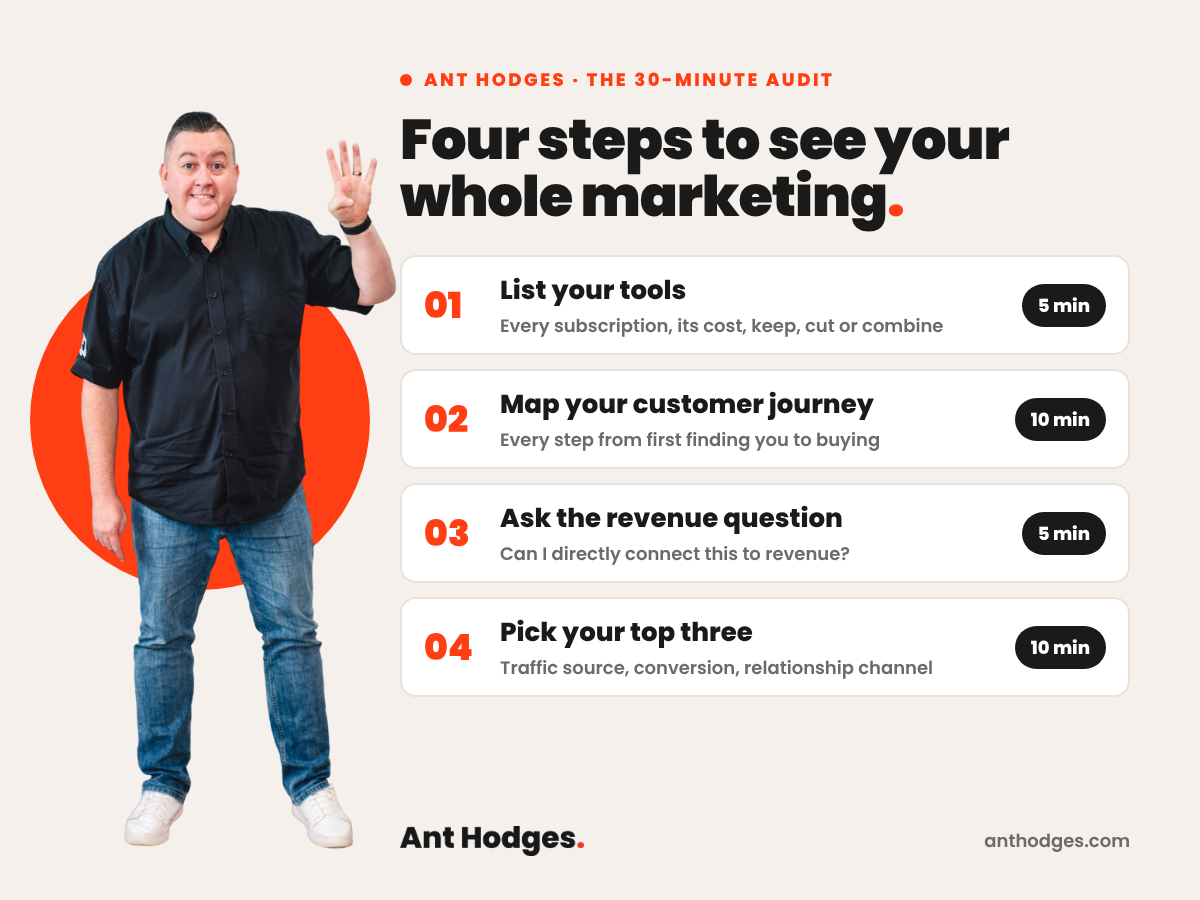
You can audit your marketing in 30 minutes with four steps. List every tool you pay for (5 minutes). Map the path a customer takes from finding you to buying (10 minutes). Ask whether each activity can be directly connected to revenue (5 minutes). Then pick the three activities that bring in the most money (10 minutes). Those three become the foundation of a simpler marketing plan, and everything else becomes a candidate for cutting.
In this post
- What is a marketing audit, and why only 30 minutes?
- Why is your marketing so hard to see in one place?
- What do you need before you start?
- Step 1: What tools are you paying for?
- Step 2: What does your customer journey really look like?
- Step 3: Can you connect it to revenue?
- Step 4: What are your top three?
- What does the audit look like in practice?
- What should you do after the audit?
- How often should you audit your marketing?
- Try this today: the 30-minute audit checklist
- Frequently asked questions
What is a marketing audit, and why only 30 minutes?
A marketing audit is a simple review of everything you do to attract customers and win sales. It looks at what you pay for, what you spend time on, and what actually produces revenue.
Big companies hire agencies to run audits that take weeks and end in a 60-page report. A small online business needs something much lighter. You already know your business better than any outside consultant does. What you're missing is a clear view of it, all in one place.
Thirty minutes is enough because the goal is clarity rather than perfection. You're looking for the big patterns: the tools you forgot about, the steps that confuse your buyers and the few activities that carry the whole business. Once you can see those patterns, the right decisions usually become obvious.
The time limit also helps in another way. Give yourself a whole afternoon and the audit turns into a research project. Give yourself 30 minutes and a timer, and you'll trust your instincts, which are usually right.
Why is your marketing so hard to see in one place?
Most marketing grows by addition. You hear about a new platform, so you set up an account. Someone recommends a tool, so you start a free trial that quietly becomes a paid plan. A launch needs a new landing page, a new email sequence and a new lead magnet, and when the launch ends, all of it stays.
Nobody plans a complicated business. It builds up one sensible decision at a time, until you're running far more than you can keep track of.
The research backs this up, even in large companies with dedicated teams. In 2023, Gartner surveyed 405 marketing leaders and found that they were using just 33% of the capabilities in their marketing technology stack, on average. That was the second year in a row the figure had fallen.1 Those are businesses with specialist staff, and they still only use a third of what they pay for.
The same pattern shows up in everyday life. A 2022 survey of 1,000 US consumers by C+R Research found that people spend an average of $133 a month more on subscriptions than they think. And 42% had forgotten about a subscription they were still paying for.2
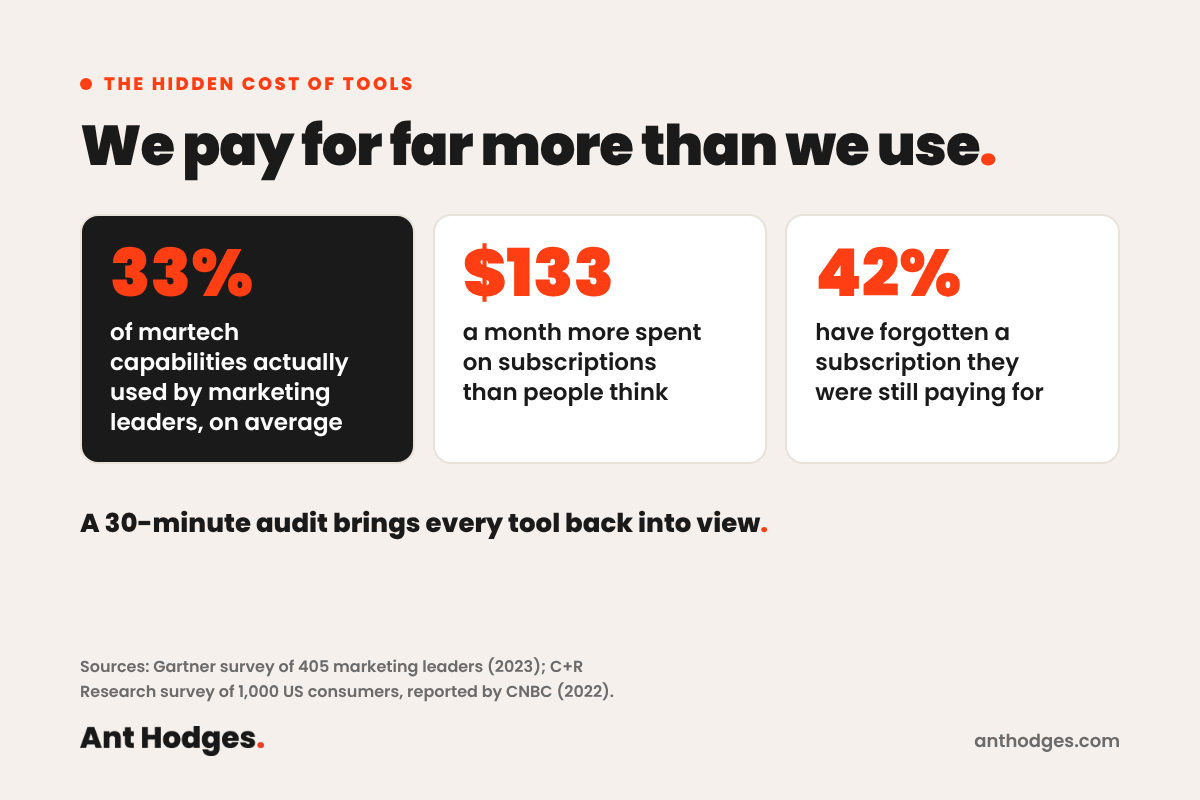
Put those two findings next to a busy online business and you can see what happens. Tools and steps pile up faster than anyone reviews them. The good news is that a short, honest audit brings all of it back into view, and that's the first step to taking control of it.
What do you need before you start?
You need very little, and that's deliberate. Here's what to gather before you set your timer.
- A pen and a large sheet of paper. This works better on paper than on a screen, because writing by hand slows you down just enough to think.
- Your last three months of bank or card statements, so you can see every subscription.
- Access to your website, so you can follow your own customer journey.
- A rough idea of where your last 10 sales came from. If you don't know, that's useful information too.
- A timer set for 30 minutes, with your phone on silent.
Try to do the whole thing in one sitting. Stopping halfway tends to turn a quick audit into a project you never finish.
Step 1: What tools are you paying for?
Allow about 5 minutes for this step.
Open your bank statement or credit card history. Write down every software subscription related to your business. That includes your email platform, landing page builder, scheduling tool, analytics, CRM, course platform, design tool, video hosting and anything else that leaves your account each month or year.
Next to each one, write what it costs and when you last used it. Then mark it with one of three words: keep, cut or combine.
Most people are surprised by the length of this list. One business owner I worked with found 28 active subscriptions, costing $3,400 a month in total. They were actively using six of them. The rest were there "just in case" or because they'd set something up ages ago and forgotten about it.
If your list looks similar, you're in very good company. It's one of the most common things I see when I audit any business. And every tool you cancel is money straight back into your pocket, every single month.
Two tips make this step faster. First, look for tools that overlap. Many all-in-one platforms now handle email, pages, courses and payments together, so you may be paying twice for the same job. Second, check for annual plans that renew soon. Put the renewal date next to the tool, so you can decide before you're charged again.
Step 2: What does your customer journey really look like?
Allow about 10 minutes for this step.
Now draw the path someone takes from first finding you to becoming a paying customer. Mark every step along the way: every post or video, every page they visit, every form they fill in, every email they receive and every decision they have to make.
Count the steps when you're done. If the journey has more than six, it's probably more complicated than it needs to be.
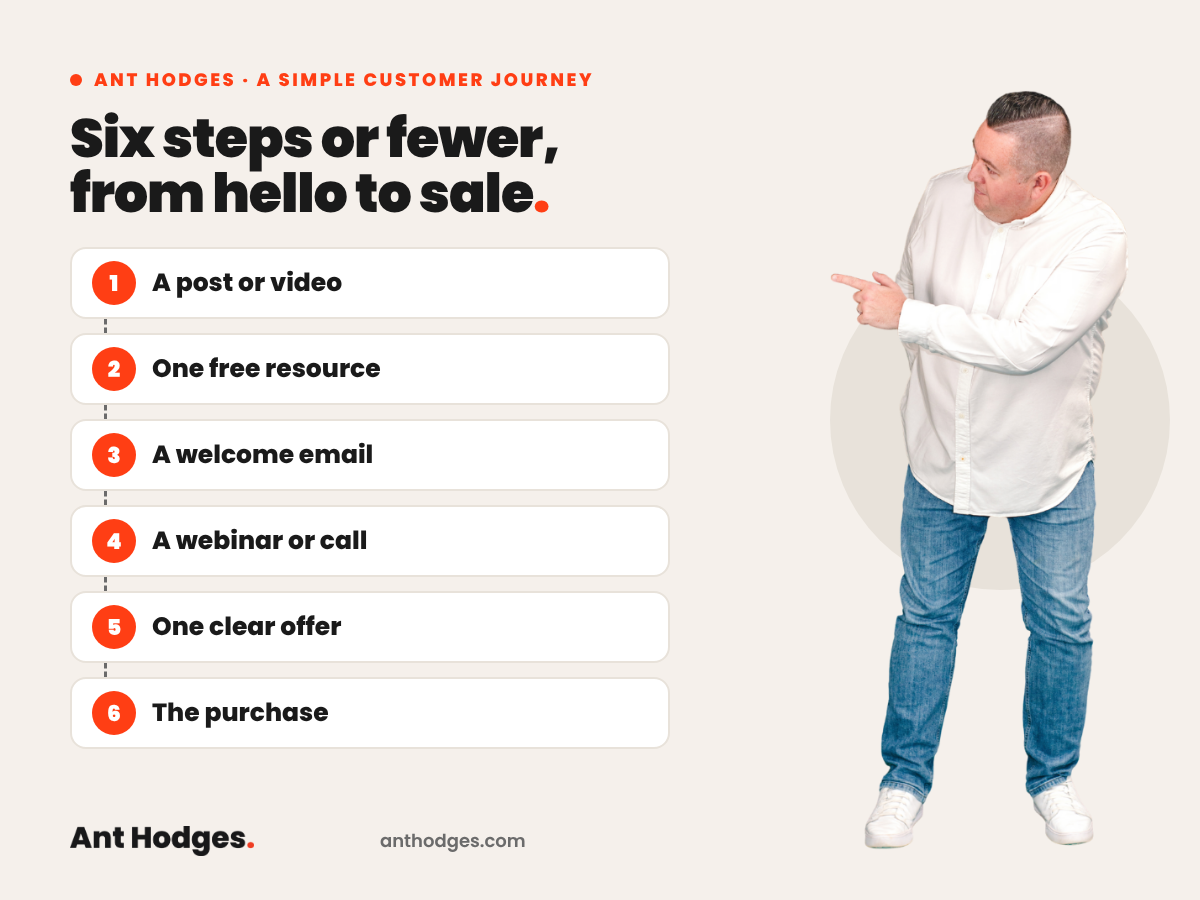
Every step you add asks your potential customer to make another small decision. Should I click this link, or sign up for that guide? Which of these options is right for me? Maybe I should just come back later. Each of those decisions builds up inside their head, and I call that build-up Decision Density.
Definition
Decision Density
Decision Density is a term used by Ant Hodges, author of Simplify the Funnel®. It describes the total number of choices, steps and actions a potential customer has to work through before they can buy. The higher the Decision Density, the less effective a marketing funnel becomes, because each extra decision is another chance for a ready buyer to stop.
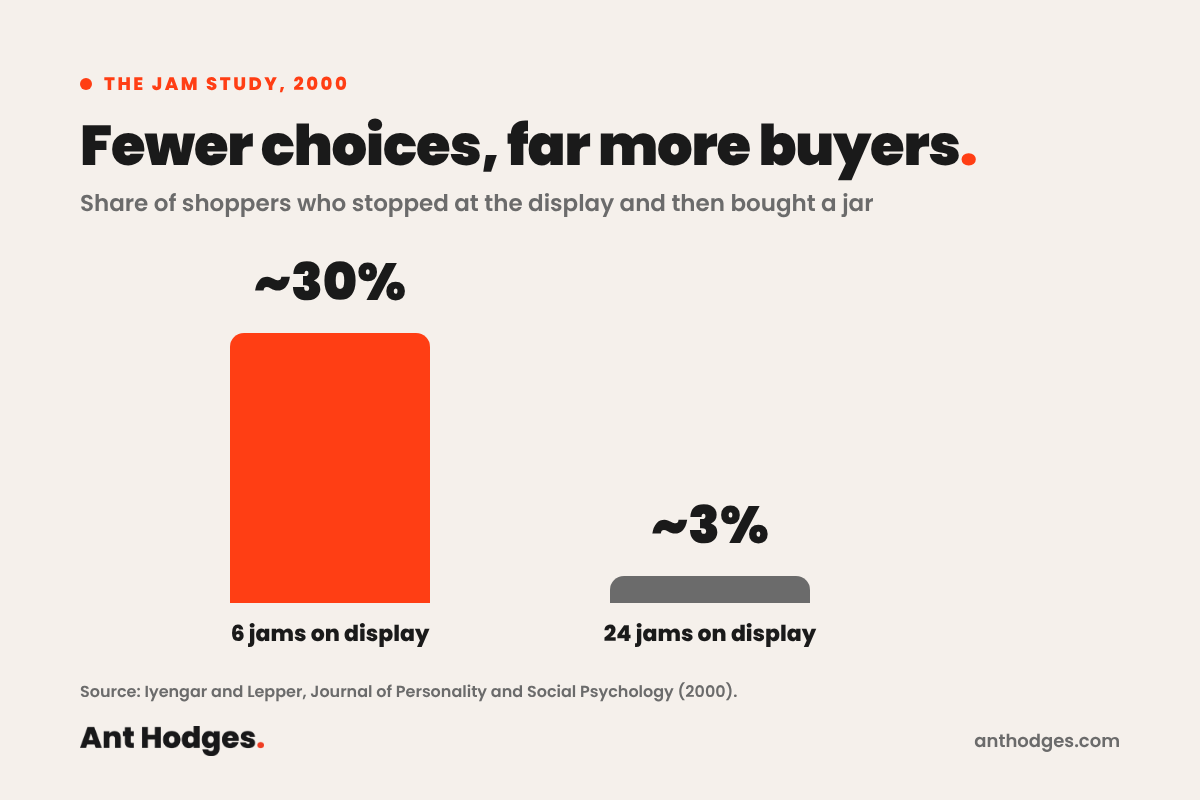
There's strong research behind this idea. In a well-known study published in 2000, psychologists Sheena Iyengar and Mark Lepper set up a jam tasting stand in a grocery store. At some times it offered 24 flavours, and at other times it offered six. The bigger display drew more people to stop and look. But only about 3% of those who stopped at the 24-jam display went on to buy, compared with about 30% at the six-jam display.3
A few years later, researchers Patrick Spenner and Karen Freeman studied thousands of consumers for Harvard Business Review. They found that the biggest driver of whether people bought, came back and recommended a brand was decision simplicity: how easy it was to find trustworthy information and weigh up the options. Brands in the top quarter for decision simplicity were 86% more likely to be bought than those in the bottom quarter.4
That's why this step matters so much. If you can't draw your customer journey from memory, your customers almost certainly can't follow it. The fix is usually simple. Remove a step, combine two pages, or replace three options with one clear recommendation.
Step 3: Can you connect it to revenue?
Allow about 5 minutes for this step.
Go back through everything on your sheet: every tool, every platform, every activity and every step in your journey. For each one, ask a single question.
"Can I directly connect this to revenue?"
If the answer is yes, put a tick next to it. If the answer is no, maybe, or "I'm not sure", highlight it.
The highlighted items are where your complexity lives. They take your time, money and energy, and right now you can't point to what they give back. Some of them may still be worth keeping, and that's fine. The point of this step is to make every item earn its place on the page.
Be honest with yourself here. A platform where you have a large following can feel valuable, but if you can't remember the last sale it brought you, it still gets highlighted. A big follower count feels good to look at. Sales conversations, email replies and booked calls are what pay the bills.
Step 4: What are your top three?
Allow about 10 minutes for this step.
Now look at everything you've ticked. From that list, choose the three activities that most directly bring in revenue. In most businesses they fall into three groups.
- Your top traffic source, the one place where most of your buyers first find you.
- Your best conversion mechanism, the thing that most often turns interest into a sale, such as a sales call, a webinar or a short email sequence.
- Your strongest relationship channel, where people get to know and trust you over time, which for many businesses is the email list.
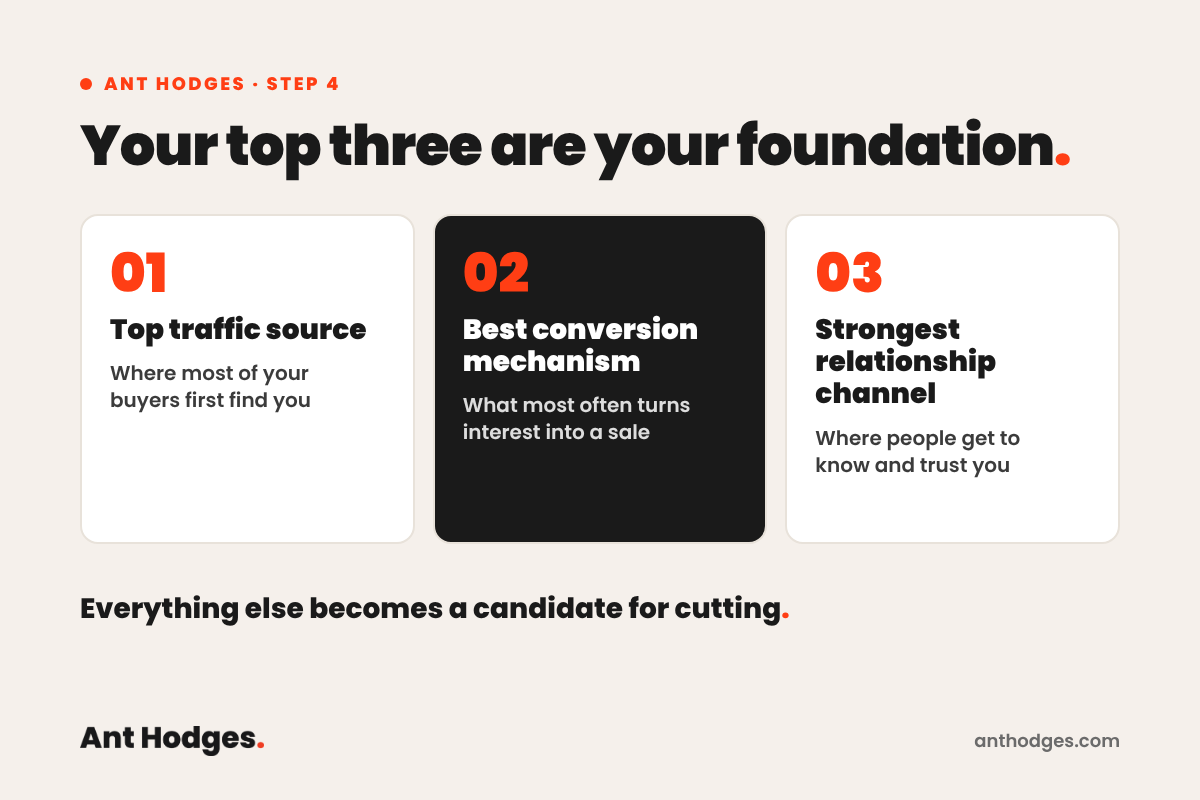
These three things are the foundation of your Minimum Viable Funnel™, the simplest version of your marketing that still brings in sales.
Definition
The Minimum Viable Funnel™
The Minimum Viable Funnel™ is a framework created by Ant Hodges and set out in his book Simplify the Funnel®. It reduces a business's marketing to four parts: one traffic source, one entry offer, one conversion event and one core offer.
Everything outside your top three becomes a candidate for cutting. You don't have to remove it all today. You do have to stop giving it the same attention as the things that pay your bills.
When I take people through this step, it often brings a real sense of relief. The business they were afraid to simplify turns out to rest on three things they already do well.
What does the audit look like in practice?
To make this concrete, here's a made-up example that mirrors what I see again and again. Imagine a business coach called Sam, who sells a group program and offers one-to-one sessions.
In step one, Sam lists 14 subscriptions. Two of them are separate email platforms, left over from a switch that never quite finished. Another is a webinar tool used once, for a launch two years ago. Sam marks four tools to cut and two to combine.
In step two, Sam draws the customer journey and counts 11 steps. People find Sam on Instagram, click to a link page, choose between three free guides, join an email sequence, get invited to a webinar, watch a replay page, see a sales page with three price options, book a call, and finally buy. Every one of those steps made sense when it was added. Together, they ask a potential client to make a lot of decisions.
In step three, Sam highlights the podcast, two of the three free guides and a Facebook group with very little activity. None of them can be linked to a recent sale.
In step four, the top three become clear. Instagram brings in most new people. Sales calls convert better than anything else. And the weekly email keeps people warm until they're ready.
Sam's simpler plan uses one free guide, one weekly email and one clear invitation to book a call. That's five steps from first finding Sam to buying, instead of 11. The podcast is paused, the spare tools are cancelled, and the time saved goes into more sales conversations.
Your own sheet will look different, of course. The pattern is usually the same, though: a business that felt complicated turns out to rest on a few simple things.
What should you do after the audit?
The audit shows you where the complexity lives. The next step is deciding what to keep and what to cut, and that's where most people get stuck. Cutting things out can feel scary. It can feel like going backwards, especially when you've spent money and time building something.
In reality, it's going forward with focus. Here's how I'd handle the next seven days.
Cancel the obvious ones today. Any subscription you haven't used in the last 90 days can usually go straight away. Most tools let you export your data first, so you lose nothing.
Remove one step from your customer journey this week. Pick the step that adds the most Decision Density and either remove it or combine it with the one next to it.
If you're unsure about something in the middle, score it for benefit against complexity, then keep it, kill it or combine it. You can read more about that approach in why doing less will make you more money.
Put the time you save into your top three. One more sales conversation, one more helpful email to your list, or one better piece of content on your main platform will do far more than spreading yourself across ten.
The hardest part of all this is the mindset, and the practical side is easy by comparison. Letting go of something you built takes a shift in thinking, and that shift is something I teach step by step in The Simplification Mindset training. To get access to the training I just mentioned, you can get instant access by joining my community.

If you want to go further with your top three, the full framework is in my book. Here's the principle I always come back to when people ask where to begin:
"Start small. Pick one area to simplify first. See the results. Then move on to the next."
From Simplify the Funnel®

How often should you audit your marketing?
Once is a great start, but the clutter has a habit of creeping back. New tools launch every week, and every new idea seems to need its own page, sequence or platform.
My recommendation is a quick audit every 90 days. Put it in your calendar now, at the start of each quarter, and give it the same 30 minutes. The second time is always faster, because you're only checking what has changed.
Between audits, one habit keeps things lean. Before you add any new tool, platform or step, ask what you could remove instead. Most of the time, the answer will save you money and keep your customer journey clear.
Try this today
The 30-minute audit checklist
- Set a 30-minute timer and grab a pen and a large sheet of paper.
- Spend 5 minutes listing every tool you pay for, with its cost.
- Spend 10 minutes drawing your customer journey and counting the steps.
- Spend 5 minutes asking "Can I connect this to revenue?" for every item.
- Spend 10 minutes choosing your top three and circling them.
- Cancel one unused subscription before you close your laptop.
Frequently asked questions
How do you audit your marketing quickly?
The quickest way is to use four timed steps. List every tool you pay for, map your customer journey from first contact to purchase, ask whether each activity can be directly connected to revenue, and then choose the three activities that bring in the most money. With a pen, paper and your bank statement, the whole audit takes about 30 minutes.
How many steps should a customer journey have?
For most small online businesses, six steps or fewer is a good target, from first finding you to buying. Each extra step adds another decision for your potential customer, and research on choice and decision simplicity shows that fewer, clearer decisions lead to more purchases.
What is Decision Density?
Decision Density is the total number of choices, steps and actions a potential customer has to work through before they can buy. The more decisions you ask someone to make, the less effective your marketing becomes, so a good audit looks for steps that can be removed or combined.
How often should I audit my marketing?
Every 90 days works well for most small businesses. A quarterly 30-minute audit catches new subscriptions, extra funnel steps and activities that have stopped bringing in revenue, before they build up into real complexity.
Can someone audit my marketing with me?
Yes, and it can make a real difference. You can do this audit on your own in 30 minutes, and many people do. If you'd like hands-on help, my Simplify Day starts with a full diagnosis of what you're doing now, using your real numbers, and ends with a written 90-day plan you can follow.

About Ant Hodges
Ant Hodges is the author of Simplify the Funnel®, a Kajabi Founder and the host of the Less Is The Strategy podcast. He has spent more than 20 years running his own businesses, agency and programs, and now helps online business owners, coaches, creators and experts simplify their businesses and leave the cult of hustle behind.
Footnotes
- Gartner (2023) "Gartner Survey Finds 63% of Marketing Leaders Plan to Invest in Generative AI in the Next 24 Months." Press release, 23 August 2023. gartner.com (press release) ↩
- CNBC (2022) "'It's a slippery slope': Most consumers underestimate monthly subscription costs by at least $100, study says." CNBC, 6 September 2022, reporting a C+R Research survey of 1,000 consumers. cnbc.com ↩
- Iyengar, S. S. and Lepper, M. R. (2000) "When choice is demotivating: Can one desire too much of a good thing?" Journal of Personality and Social Psychology, 79(6), 995-1006. faculty.washington.edu (PDF) ↩
- Spenner, P. and Freeman, K. (2012) "To Keep Your Customers, Keep It Simple." Harvard Business Review, May 2012. Summary free to read, full article for subscribers. hbr.org ↩
All sources were checked and live at the time of writing.