How to Close Sales Without Feeling Pushy
Mar 02, 2026
Most of the entrepreneurs I work with are brilliant at what they do. They're great coaches, consultants, course creators and experts, and they genuinely want to help people. But the moment a conversation turns towards money, something changes. Their voice tightens, they start talking faster, and the whole thing suddenly feels awkward.
If that sounds like you, you're in very good company. Nobody wants to be the pushy salesperson reading from a script. And because nobody wants to be that person, a lot of talented people avoid sales conversations altogether, or rush through them and hope for the best.
Here's the thing that matters, though. Selling is a skill every business owner needs, because without it there's no income and no one to help. The good news is that selling can feel completely natural. The best salespeople I know aren't pushy at all. They're simply great at conversations.
This post shows you how to have those conversations. You'll see why selling feels pushy in the first place, what the research says about listening, and the seven-step framework I've used on my own sales calls since 2016.
The short answer
You can close sales without feeling pushy by replacing scripts and pressure with a simple conversation structure. Ask about the problem first, let the other person explain what it's costing them and where they want to be, then ask permission before you share how you can help. Recommend one clear next step, check how it sounds, and only then talk about price. When people feel heard and stay in control of the decision, they're far more likely to say yes, and nobody feels pushed.
In this post
- Why does selling feel so pushy?
- Should you use a sales script or wing it?
- What is Selling Without Selling?
- How do the seven steps work on a real call?
- Why does listening close more sales than talking?
- How do you talk about price without it feeling awkward?
- What if the answer is still no?
- Who should get a sales call in the first place?
- Try this today: your next sales call
- Frequently asked questions
Why does selling feel so pushy?
Selling feels pushy when one person is trying to move another person somewhere they haven't chosen to go. You can feel it from both sides. As the seller, you're pushing. As the buyer, you're digging your heels in.
Psychologists have a name for that digging in. It's called reactance, and it was first described by Jack Brehm in the 1960s. A 2019 review of the research describes it as the motivational state that kicks in "when a freedom is eliminated or threatened with elimination."1 The same review notes that more explicit, forceful messages tend to feel more threatening to people, which makes them resist even harder.1
That explains a lot about sales. Pressure lines, countdown deals and clever closing phrases all chip away at the buyer's sense of choice. Even when the offer is a great fit, the pressure itself makes people want to say no.
The answer is to keep the buyer in control from start to finish. When someone feels free to decide, they relax, they think more clearly, and they tell you what they really need. Helpful sales calls have a recognisable sound to them.
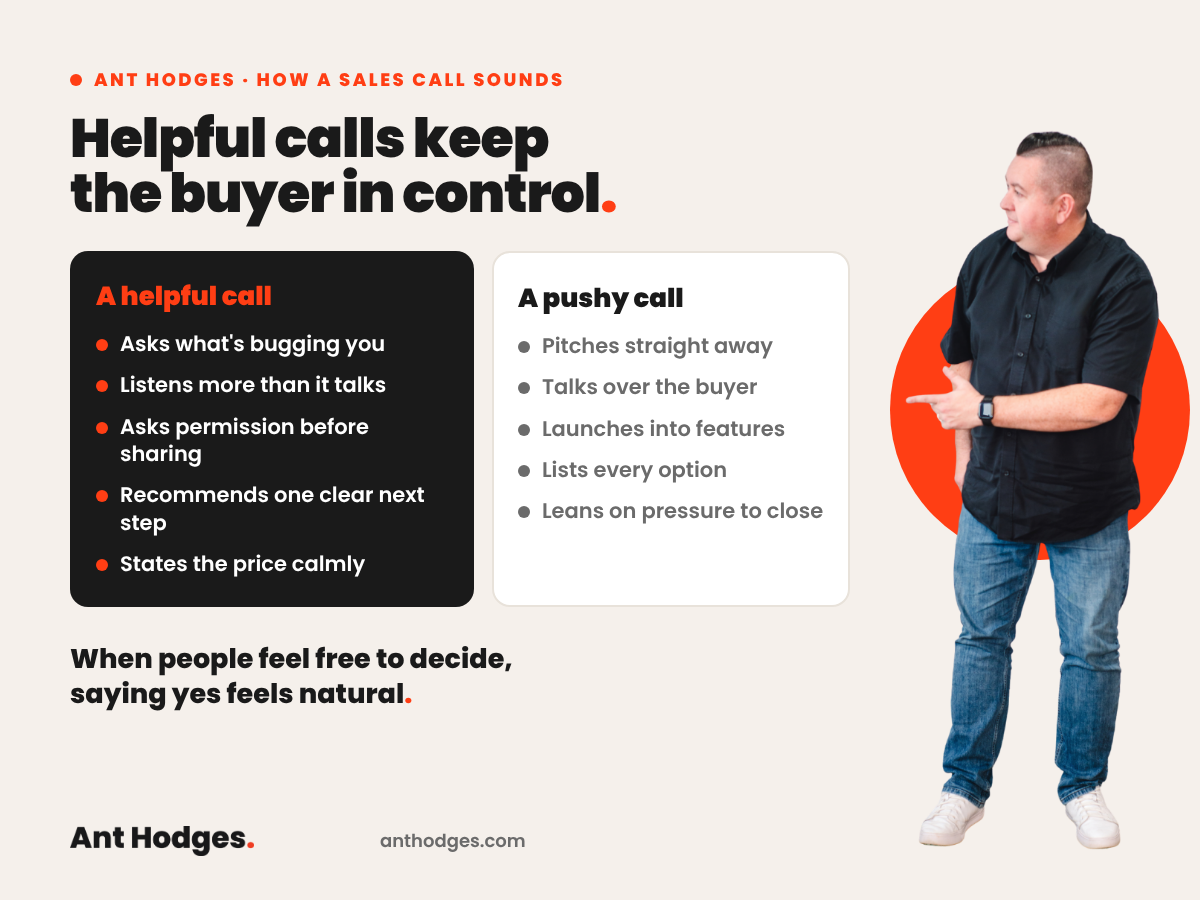
Notice that everything on the helpful side is about the other person. Their problem, their goals, their decision. That shift in focus is what takes the pushiness out of selling.
Should you use a sales script or wing it?
Most sales training was built for corporate sales teams. It comes with word-for-word scripts, objection-handling routines and closing techniques, including lines that make most of us cringe. That approach can work in some settings, like a call centre with hundreds of reps.
When you're a coach, consultant or course creator selling a personal service, a script tends to feel wrong to both of you. Your buyer is buying you, and they can hear when you're reading lines. It chips away at trust before you've had the chance to build any.
Winging it causes a different problem. Without any structure, calls drift. You ramble, go off topic, forget to ask the important questions and end up talking far more than you need to. The person leaves the call unsure what you offer, let alone the result you could help them get.
The sweet spot sits between the two. You want a simple structure you can hold in your head, made of a few good questions in the right order. It keeps the call on track while leaving plenty of room for a real conversation. That's exactly what Selling Without Selling™ gives you.
What is Selling Without Selling?
Selling Without Selling™ is the conversation framework I teach in my book. It has seven steps, and there's nothing to memorise word for word. Each step is a question or a short statement that guides the conversation naturally from the person's problem to the right next step.
Definition
Selling Without Selling™
Selling Without Selling™ is a seven-step conversational sales framework created by Ant Hodges, author of Simplify the Funnel®. The seven steps are: ask "What's bugging you right now?"; ask "What's going to happen if you don't get that sorted?"; ask "Where do you want to be in [x] time?"; ask "OK... I think there's a way I can help... want to hear it?"; prescribe the ideal next step without mentioning money; ask "How does that sound?"; then state the cost and timeframe and ask "How would you like to pay?" It helps coaches, consultants and experts sell through genuine conversation, so the value is clear to both people before price is discussed.
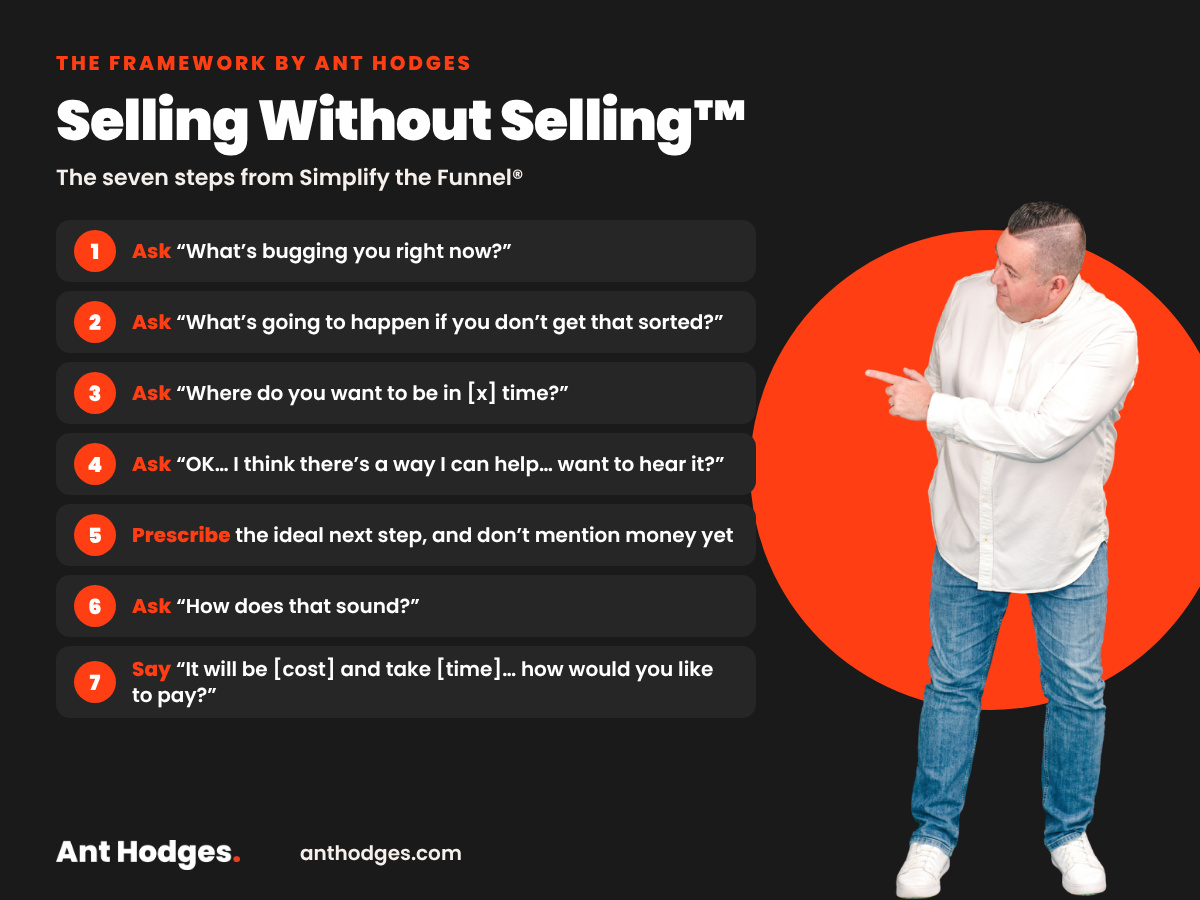
Since I started using this framework in 2016, I've converted around 90% of my sales calls. That number isn't about being a sales genius. The framework takes the pressure off both people, so the conversation stays honest and the decision feels easy.
How do the seven steps work on a real call?
Here's how each step plays out, along with what to listen for. You'll notice that you do very little talking until step five.
Step 1: "What's bugging you right now?"
Start with the problem that's on their mind today. Skip the big questions about five-year goals for now. Just ask what's keeping them stuck at the moment.
That one question changes the whole feel of the call. You're listening instead of pitching, and people open up when they can see you're interested. Let them talk, and ask a follow-up question or two before you move on.
Step 2: "What's going to happen if you don't get that sorted?"
This question helps the person say out loud what the problem is costing them. It might be money, time, stress or missed opportunities. You don't need to add urgency, because they'll describe it themselves in their own words.
Listen carefully to the answer here. It tells you how important this really is to them, and it gives you the words you'll use later when you recommend a next step.
Step 3: "Where do you want to be in [x] time?"
Now ask about the future they want. Pick a timeframe that suits your offer, such as 90 days, six months or a year. This is often the moment people light up, because they get to picture life with the problem solved.
Between steps two and three, you now have the gap. You know where they are, what staying there will cost, and where they want to go.
Step 4: "OK... I think there's a way I can help... want to hear it?"
This is the turning point of the call, and it's a question for a reason. You're asking permission before you share anything about your offer. Almost everyone says yes, and that yes changes everything. They've invited you to tell them, so nothing you say next feels pushed.
Step 5: Prescribe the ideal next step, without mentioning money
Now you recommend one clear next step, using what they've told you. Think of it like a good doctor. You've asked the right questions, you understand the situation, and you're recommending what you believe is best for them.
Keep it to one recommendation, and leave the price out for now. You want the person to focus on whether the solution fits their problem first.
Step 6: "How does that sound?"
This simple question brings any worries into the open while you're both still talking. If they have a concern, treat it as a request for more information and talk it through together. If they need to involve a partner, invite that person to a second conversation.
Step 7: "It will be [cost] and will take [x] amount of time... how would you like to pay?"
State the investment and the timeframe clearly, then ask how they'd like to pay. By this point, the value is clear to both of you. In my experience, many people are already asking "How do we get started?" before you even reach this step.
The full Selling Without Selling™ training walks you through each step in much more detail, with examples of what to say when a conversation goes off track. To get access to the training I just mentioned, you can get instant access by joining my community.
Why does listening close more sales than talking?
When you're nervous on a sales call, the natural reaction is to fill the silence. You explain your process, list your features and share your best success stories. It feels like selling, but it often has the opposite effect.
Research suggests people enjoy talking about themselves far more than we might expect. In a 2012 study at Harvard, neuroscientists Diana Tamir and Jason Mitchell found that sharing information about ourselves activates the brain's reward system. People in their experiments were even willing to give up money for the chance to talk about themselves. The researchers also noted that roughly 30% to 40% of everyday speech is spent telling others about our own experiences.2
A second study shows what happens when you ask good questions. In 2017, a team of researchers led by Karen Huang at Harvard Business School published a series of experiments on question-asking. People who asked more questions in conversation were rated as more likeable by their partners, and follow-up questions had an especially strong effect. Those follow-ups show the other person that you're really listening.3
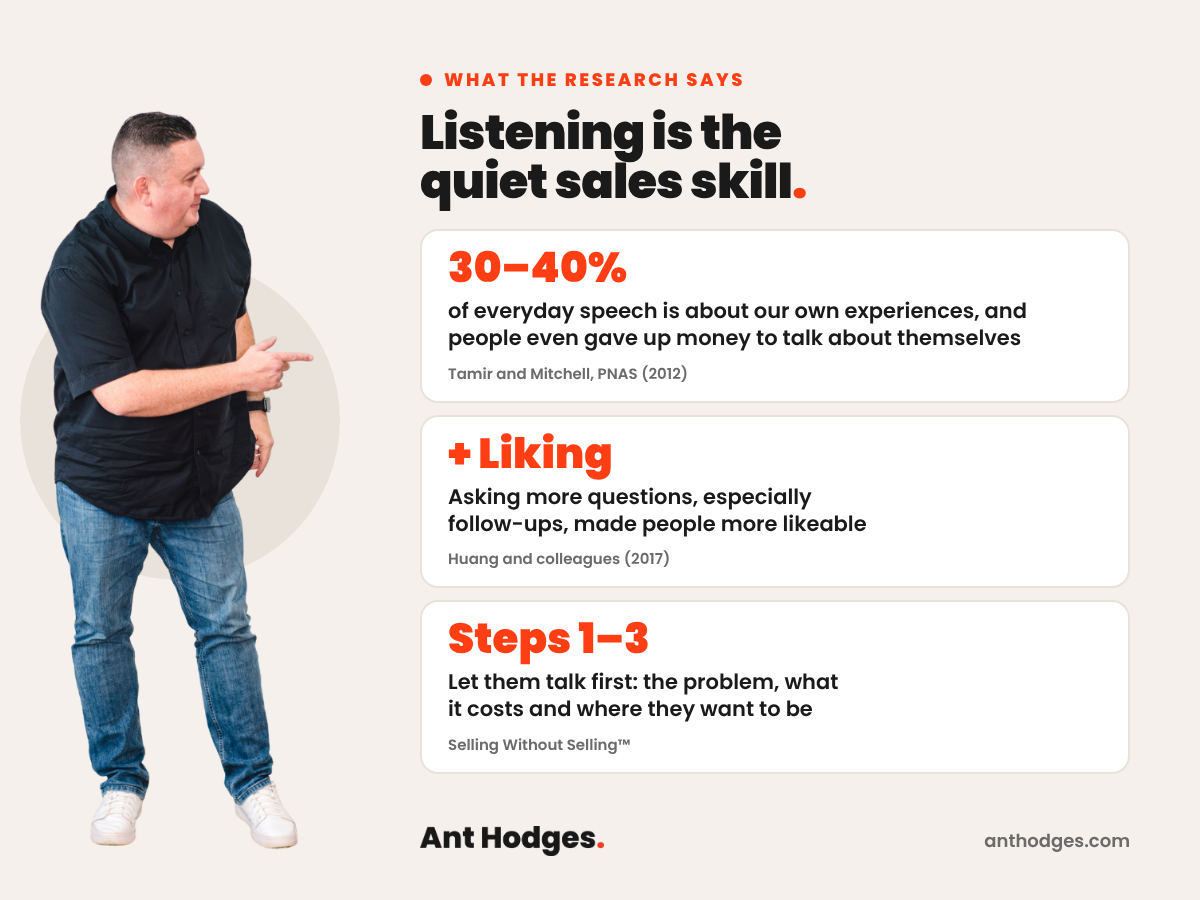
Put those two findings together and you can see why the first three steps of the framework work so well. Asking about the problem, the cost and the goal gives your prospect a chance to talk about the thing that matters most to them. And every follow-up question tells them you care about getting it right.
When you listen more and talk less, the buyer feels understood rather than sold to. So when you recommend a solution that answers exactly what they told you a few minutes earlier, the yes comes naturally.
A good rule of thumb is to let the other person do most of the talking until step four. If you notice you've been speaking for more than a minute or two, stop and ask another question.
How do you talk about price without it feeling awkward?
Price is the part of the call most people dread. Selling Without Selling™ makes it easier in two ways.
First, price always comes last in the conversation. By the time you mention a number, you've agreed on the problem, the cost of leaving it, the goal and the recommended next step. The price is simply the final detail of a plan you've built together.
Second, it helps to understand what a price objection usually means. Here's how I put it in my book.
"When someone objects to price, it's rarely about the number itself. It's usually about the perceived value of transformation – either the level of result or the speed of getting the result they want."
From Simplify the Funnel®
So if someone hesitates at the price, go back to the result. Ask what they'd need to see to feel confident it's worth it, or whether a faster or bigger result would matter more to them. Most of the time, the conversation moves forward from there.
A few small habits help as well. Say the price once, clearly and calmly, without apologising for it. Then stop talking and let the person respond. Silence can feel uncomfortable for a moment, but it gives them space to think, and it shows you're confident in what you're offering.
People happily invest $5,000 or more when the connection feels real and the result is clear. The moment it starts to feel transactional, they pull back. Keeping the conversation human is what makes the price feel fair.
What if the answer is still no?
Even with a great conversation, some people will say no, and that's completely fine. A clear no is one of the most useful things you can hear on a sales call. It means the person felt safe enough to be honest with you, and nobody is left wondering.
When it happens, thank them for their time and ask one gentle question: "Is it the timing, or is it something about the fit?" Their answer helps you either way. If it's timing, you can agree when to check in again. If it's the fit, you've learned something about your offer or your marketing.
Then point them to something helpful that suits where they are today. That might be your book, your email list or a smaller program. People remember how a sales conversation made them feel, and many come back months later when the timing is right.
Ending a call on good terms is part of selling without feeling pushy. You're building a relationship, and that relationship is still there after the call ends.
Who should get a sales call in the first place?
Part of my high conversion rate comes from what happens before the call. Every enquiry I get is triaged, and not everyone books a call with me directly. That might sound strict, but it's kinder for everyone involved.
A sales call works best when the person has a real problem you can solve, the timing is right for them, and your offer is a sensible next step from where they are now. If any of those are missing, even the best conversation will struggle.
You can build simple triage into your own business in a few ways.
- Ask two or three short questions on your booking form, so you know what the person needs before the call.
- Offer a smaller first step, like a book, a low-cost program or a community, for people who aren't ready for your main offer yet.
- Be clear on your website about who your main offer is for, so the right people book and others find a better starting point.
When the right people are on your calls, you'll find you naturally relax. You stop trying to convince anyone, because you're only talking to people you can genuinely help.
If sales conversations make you uncomfortable, this approach was built for you. It was designed for people who don't enjoy traditional selling. And in my experience, those people often turn out to be the best salespeople of all, because they care more about the person than the sale.
Try this today
Prepare for your next sales call
- Write the seven Selling Without Selling™ questions on a single card.
- Choose the timeframe you'll use for step three, such as 90 days or six months.
- Decide the one next step you'll most often recommend, and write the price next to it.
- Add three short questions to your booking form to check each person is a good fit.
- On your next call, stay quiet until step four and see how much more you learn.
Frequently asked questions
How do you close a sale without being pushy?
Close a sale without being pushy by keeping the buyer in control of the decision. Ask about their problem, what it's costing them and where they want to be, then ask permission before sharing how you can help. Recommend one clear next step, check how it sounds, and only then talk about price. When people feel heard and free to choose, saying yes feels natural.
What is Selling Without Selling?
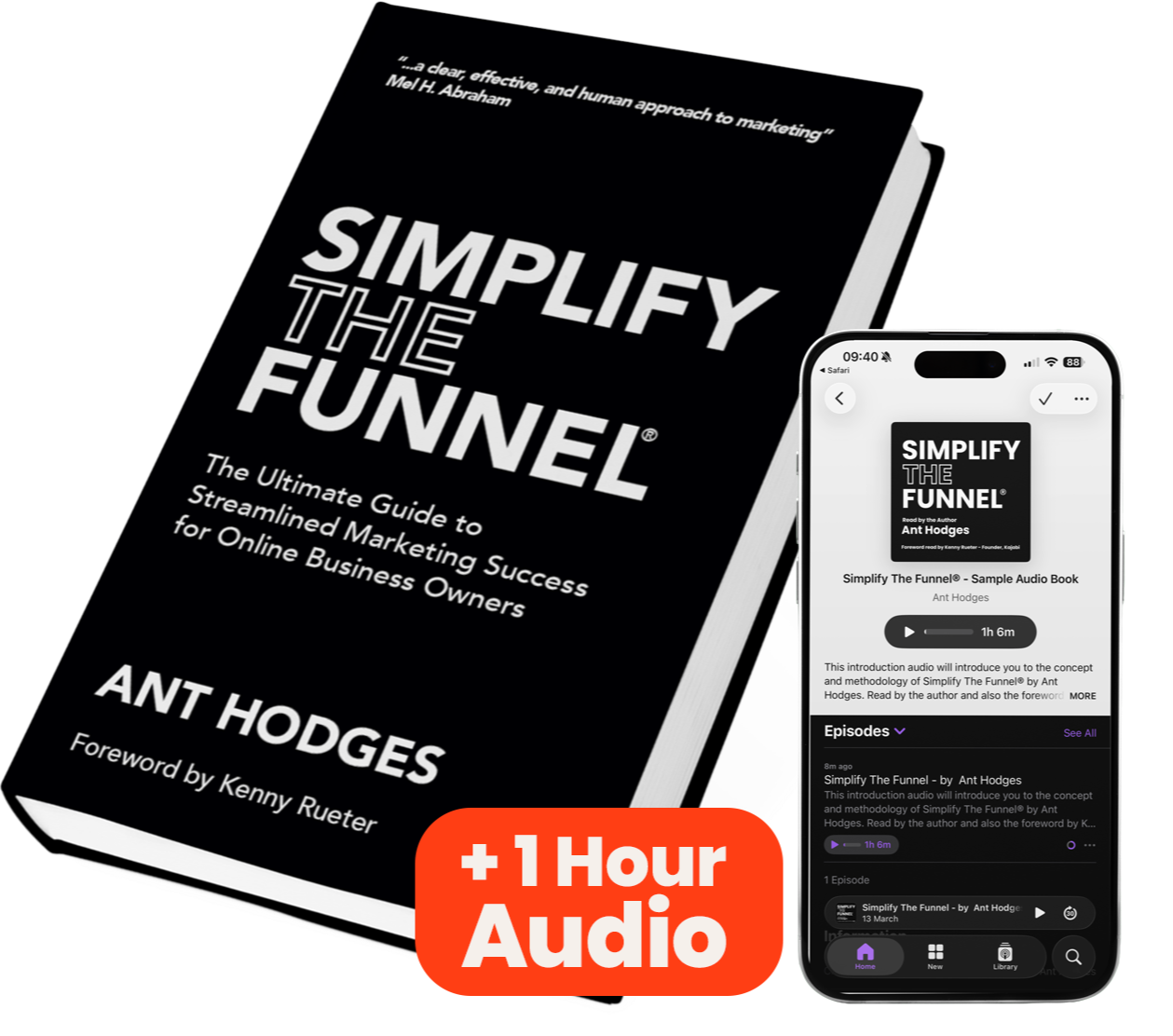
Selling Without Selling™ is a seven-step conversational sales framework from the book Simplify the Funnel®. It guides a sales call from the buyer's problem, through what it's costing them and where they want to be, to a single recommended next step. Price is only discussed at the end, once the value is clear to both people.
Should I use a sales script?
Most coaches, consultants and experts do better with a simple structure than a word-for-word script. Buyers can usually hear when someone is reading lines, which makes it harder to build trust. A short set of questions in the right order keeps the call on track while leaving room for a natural conversation.
Why do people say no when they feel pressured?
Psychologists call this reaction psychological reactance. When people feel their freedom to choose is being threatened, they tend to resist, even if the offer is a good fit. Forceful sales tactics often trigger this reaction, so keeping the buyer in control usually leads to more sales.
How can I get help with my sales conversations?
The Selling Without Selling™ training inside the Simplify Community teaches the full seven-step framework, and you can bring real sales situations to the live calls. If you'd like to work through your offers and sales process with me directly, my Simplify Day covers your whole business in one focused session.

About Ant Hodges
Ant Hodges is the author of Simplify the Funnel®, a Kajabi Founder and the host of the Less Is The Strategy podcast. He has spent more than 20 years running his own businesses, agency and programs, and now helps online business owners, coaches, creators and experts simplify their businesses and leave the cult of hustle behind.
Footnotes
- Reynolds-Tylus, T. (2019) "Psychological Reactance and Persuasive Health Communication: A Review of the Literature." Frontiers in Communication, 4, 31 October 2019. frontiersin.org ↩
- Tamir, D. I. and Mitchell, J. P. (2012) "Disclosing information about the self is intrinsically rewarding." Proceedings of the National Academy of Sciences, 109(21), 8038-8043. collaborate.princeton.edu ↩
- Association for Psychological Science (2017) "Asking Questions Increases Likability," 14 July 2017, reporting Huang, K., Yeomans, M., Brooks, A. W., Minson, J. and Gino, F. (2017) "It Doesn't Hurt to Ask: Question-Asking Increases Liking." Journal of Personality and Social Psychology. psychologicalscience.org ↩
All sources were checked and live at the time of writing.