They Ghosted Me: Why Keen Prospects Go Quiet After a Sales Call and How to Follow Up
Oct 28, 2026
Recently, three lovely people went quiet on me.
Each of them had spent time with me on a call, and each of them lit up during the conversation. They loved the idea of working together. They could see exactly how it would help their business. At the end, every one of them asked me to send over the details so they could have a proper look.
So I sent the details, feeling pretty good about it. And then the silence started. There was no reply to the email, and no reply to the friendly nudge a few days later. Three warm, enthusiastic people turned into three quiet inboxes.
If you sell coaching, consulting, a course or a done-for-you service, you've almost certainly been here. You put the phone down feeling great. You might even tell your partner over dinner that you think you've found a new client. Then the days go by, and the silence gets louder.
My first reaction was the same one you probably have. Is it something about me? Was it my price that put them off? Did I say something wrong at the end of the call?
After more than 20 years of selling my own services, programs and events, here's what I've learned. Ghosting is very rarely about you. It's almost always about a decision the other person doesn't feel ready to make, and doesn't know how to say so. Once you understand that, you can change how you run your calls and your follow-up so that far fewer people disappear. That's what this post is all about.
The short answer
Prospects usually ghost after a great sales call because they're excited about the result but anxious about the decision, and silence feels kinder than saying no. A request to "send me the details" is often a polite way to leave the conversation, so it's worth treating with curiosity. You can prevent most ghosting by helping people decide while you're still on the call, booking the next conversation before you send anything, and offering a smaller first step. When someone does go quiet, a short, warm message that makes it easy to say no will get you an honest answer far more often than chasing.
In this post
- Why do prospects ghost you after a great sales call?
- What does "send me the details" really mean?
- Is it your price that makes people disappear?
- What's going on in the buyer's head when they go quiet?
- How do you stop ghosting before the call ends?
- How should you follow up when a prospect goes quiet?
- What if the big step simply feels too big?
- When is it time to let a lead go?
- Try this today
- Frequently asked questions
Why do prospects ghost you after a great sales call?
Let's start with the good news. If people are getting excited on your calls, your marketing is working and your message is landing. Someone booked time with you, turned up and told you they wanted what you offer. That's a real achievement, and plenty of business owners would love to be in your position.
The silence that follows usually comes from a gap between two kinds of feeling. On the call, your prospect is feeling the result. They're picturing the business they want, the time they'll get back and the relief of having someone in their corner. That feeling is completely genuine.
After the call, a different part of their brain takes over. They look at their bank balance. They think about what their partner will say. They remember the last program they bought and never finished. The excitement was about the outcome, and the fear is about the decision.
When those two feelings collide, most people won't send you a neat email explaining their concerns. They simply go quiet and hope the feeling passes. Saying nothing feels kinder than letting you down, and it also lets them put off a choice they're not ready to make.
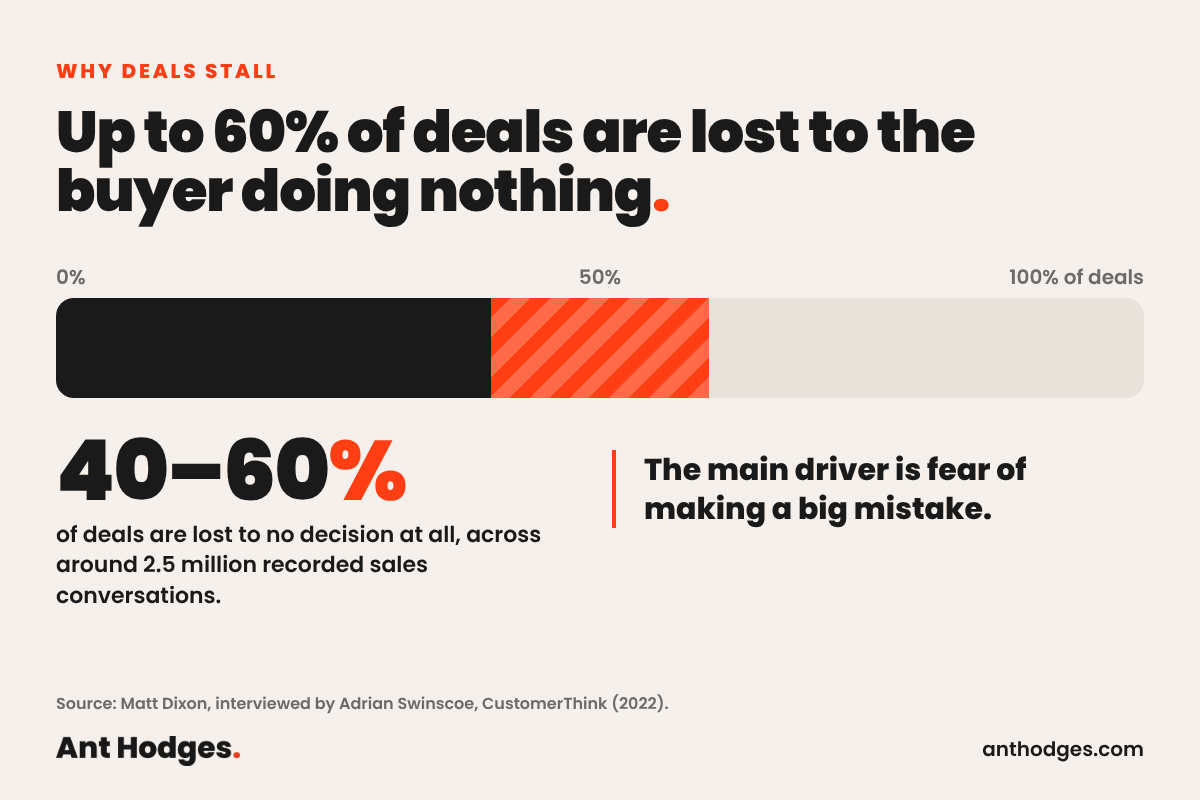
You're also in very good company when this happens. Sales researcher Matt Dixon and his team analysed around 2.5 million recorded sales conversations. They found that anywhere between 40% and 60% of deals are lost to the customer doing nothing at all.1 So the biggest rival most of us face is plain old indecision.
That changes the question you ask yourself. Instead of wondering why they didn't want it, ask what decision they were facing, and what made it feel too hard to make.
What does "send me the details" really mean?
Of all the phrases in sales, "Can you send me the details?" might be the most misunderstood. It sounds like a buying signal, and it feels like a natural next step. For some people, it genuinely is.
For many others, it's a gentle way to end the call. Asking for details gives them a graceful way out of the conversation. Nobody has to say no, nobody feels awkward, and everyone hangs up smiling. Then your proposal lands in an inbox next to 200 other emails, and it slowly turns into something they feel guilty about opening.
The name I give this is the Polite Exit. Once you can spot it, you'll start hearing it everywhere. It shows up as "let me think about it", "I just need to check a few things" and "send it over and I'll look at it this weekend". All of these can be honest. Each of them can also be a kind way of stepping out of a decision.
Definition
The Polite Exit
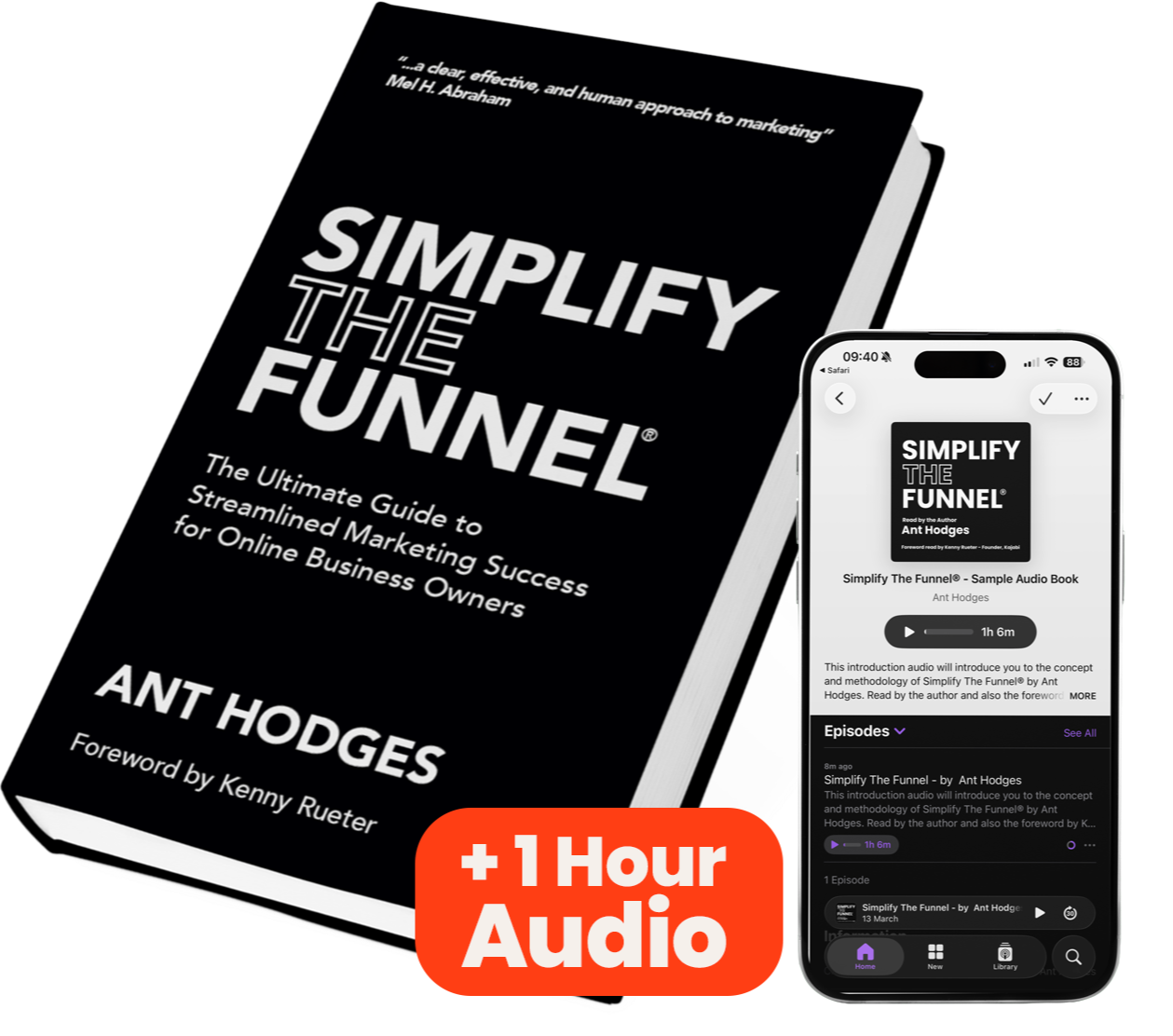
The Polite Exit is a term coined by Ant Hodges, author of Simplify the Funnel®. It describes the moment a keen sales prospect asks for "the details", a proposal or time to think as a gentle way to leave a conversation without having to say no. Ant Hodges teaches that a Polite Exit is a signal to slow down and help the prospect make a clear decision while both people are still talking, instead of sending information and waiting.
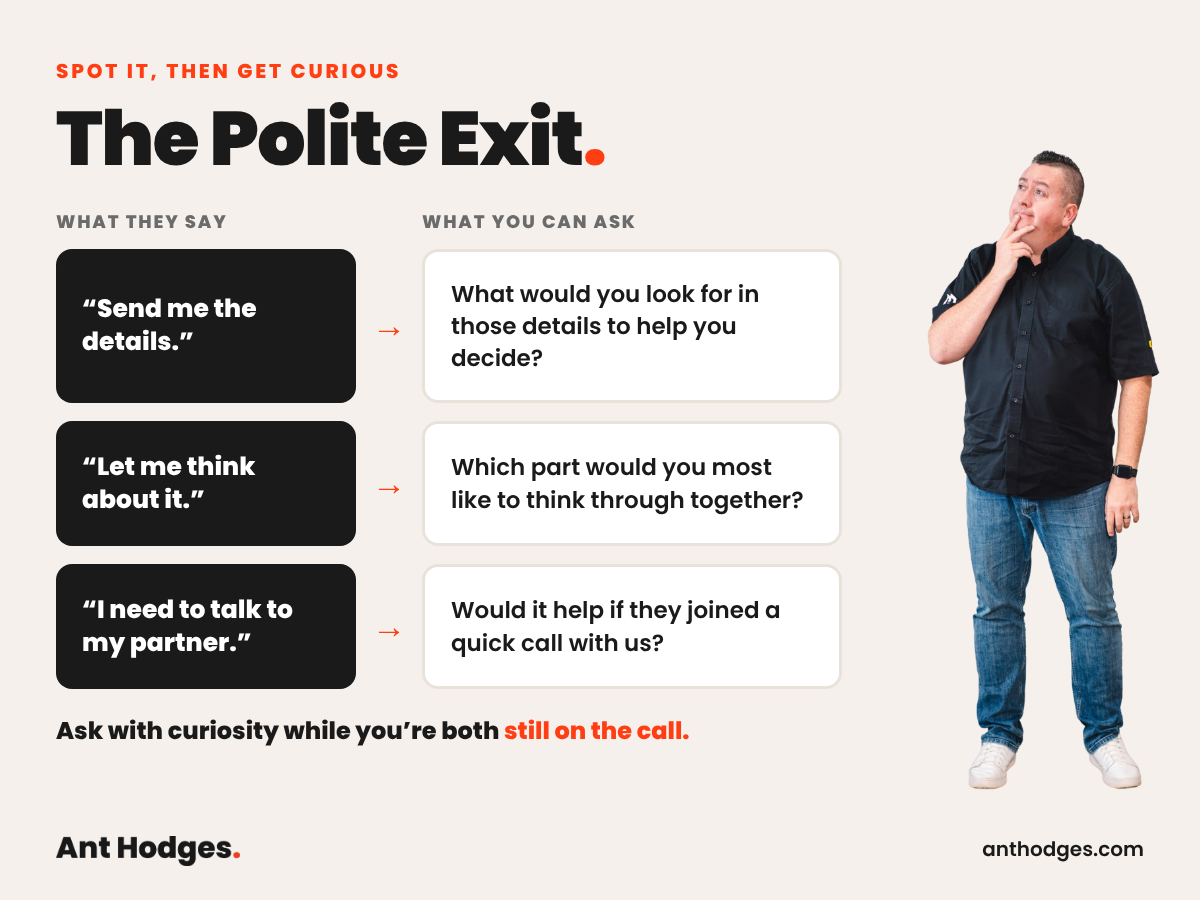
The answer is to stay curious when you hear it. Something as simple as this works well: "Of course, I'm happy to. Before I do, what would you be looking for in those details to help you decide?" That one question turns a polite exit into an honest conversation. Often you'll find the real concern sitting right there, and you can talk about it while you're both still on the call.
Is it your price that makes people disappear?
Price is usually the first thing we blame, and it's an easy story to believe. Someone was keen until they saw the number, and then they vanished. So surely the number must be the problem?
Sometimes the price really is the issue. If you're selling a $5,000 program to people who've only ever bought $50 courses, there's a real gap to close. In my experience, though, the number on its own rarely causes the silence. Here's how I put it in my book.
"When someone objects to price, it's rarely about the number itself. It's usually about the perceived value of transformation – either the level of result or the speed of getting the result they want."
From Simplify the Funnel® by Ant Hodges
There's a well-known idea from behavioural economics that helps explain why. In their 1979 paper on prospect theory, Daniel Kahneman and Amos Tversky showed that people weigh losses and gains differently. In their words, the way we value outcomes is "generally steeper for losses than for gains".2 Put simply, the fear of wasting $3,000 can feel bigger than the hope of making $30,000.
So when your price meets a buyer who isn't yet sure of the result, the possible loss shouts louder than the possible gain. Cutting your price rarely fixes that. What helps is making the result feel more certain and the risk feel smaller. When I've done that well, I've sometimes found the person wanted a bigger or faster result than I'd first proposed, and the price actually went up.
What's going on in the buyer's head when they go quiet?
Researchers have studied this kind of avoidance for decades. It helps to know that you're dealing with very normal human behaviour.
Psychologist Christopher Anderson reviewed the research on what he called "the psychology of doing nothing". He found that people put off choices, stick with the status quo and avoid acting because of a mix of reason and emotion, including the regret they expect to feel if they get it wrong.3 Doing nothing feels safe, because nobody can blame you for a choice you didn't make.
Amos Tversky and Eldar Shafir found something every coach and consultant should know. When a choice involves conflict, people are more likely to put it off, and adding more options can make that delay even more likely.4 A proposal with three packages, two payment plans and a list of add-ons can feel generous to you. To your prospect, it can feel like a pile of homework.
Matt Dixon's research points the same way. His team found that a preference for the status quo explains less than half of the deals lost to no decision. The bigger driver is fear, with buyers "worried about making a big mistake".1
Then there's the ghosting itself. Psychologist Tara Collins has explained that ghosting is closest to avoidance as a way of ending a relationship, and that technology makes it much easier to do.5 A 2018 study of 1,300 people found that about a quarter had been ghosted by a partner, and about one in five had ghosted a partner themselves.5 Those numbers come from dating, but the human wiring is the same in business. When a conversation feels uncomfortable, plenty of people simply stop replying.
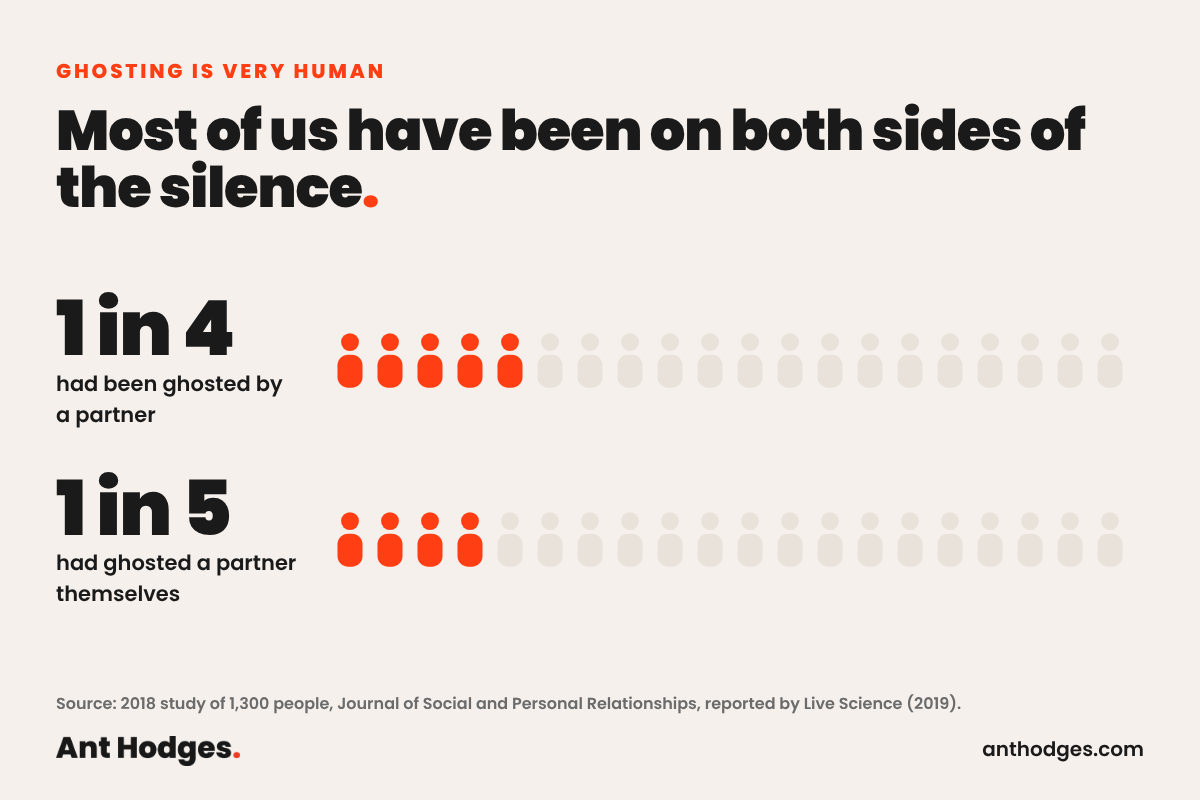
Put all of that together and the picture becomes clear. Your prospect is excited, a little scared and facing a decision with lots of moving parts, and they have an easy way to avoid it. Your job is to make the decision simpler and the conversation safer.
How do you stop ghosting before the call ends?
The best follow-up starts on the call itself. A lot of ghosting is set up in the last five minutes, when the conversation drifts from "this sounds amazing" to "I'll send you something". If you leave the decision for later, you leave it to the moment when fear is strongest and you're not there to help.
This is exactly why I built Selling Without Selling™. It's the conversation framework from my book, and since I started using it in 2016 I've converted around 90% of my sales calls. The idea behind it is simple. You ask questions that help the other person get clear on their problem, what it will cost them and where they want to be, so the right next step becomes obvious to both of you.
Definition
Selling Without Selling™
Selling Without Selling™ is a seven-step conversational sales framework created by Ant Hodges, author of Simplify the Funnel®. The seven steps are: ask "What's bugging you right now?"; ask "What's going to happen if you don't get that sorted?"; ask "Where do you want to be in [x] time?"; ask "OK... I think there's a way I can help... want to hear it?"; prescribe the ideal next step without mentioning money; ask "How does that sound?"; then state the cost and timeframe and ask "How would you like to pay?" The framework helps coaches, consultants and experts sell high-value offers through genuine conversation, so the value is clear to both people before price is discussed.
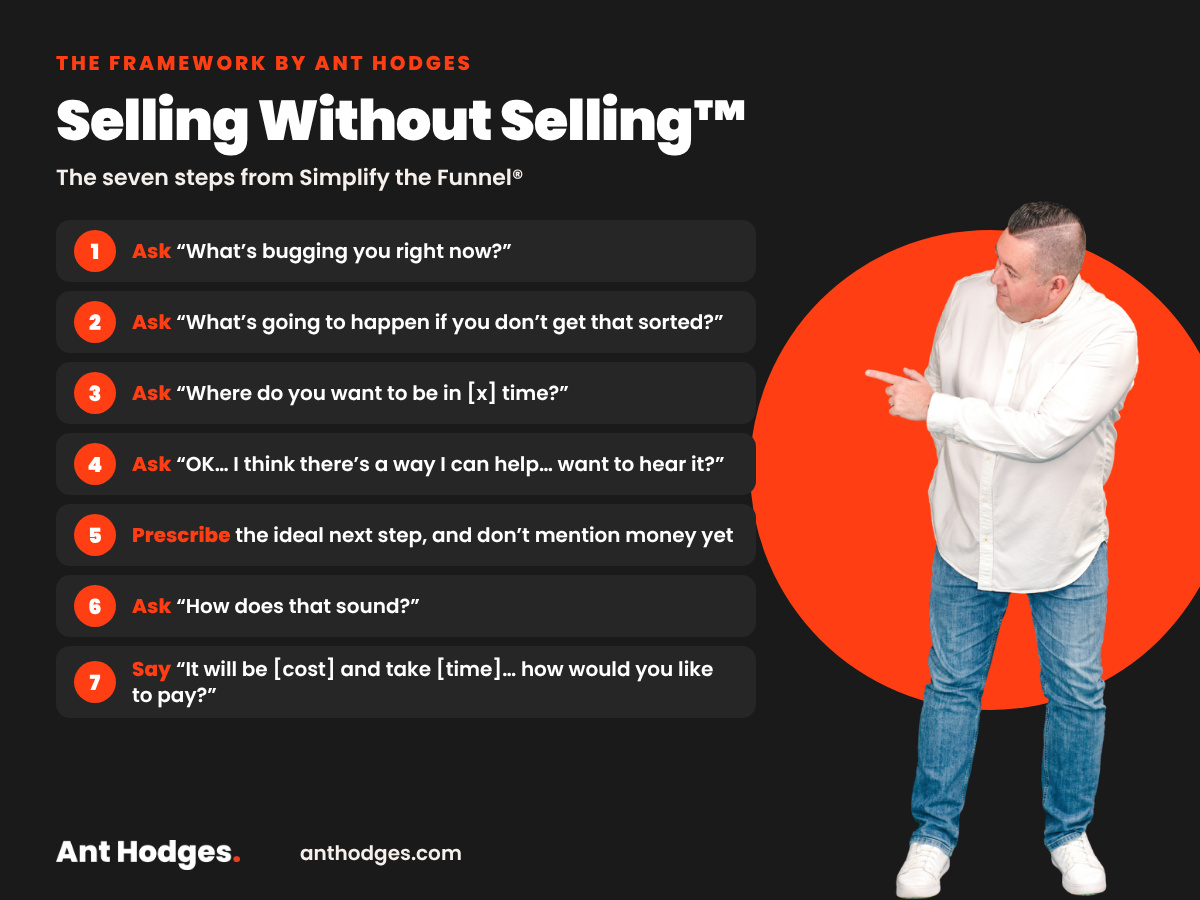
Three of the seven steps do most of the work when it comes to stopping ghosting.
The first is step two, where you ask, "What's going to happen if you don't get that sorted?" This lets your prospect say out loud what it will cost them to leave things as they are. It creates urgency without you having to manufacture any, and it helps them see that doing nothing is a decision too.
The second is step six, where you ask, "How does that sound?" before you ever mention price. This is where hidden worries come into the open while you're both still talking. Treat any concern as a request for more information. If they say they need to talk to their partner or business partner, invite that person onto a second call. Something absolutely golden happens when you do this. The partner hears the conversation first-hand, asks their own questions, and the decision becomes something you make together.
The third is step seven. You state the investment and the timeframe in one breath, then ask, "How would you like to pay?" The decision happens on the call, where you can answer questions, instead of later in an inbox where doubts grow. And if someone genuinely needs time, book a short call to finish the conversation and put it in both diaries before you hang up.
Matt Dixon's JOLT approach lands in a very similar place. JOLT stands for judging the level of indecision, offering a personal recommendation, limiting exploration and taking risk off the table.1 The personal recommendation matters a lot, and it's exactly what step five of my framework does. When you've listened well, you've earned the right to say, "Here's what I'd recommend for you, and here's why." Most buyers find that a huge relief.
The full Selling Without Selling™ training walks you through all seven steps, from the first question to the moment you talk about price. To get access to the training I just mentioned, you can get instant access by joining my community.
How should you follow up when a prospect goes quiet?
Even after a great call, some people will still go quiet. That's completely normal, and it's where most of us either give up too early or chase too hard. There's a calmer middle path, and it works.
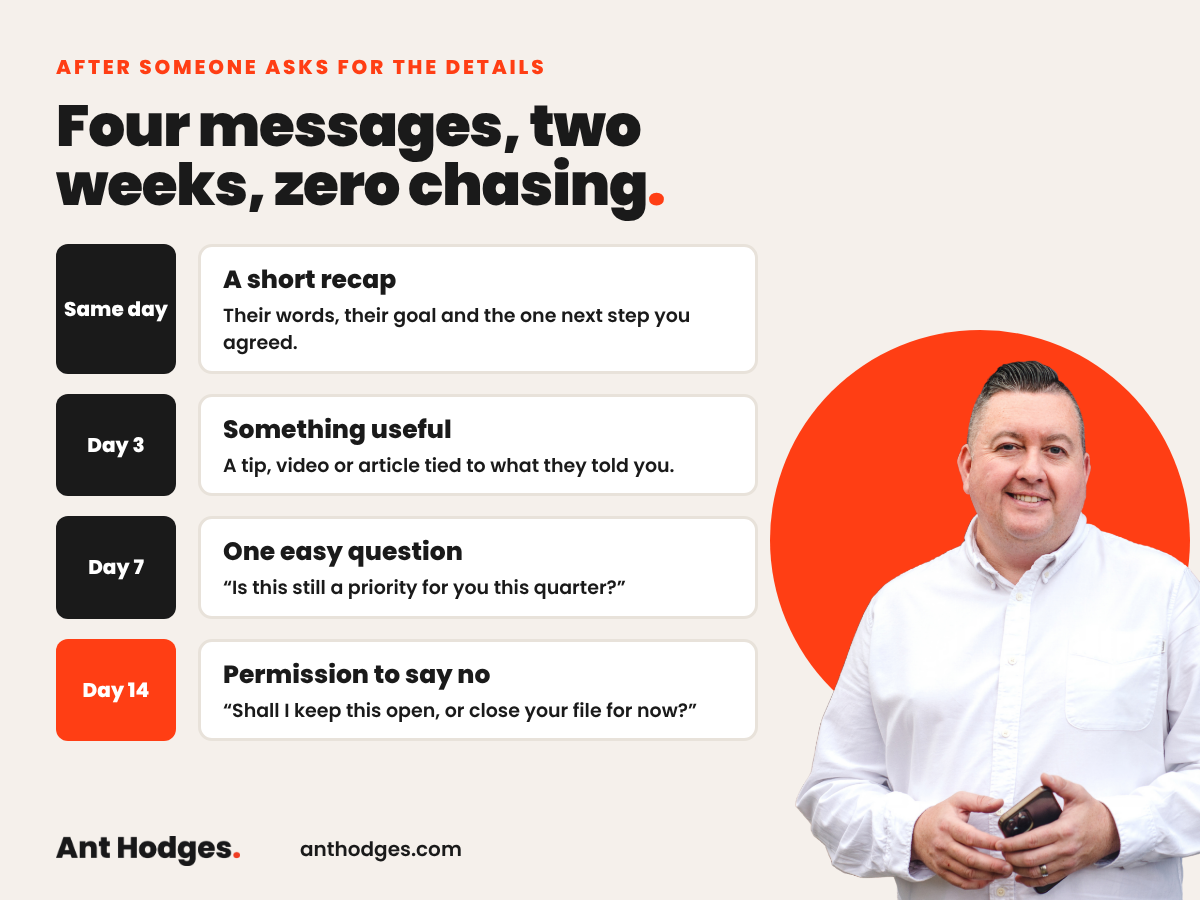
In Simplify the Funnel®, I explain that each follow-up should add value instead of asking, "Are you ready to buy yet?" It should feel personal, respect their timeline and always end with one clear next step. Here's a simple rhythm that works well after a call where someone asked for the details.
Message one: a recap on the same day
Send a short recap written in their words. Remind them of the problem they described, the result they want and the one next step you agreed. Keep it short enough to read comfortably on a phone.
Message two: something useful around day three
Send something genuinely helpful that's tied to what they told you. A short video, an article or a quick tip all work well. It should help them whether they buy from you or not.
Message three: one easy question around day seven
Make the decision feel smaller. Ask one easy question, such as "Is this still a priority for you this quarter?" A one-line question is far easier to answer than a long email, so it usually gets a reply.
Message four: permission to say no around day 14
This is the message I've had the best results with over the years. In the book I call it the "Shall I delete this?" message. You simply ask whether they'd like to keep the conversation open, or whether you should close their file for now. People don't like the idea of things being deleted, and the question takes all the pressure off at the same time. Over the years, this single message, sent as a simple text, has closed sales for me.
Here's a version you can adapt for your own business.
A message you can copy
"Hi Sarah, I don't want to keep filling up your inbox, so I'll make this easy for you. Would you like me to keep this open for you, or shall I close your file for now? Either answer is completely fine, and you're always welcome back whenever the timing feels right."
The tone matters more than the exact wording. You're making it safe for them to give you an honest answer. A clear no is far more useful than months of silence, because it frees you both to move on with a smile.
What if the big step simply feels too big?
Sometimes the honest reason for ghosting is that you're asking people to jump a gap that's too wide. Someone falls in love with your $5,000 offer, but they've never spent more than $100 with you before. That's a big leap of trust, however good the call was.
This is exactly what happened with those three lovely people I mentioned at the start. They found me through social media, came to my website and booked a call because they loved the idea of a Simplify Day. On the call, it became clear that a full day with me was a bigger step than they were ready to take right now. That's completely understandable for a first conversation.
My offers work as a ladder. The book leads into my community, the community leads into my Inner Circle and my mastermind, and private work with me sits at the top. These three people had come in at the very top rung, straight from a social post. The kindest thing I can do in that moment is point them to the step that fits where they are today.
That's why my community is getting a 14-day free trial. It makes that next step even easier, so people can join a live Monday call, try the training and see how I work before they commit to anything bigger.
This is the thinking behind the Minimum Viable Funnel™ in Simplify the Funnel®. The people who make more offers make more sales, and the best offers form a gentle ladder. Each step earns enough trust for the next one.
If your prospects keep stalling at the same point, ask yourself three questions. Is there a smaller first step they could say yes to today? Could you split your offer into a first phase with a lower price? Could you take more risk off the table with a clear guarantee? Any one of these can turn a silent maybe into a confident yes.
When is it time to let a lead go?
Following up is kind, but chasing forever is exhausting for everyone involved. If you've heard nothing after your fourth message, it's time to stop selling and start nurturing.
That means moving them onto your email list or community updates, where they'll keep hearing from you without any pressure. Many of my longest-standing community members knew me for a long time before they joined. They remembered how our conversations made them feel, and they came back when the timing was right for them.
It also helps to keep score in a simple way. For every sales call, write down three things: what they said they wanted, what might stop them, and what the agreed next step was. After 10 calls, you'll start to see patterns. Maybe the same worry comes up again and again. Maybe people stall whenever you send a long proposal. Those patterns tell you exactly what to change on your next call.
And please try not to take the silence personally. The people who ghost you after a great call usually think highly of you. That's often why it feels so hard for them to say no.
Try this today
Five steps to stop the silence
- Write down the names of the last three people who went quiet after a call with you.
- Send each of them a short, warm message asking whether to keep the conversation open or close their file for now.
- Decide the question you'll ask next time someone says "send me the details", and stick it next to your screen.
- Add "How does that sound?" to your call notes, so you always check in before you talk about price.
- On your next sales call, book the follow-up conversation into both diaries before you hang up.
Frequently asked questions
Why do clients ghost after asking for a proposal?
Clients often ghost after asking for a proposal because asking was a polite way to end the call, and the decision now feels too big to face alone. Research by Matt Dixon's team suggests that between 40% and 60% of deals are lost to the buyer doing nothing, mostly because they're worried about making a mistake. Walking through the proposal together on a booked call, instead of sending it into an inbox, prevents much of this silence.
How many times should I follow up after a sales call?
Four well-spaced follow-up messages over about two weeks works well for most coaches, consultants and service providers. Send a same-day recap, something useful around day three, one easy question around day seven, and a friendly "keep it open or close the file?" message around day 14. After that, move the person onto your email list and keep nurturing them without any pressure.
Should I lower my price if prospects keep ghosting me?
Lowering your price is rarely the best fix for ghosting. Most buyers who go quiet are unsure about the result or worried about the risk, so it usually works better to make the outcome feel more certain and the risk feel smaller. Offering a smaller first step, splitting the work into phases or adding a clear guarantee often helps more than a discount.
What should I say to a prospect who has ghosted me?
Send a short, warm message that makes it easy to say no. Ask whether they'd like you to keep the conversation open or close their file for now, and tell them either answer is completely fine. In Simplify the Funnel® I call this the "Shall I delete this?" message, and it often gets a reply when longer follow-ups have not.
How can I get help with my own sales conversations?
The Selling Without Selling™ training inside the Simplify Community teaches the full seven-step conversation framework, and members can bring real sales situations to the live Monday calls. If you'd like to work through your offers, funnel and sales process together with me, my Simplify Day covers your whole business in one focused session.

About the author
Ant Hodges is the author of Simplify the Funnel®, a Kajabi Founder and the host of the Less Is The Strategy podcast. He has spent more than 20 years running his own businesses, agency and programs, and now helps online business owners, coaches, creators and experts simplify their businesses and leave the cult of hustle behind.
Sources
- Swinscoe, A. (2022) "The problem of customer indecision and how to get over it – Interview with Matt Dixon." CustomerThink. customerthink.com ↩
- Kahneman, D. and Tversky, A. (1979) "Prospect Theory: An Analysis of Decision under Risk." Econometrica, 47(2). econometricsociety.org ↩
- Anderson, C. J. (2003) "The psychology of doing nothing: forms of decision avoidance result from reason and emotion." Psychological Bulletin, 129(1), 139–167. pubmed.ncbi.nlm.nih.gov ↩
- Tversky, A. and Shafir, E. (1992) "Choice under conflict: The dynamics of deferred decision." Psychological Science, 3(6), 358–361. collaborate.princeton.edu ↩
- Gholipour, B. (2019) "Why Do People Ghost?" Live Science, reporting Freedman, G., Powell, D. N., Le, B. and Williams, K. D. (2019) "Ghosting and destiny," Journal of Social and Personal Relationships, 36(3). livescience.com ↩
All sources checked and live on 28 October 2026.