Built to Be Human: Why AI Belongs in the Back Office and Humans Belong at the Front
Oct 08, 2026
A few years before the pandemic, I was sitting in a conference audience when the speaker on stage set us a challenge. Before the lunch break was over, he wanted every one of us to send a short personal video to someone we wanted to work with.
So during lunch I stepped outside, held my phone up and recorded a 10-second message to a business owner I'd been talking to. Their name, one line about something they'd said to me, and a smile. That was all it took.
By the time I walked back into the room, I had a reply. That 10-second video turned into a five-figure contract. It cost me nothing, it took less time than queueing for a coffee, and it's been a standard part of how I run my business ever since.
Here's why that story matters now. Today I could ask AI to write that message, build an automated sequence around it and send a thousand of them while I sleep. What made the video work is that it was obviously, unmistakably me. A real person, a real face and a real reason to reply.
That's the line this post is about. My position is simple, and it sits at the centre of everything I teach about AI. AI belongs in the back office of your business. Humans belong at the front.
Let me be clear from the start. This is a pro-AI post. AI does a whole bunch of things brilliantly, and I use it every single day. It's also a pro-human post, because the moments that build trust, close sales and keep customers around still need you. Getting the split right is where the growth is.
The short answer
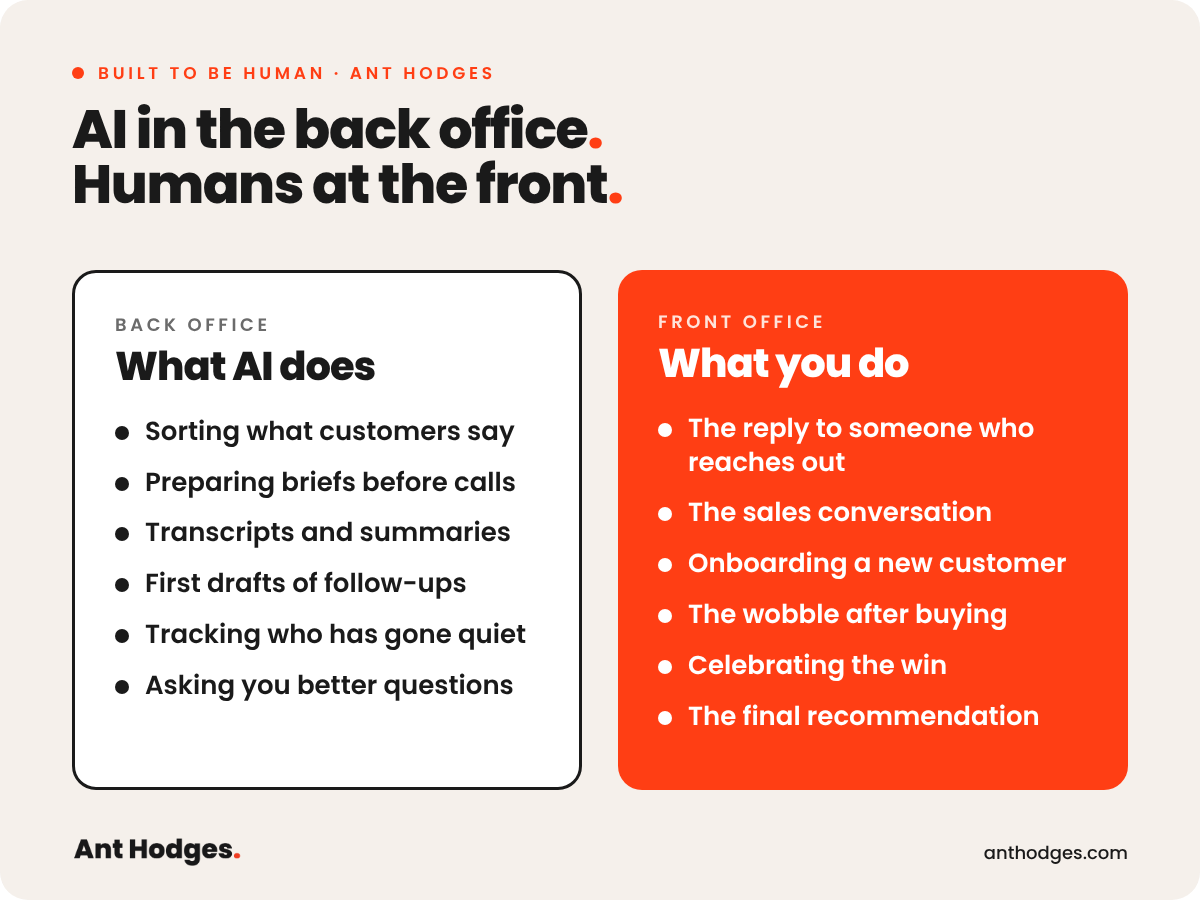
Use AI in the back office of your business, where it can research, sort, summarise, draft and remind you faster than any person. Keep humans at the front, where people decide whether to trust you: replying to someone who reaches out, the sales conversation, onboarding, the wobble after buying and the win worth celebrating. Small businesses that use AI to give the owner more time for real conversations get the benefit of both, without losing what makes people buy from them.
In this post
- What does "AI in the back office, humans at the front" mean?
- What is AI genuinely good at in a small business?
- Why do customers still want a human?
- What is the HUMAN Method?
- How do you decide what to automate and what to keep human?
- What AI does in my back office
- The four meets: where your business stays human
- How do you sell like a human when AI can write the pitch?
- How do you keep people close after the sale?
- Try this today: your 30-minute touch point audit
- Frequently asked questions
What does "AI in the back office, humans at the front" mean?
Every business has two sides, whether you've named them or not.
The back office is everything your customer never sees. Research, admin, note-taking, scheduling, sorting feedback, preparing for calls, first drafts of follow-ups and keeping track of who needs what. It's essential work, and most of it is repetitive.
The front office is every moment where a real person meets your business and decides how they feel about it. It's the reply to their message, the sales conversation and the welcome when they join. It's also the moment they wonder whether they made the right choice, and the day something finally works for them.
AI is extraordinary in the back office. It can read hundreds of comments in under a minute, turn a recorded call into tidy notes and remind you that a client has gone quiet. Every hour it saves there is an hour you can spend at the front, with people.
Things go sideways when the split happens by accident. A tool gets added here and a sequence switched on there. Nobody ever sits down and consciously chooses where the machine takes over from the human. Then, 6 to 12 months later, the customer experience has changed and nobody can quite say when it happened.
This is a lesson I learned the hard way. From 2011 to 2023 I ran a done-for-you marketing agency, and as it grew I looked for ways to systemise sales because I had less time. Enquiries came in through a form, ran through a Google Doc and produced a proposal I could check, tweak and send. There was very little conversation left in it. At the end of 2019 I switched the whole thing off, went back to talking with people, and rebuilt our offers around the transformation we could deliver.
That's what "Built to Be Human" means to me. AI should give you back the time and headspace to be more present with people. It should never quietly stand in your place.
What is AI genuinely good at in a small business?
Before we get into the human side, let's give AI its full credit. The evidence for it in the back office is strong, and it's growing fast.
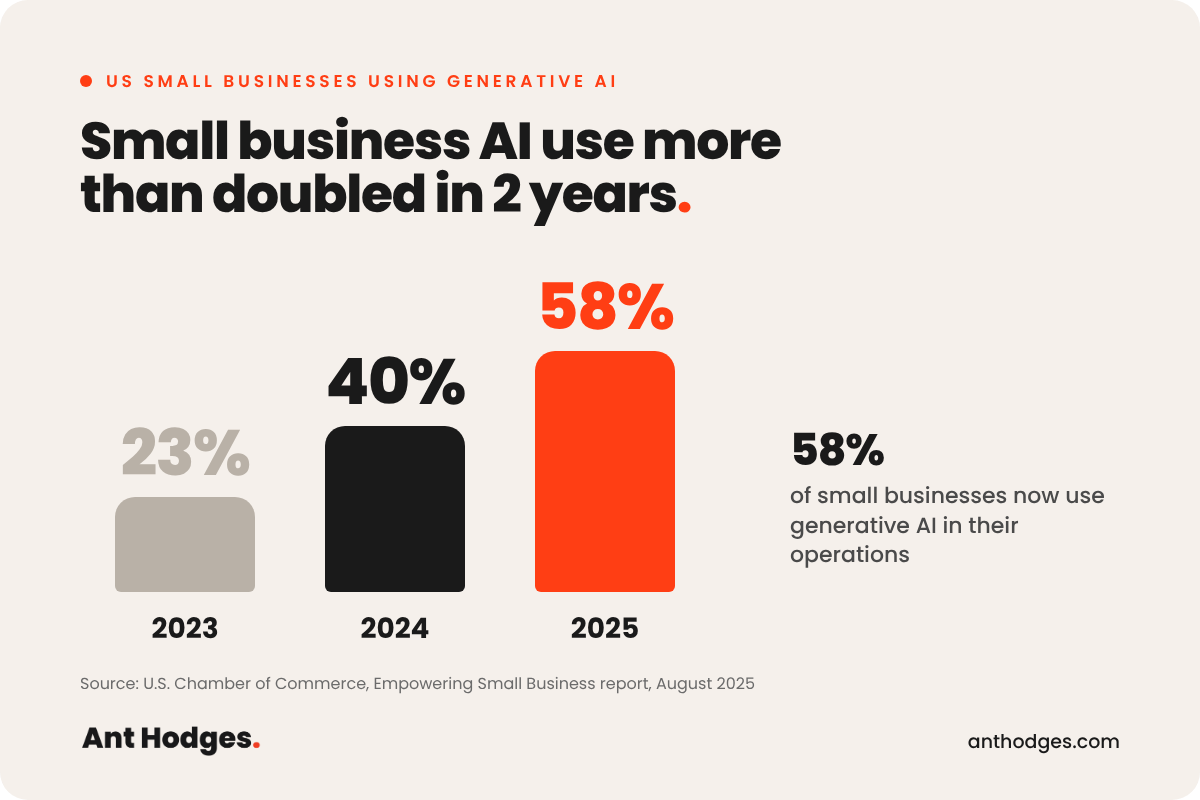
The U.S. Chamber of Commerce tracks how small businesses use technology every year. In its 2025 report, 58% of small businesses said they use generative AI, up from 40% in 2024 and 23% in 2023.1 That's a huge shift in just two years.
People are using it at work whether their business has a plan or not. Microsoft and LinkedIn surveyed 31,000 knowledge workers across 31 markets for their 2024 Work Trend Index. Of those surveyed, 75% said they already use generative AI at work, 90% of those users said it saves them time, and 85% said it helps them focus on their most important work.2
The strongest evidence comes from a study of 5,179 customer support agents, later published in The Quarterly Journal of Economics. Agents with an AI assistant resolved 14% more issues per hour on average. Newer and less experienced agents improved by 34%, customer sentiment went up, and staff were more likely to stay.3
Look closely at how that AI was used. It sat beside a human agent and suggested responses. The human still had the conversation, chose what to say and owned the outcome. That's the back office supporting the front office, and it's exactly the model I'm arguing for.
Here's a small example from my own business. Every Zoom call I have is recorded and transcribed by Fyxer, which drafts a notes and actions email straight into my Gmail. It saves me real time after every call. And in about 18 months of using it, there hasn't been a single email I've sent without editing it first. The machine clears the path so I arrive ready. The words that reach my client are still mine.
Why do customers still want a human?
Now look at the same technology from the other side of the counter.
Gartner surveyed 5,728 customers about AI in customer service. Overall, 64% said they would prefer companies didn't use AI for customer service at all, and 53% said they would consider switching to a competitor if they found out a company was going to. Their biggest worry was simple: that AI would make it harder to reach a person.4
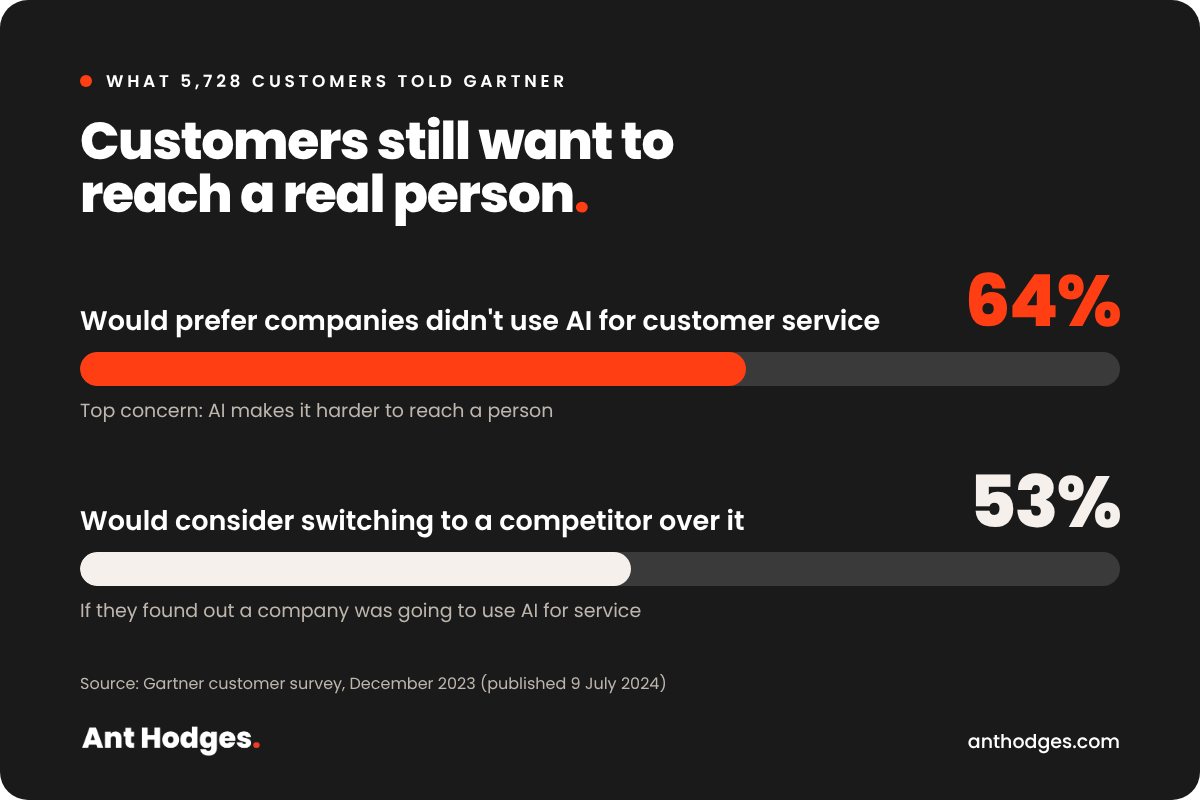
That's genuinely good news for small businesses. If most buyers value being able to reach a real person, then a small business owner who is easy to reach has an advantage that large companies struggle to copy.
There's a bigger picture too. In 2023 the U.S. Surgeon General published an advisory on what he called an epidemic of loneliness and isolation. It reported that about half of adults in America had experienced loneliness, and that a lack of social connection can raise the risk of early death as much as smoking up to 15 cigarettes a day.5
Your customers are living in that world. Many of them go days without a meaningful conversation. When your business is the place where someone gets a personal reply, a real welcome and a voice note that uses their name, you're giving them something rare. People remember how you made them feel, and they tell other people.
One sentence I keep coming back to sums it up. Nobody refers people to a business that felt like a machine.
What is the HUMAN Method?
Saying "keep it human" is easy. Doing it consistently while your business grows takes a system. The one I built and teach is called the HUMAN Method, and it's the five-stage engine behind everything in this post.
Definition
The HUMAN Method
The HUMAN Method is a five-stage customer relationship framework created by Ant Hodges, author of Simplify the Funnel®, and taught in his Built to Be Human training. The stages are Hear, Understand, Meet, Advise and Nurture. At every stage AI handles the back-office work, such as sorting, preparing, summarising and reminding, while the business owner handles the front-office moments where trust is built. Together the five stages form what Ant calls The Built Engine™.
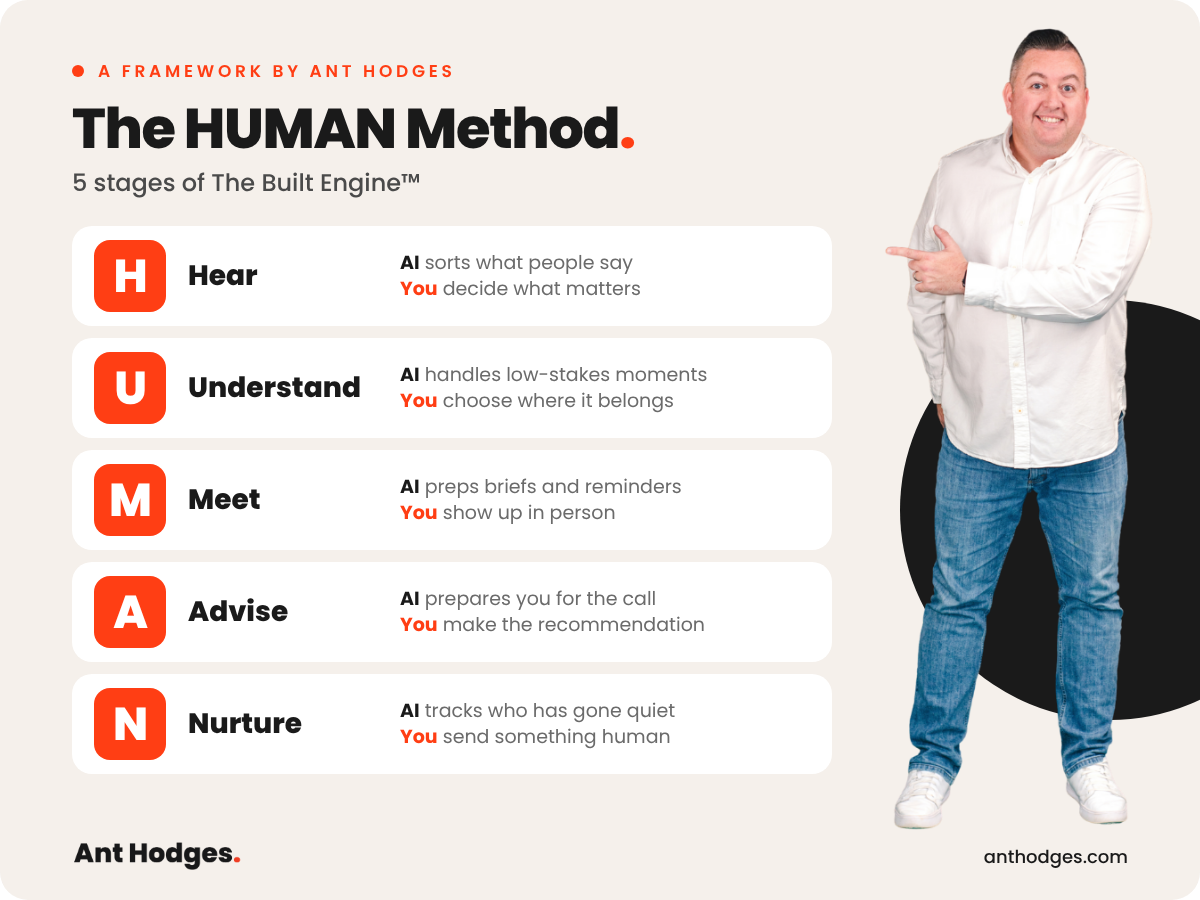
Here's how the five stages work, and where the line sits in each one.
1. Hear. Listen to what your market is really saying. Gather the exact words people use in comments, DMs, email replies, call notes and reviews. AI can sort 300 pieces of customer language into themes in a minute. Only you can tell which comment came from your ideal buyer and which feeling sits underneath the problem they described.
2. Understand. Map every moment where someone connects with your business, and decide on purpose which ones a machine can handle. The tool for this is the Touch Map, and it gets its own section below.
3. Meet. Create real moments of contact that scale: paid workshops, one-to-one conversations, small live events and 10-second video DMs. AI handles the briefs, summaries and reminders, and you show up in person.
4. Advise. Treat selling as a service. Listen first, read between the lines, then prescribe one clear next step with permission. AI can prepare you, and the recommendation always comes from you.
5. Nurture. Keep a simple rhythm of contact with your audience, your customers and your past clients. AI tracks who has gone quiet, and you send something human.
Nurture feeds straight back into Hear, because the conversations you have while nurturing people become the raw material for your next round of listening. That's why I call it an engine rather than a funnel. It keeps running, and every turn makes the next one better.
The whole method is taught week by week, with the prompts, templates and worksheets, in my Built to Be Human training. To get access to the training I just mentioned, you can get instant access by joining my community.
How do you decide what to automate and what to keep human?
A touch point is any moment where somebody connects with your business. Each one tells that person something about what working with you feels like.
Most people underestimate how many they have. It's not just your social channels and your emails. Think about the ad, the post, your reply to a comment, the lead magnet, the confirmation email, the welcome sequence, the sales page, the checkout, the receipt, the onboarding message, the first login, the first question they ask, the first time something goes wrong, the renewal notice and the cancellation form.
The small ones carry huge weight. Even the message telling someone their card has failed is a touch point, and it's one of the most emotionally loaded things your business will ever send.
The tool I use to sort all of this out is the Touch Map.
Definition
The Touch Map
The Touch Map is a four-step process created by Ant Hodges for deciding where AI and automation belong in a customer path: Map, Mark, Move and Measure. Every touch point is marked into one of four categories, known as the four A's: Automate freely, Assist with AI, Augment with AI, or Avoid AI. It forms the Understand stage of his HUMAN Method.
Step 1: Map. Write down every touch point in the order your customer meets it, from first contact through buying, delivery, renewal and leaving. Do it in one sitting, and don't tidy it up yet.
Step 2: Mark. Put every touch point into one of four categories, based on two questions. Is the moment repetitive or relational? And how much emotional weight does it carry?
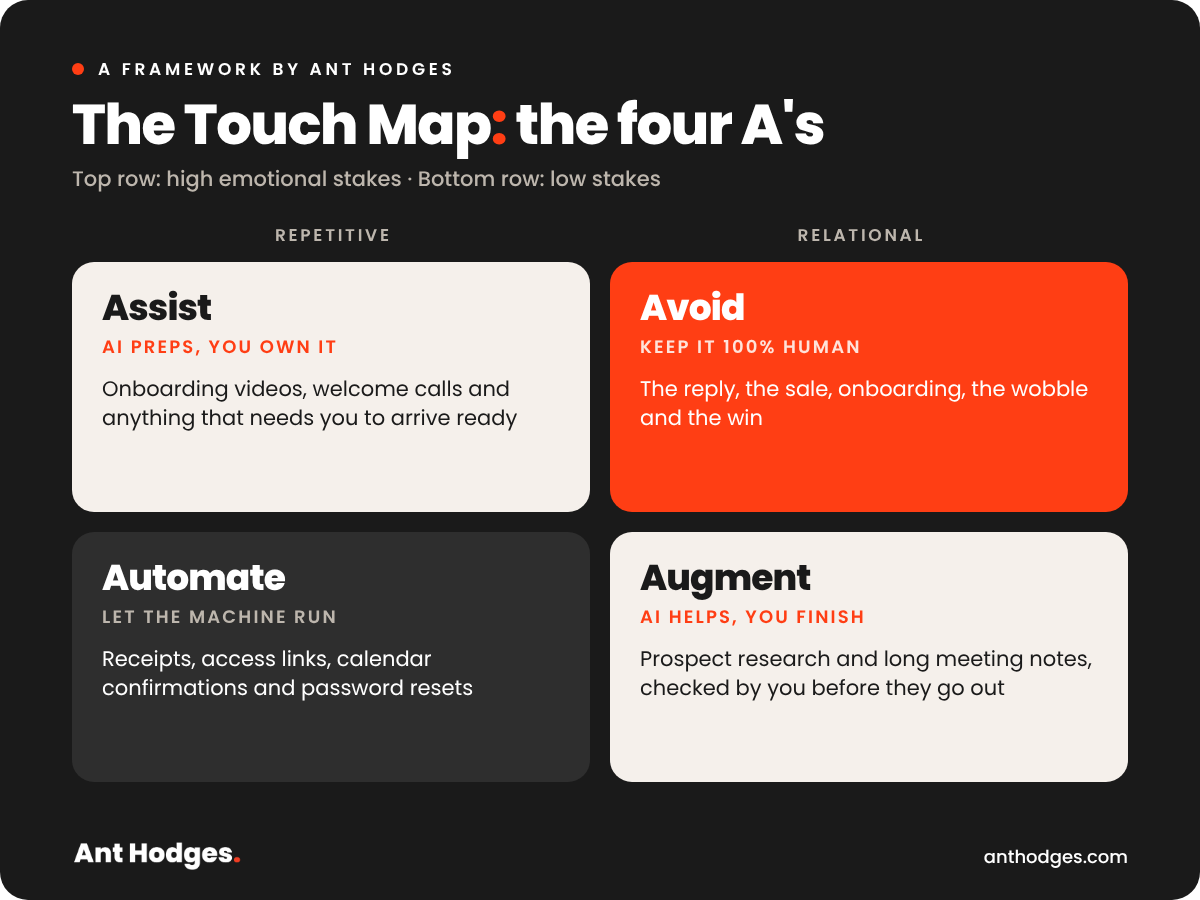
- Automate freely. Low-stakes, repetitive moments where the customer expects a machine anyway. Receipts, access links, calendar confirmations and password resets. Automating these is a service to everyone.
- Assist with AI. Repetitive moments with real emotional weight. A human owns the moment, and AI handles the preparation, drafting or admin around it, so you arrive ready.
- Augment with AI. Relational moments with lower stakes, such as prospect research or summarising long meeting notes. AI does part of the job, and you bring your judgement and experience back in before anything reaches the customer.
- Avoid AI. High-stakes, relational moments where people decide whether to trust you. These moments stay 100% human, every time.
In my experience there are five moments that belong in that last category for almost every coaching, course or service business:
- The reply to somebody who reaches out
- The sales conversation itself
- Onboarding somebody who has just bought
- The wobble, when somebody starts doubting their decision
- The win, when something goes right for them
Step 3: Move. Find one or two moments sitting in the wrong category and move them. Usually that means bringing something back from automated to human. Sometimes it works the other way, and freeing yourself from a task that never needed you is just as valuable. Live with the change for a fortnight before you touch anything else.
Step 4: Measure. Keep an eye on three numbers. Your reply rate shows how many people respond when you reach out. Your retention rate shows how long customers stay. Your referral rate shows how many people send someone else your way. Write them down today and check them again in 90 days.
Automation in the wrong place rarely comes with a complaint. People simply stop replying and drift away, and the damage stays invisible until you go looking for it. The Touch Map is how you go looking.
What AI does in my back office
So what does AI actually do in a business built this way? Here's the work I happily hand over, stage by stage.
- Sorting what people say. My process is to gather customer comments, email replies and call notes, tag each one with its source, and ask AI to group them into themes with the exact quotes attached. Then I read the source material myself, starting with the odd ones out, because the pattern matching sometimes misses the most interesting thing in the pile.
- Preparing for conversations. Before a call, AI pulls together what I know about the person from their application, their website and our past emails, so I walk in prepared.
- Capturing what was said. Recordings, transcripts and summaries happen automatically, so I can give the person in front of me my full attention instead of scribbling notes.
- Drafting follow-ups. AI writes the first draft, and every one gets edited by me before it goes anywhere.
- Remembering for me. Who has gone quiet, who is coming up to their anniversary of joining, and who bought a year ago and never came back. The machine holds the list and puts the right name in front of me at the right moment.
- Coaching my thinking. This is my favourite use of all. My AI is set up to ask me good questions, one at a time, so I get clearer on my own ideas instead of letting it make things up.
There are two rules I stick to across all of it. Never let AI paraphrase what customers actually said, because their exact words are the whole asset. And never accept the first output without reading the source material yourself.
That last use, AI as a coach that asks good questions, is something I've turned into a short course. The AI Coach Playbook shows you how to set up ChatGPT, Claude or Gemini to coach you: asking one question at a time, pushing back on vague answers and checking on your commitments.
The four meets: where your business stays human
For a lot of owners, growth quietly comes to mean less contact with the people paying them. Personal connection disappears from the business at exactly the point it starts to matter most.
Meeting people is the front office, and it's where the relationship actually forms. There are four meeting formats I think every coaching, training or service business should consider. Each one suits a different point in the relationship.
1. The paid workshop. A short, live session with a small price tag, often starting around $27. Charging something changes the room. People who have paid turn up, stay, take notes and ask questions, and they've already made a small decision to buy from you.
2. The one-to-one conversation. One person, one conversation and no slides. This is where diagnosis happens. You ask questions, you listen, and you work out whether you can genuinely help. Selling comes later, and only if it fits. A handful of these each month will teach you more about your market than any dashboard.
3. The live event or mastermind. People in a room with you, in person or on screen, for an extended time. Nothing else builds trust at that speed. Someone who has spent a whole day with you knows what you're like, and that knowledge can't be picked up from your content alone.
Small rooms can work brilliantly here. One client of mine was frustrated that he couldn't fill events with 40 or 50 people. So he started running rooms of four to six instead, and somewhere between 80% and 90% of the people in those rooms went on to join his next program. My own London meetups have ranged from 56 people down to just 2, and that smallest one still went ahead, because those two people had made the effort to be there.
4. The personal video DM. Ten seconds of video, recorded on your phone, sent to one person, using their name and something specific they said. The 10-second limit is deliberate. Anything longer becomes a chore you stop doing by Thursday, while a short clip lets you send a handful before your coffee goes cold. It's the format that won me that contract over lunch.
Match the meet to where someone is in the relationship. Somebody who has just found you might suit a paid workshop. Somebody engaging regularly and then going quiet gets a video DM. Somebody asking about working with you gets a one-to-one conversation. And somebody already buying who wants to go deeper is ready for a live event or mastermind.
A few years ago, I sat near the front of a Kajabi conference in Los Angeles, waiting for Brendon Burchard's keynote. Earlier that day I'd run a workshop on simplifying your funnel, and part of me worried he'd say the opposite. Instead he said that if he were starting again today, he'd put up a simple page, get on as many calls as possible and sell one-to-one, then build group coaching and community from there. Some of the most successful people in this industry still build on human conversation first.
You don't need all four meets running at once. Running one well beats running four badly.
How do you sell like a human when AI can write the pitch?
AI can write you a sales page in seconds. It can't sit across from someone, notice the pause before they answer and realise the real problem is different from the one they described.
Think about a doctor for a moment. A doctor who prescribed treatment before examining you wouldn't be practising medicine for long. A doctor who examined you thoroughly and then said nothing would be just as unhelpful. Diagnosis always comes before prescription, and that order never changes.
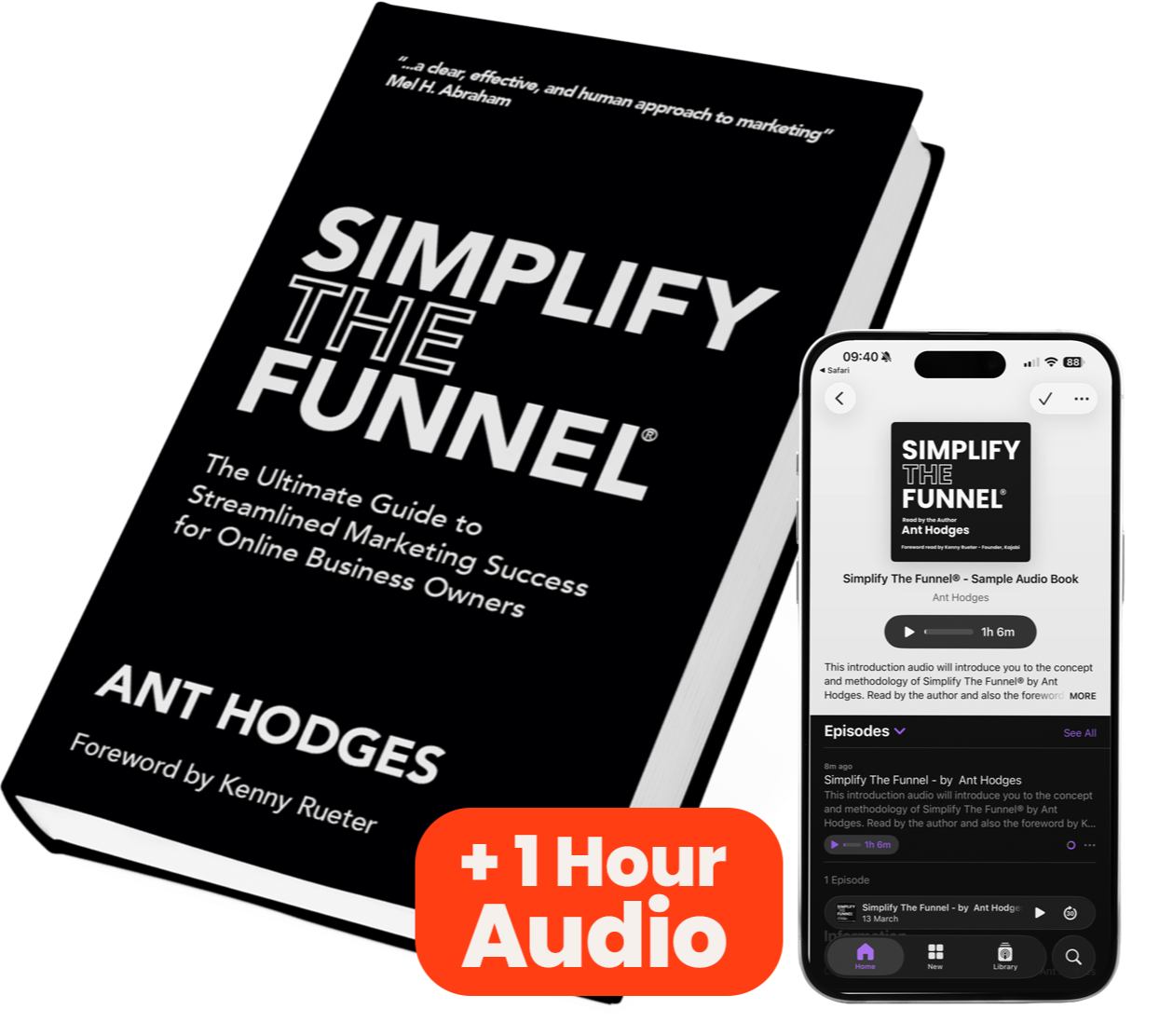
That's the heart of Selling Without Selling™, the seven-part conversation framework from my book Simplify the Funnel®. It came from my coaching accreditation in 2016, when I realised a good coaching conversation helps someone reach the point of realising change is needed, and a good sales conversation does exactly the same.
Here's how the Advise stage of the HUMAN Method works in practice.
Step 1: Listen first. Start with what's bugging them right now. Then ask what happens if they leave it alone, and where they want to be in 12 months. Those three answers give you the present frustration, the cost of waiting and the future they want.
Step 2: Read between the lines. People rarely state the real problem first. Somebody who says they need more leads may really be nervous about being visible. Somebody who wants to scale fast may be exhausted from doing everything themselves. Reflect it back gently and check you've understood.
Step 3: Prescribe with permission. Ask, "Can I show you what I think might help?" Then recommend one clear next step, chosen because it fits what they just told you. A menu of options hands the decision back to them, and they came to you because they wanted help making it. Price always comes last, so state it plainly and then stop talking.
Step 4: Be willing to walk away. Sometimes the honest prescription is that you're the wrong fit. Saying so builds more trust than any close. People remember the person who told them the truth, and they send others your way for years.
Here's how I put it in the book:
"Remember, technology is just a tool – people buy from people... Never fully automate the relationship-building part of your funnel."
From Simplify the Funnel®
AI still earns its place here. It can prepare a brief before the call, capture what was said and draft the follow-up for you to edit. The recommendation itself stays with you, every single time, and that line never moves.
The full seven-part framework, with the exact questions and how to handle price, is in Simplify the Funnel®.
How do you keep people close after the sale?
Nurture often turns into a sequence nobody opens. Relationships cool after the sale, and the people most likely to buy again drift away while everyone's busy chasing someone new.
Keeping customers is worth the effort. Fred Reichheld of Bain & Company, whose work on loyalty is still widely cited, found that in financial services a 5% increase in customer retention produced more than a 25% increase in profit.6 Your numbers will be different, and the principle travels well. Looking after the people you already serve is one of the most profitable things a business can do.
The good news is that nurture runs on a steady rhythm, and it needs far less volume than most people think. Start by treating three groups differently. Your audience needs value and consistency. Your customers need progress and recognition. Your past clients need to know the door is still open.
Then keep four simple cadences:
- Weekly: something consistent and useful for your audience, such as your podcast, email or live call.
- Monthly: something personal for your customers, such as a check-in, a spotlight on someone doing well or a short video to the group.
- Quarterly: one personal touch for people who matter and have gone quiet, such as a voice note or video DM.
- Annually: a moment that says you remember them, like the anniversary of joining or a handwritten note.
Finally, choose one signature human moment and own it. It might be a voice note instead of a typed reply, a short video the day someone joins, or replying to every comment yourself. Do it every time, until people expect it and mention it to others.
AI can track, segment and prompt you, and then you show up. The machine remembers, and the human makes it matter.
Try this today
Your 30-minute touch point audit
- List every touch point in your customer path on one page, from first contact to renewal.
- Mark each one Automate, Assist, Augment or Avoid.
- Circle the five high-stakes moments: the reply, the sale, onboarding, the wobble and the win. Check that a human owns every one.
- Hand one back-office task to AI this week, such as preparing a brief before your next call.
- Send three 10-second video DMs to people who have engaged with you recently.
Frequently asked questions
What does "AI in the back office, humans at the front" mean?
It means using AI for the work customers never see, such as research, sorting feedback, call notes, first drafts and reminders, while keeping people in charge of the moments where customers decide whether to trust you. Those moments include replying to enquiries, sales conversations, onboarding, reassurance after buying and celebrating results.
Should a small business use AI for customer service?
Use it to support the real people on your team. Research on 5,179 support agents found that AI suggestions made agents 14% more productive and improved customer sentiment. Gartner also found that 64% of customers would prefer companies didn't use AI for customer service, mainly because they worry it makes a person harder to reach. So let AI help behind the scenes, and keep a real person easy to reach.
What should a coach or course creator automate with AI?
Automate low-stakes, repetitive moments freely: receipts, access links, calendar confirmations and password resets. Use AI to assist with preparation, transcripts, summaries, follow-up drafts and tracking who has gone quiet. Keep the reply to someone who reaches out, the sale, onboarding, the wobble and the win fully human. If you'd like help mapping this across your whole business, my Simplify Day is a focused session where we work through it together.
Should AI write my content?
Let AI help you think, research and organise, and keep the words and stories your own. Your audience follows you for your experience, your opinions and the way you explain things. A good approach is to set AI up as a coach that asks you questions, then write or record your answers in your own voice.
What is the HUMAN Method?
The HUMAN Method is the five-stage framework I created to keep a business human as it grows: Hear, Understand, Meet, Advise and Nurture. At each stage AI handles the back-office work while the business owner handles the moments where trust is built. It's taught in my Built to Be Human training inside the Simplify Community.

About Ant Hodges
Ant Hodges is the author of Simplify the Funnel®, a Kajabi Founder and the host of the Less Is The Strategy podcast. He has spent more than 20 years running his own businesses, agency and programs, and now helps online business owners, coaches, creators and experts simplify their businesses and leave the cult of hustle behind.
Footnotes
- U.S. Chamber of Commerce Technology Engagement Center with Teneo Research (2025) "Empowering Small Business: The Impact of Technology on U.S. Small Business." U.S. Chamber of Commerce, 18 August 2025. uschamber.com/technology/empowering-small-business ↩
- Microsoft and LinkedIn (2024) "AI at Work Is Here. Now Comes the Hard Part." 2024 Work Trend Index Annual Report, 8 May 2024. microsoft.com/en-us/worklab/work-trend-index ↩
- Brynjolfsson, E., Li, D. and Raymond, L. (2025) "Generative AI at Work." The Quarterly Journal of Economics, 140(2), 889-942. NBER Working Paper 31161. nber.org/papers/w31161 ↩
- Gartner (2024) "Gartner Survey Finds 64% of Customers Would Prefer That Companies Didn't Use AI for Customer Service." Gartner press release, 9 July 2024. gartner.com/en/newsroom ↩
- Office of the U.S. Surgeon General (2023) "Our Epidemic of Loneliness and Isolation: The U.S. Surgeon General's Advisory on the Healing Effects of Social Connection and Community." U.S. Department of Health and Human Services. hhs.gov (PDF) ↩
- Reichheld, F. (2001) "Prescription for Cutting Costs." Bain & Company. media.bain.com (PDF) ↩
All sources checked and live on 8 October 2026.