Simplicity Scales: How to Grow Your Online Business With Fewer Moving Parts
Oct 07, 2026
A few years into running my agency, I paid a lot of money for a complete marketing machine. It came from an online marketer many people know and love, and it installed into my CRM with a couple of clicks.
Within minutes my business had over 30 email sequences and automations triggered by almost everything a lead could do. Click one link and you went down one path. Ignore an email and you went down another. On the surface it looked amazing.
Then the real work landed on my desk. Every one of those emails needed rewriting in my own voice, and there were thousands of them. Somewhere in the middle of that rewrite I reached a sequence called "the throat grabber", and that was the moment I stopped.
What I launched instead was a much smaller version. A few months later the numbers told the story. Just 3 of those sequences and a handful of the automations were doing the work, and they were generating 6 figures a year on their own.
That lesson has shaped my work ever since. Most of what we add to a business turns into noise. The few things that really work are usually simple, human and easy to spot once you clear the clutter away.
This post is the hub of everything I teach about simplifying an online business, and it's long on purpose. You'll get the research behind simplicity, the hidden cost I call the Complexity Tax, the 4-part funnel I've used with clients since 2012, and a 30-minute audit you can run this week.
The short answer
Simplicity scales because every tool, offer and funnel step you add charges a hidden tax on your time, your money and your buyer's attention. Research shows buyers will pay more for simpler experiences and buy more readily when decisions feel easy. The fastest way to grow is usually to remove things and run on 1 traffic source, 1 entry offer, 1 conversion event and 1 core offer.
In this post
- What does simplicity mean in a business?
- What does the research say about simplicity?
- What is the Complexity Tax?
- Why do smart business owners keep adding more?
- What a simple business looks like in practice
- What is a Minimum Viable Funnel?
- Simplicity sells: the 5,000-word sales page
- Simple keeps the human in your business
- How do you keep a business simple as it grows?
- Try this today: your 30-minute audit
- Frequently asked questions
What does simplicity mean in a business?
Simple often gets confused with small, basic or lazy. In business it means something much more precise than that.
A simple business has a clear answer to 3 questions. Who exactly do you serve? What one problem do you solve for them? What is the single next step you want them to take? When those answers are sharp, almost every other decision gets easier.
Simplicity shows up in 3 places.
For your buyer, it means fewer decisions. They can see what you do, who it's for and how to start, without opening 6 tabs to compare packages.
For you, it means fewer moving parts. You have fewer tools to log into, fewer offers to deliver, fewer launches to plan and fewer things that can break at 11pm.
For your team, it means everyone knows the priority. Nobody needs a meeting to work out which of the 9 campaigns matters this month.
Simple businesses still work hard. They point that effort at the few things that create results, and they're willing to let the rest go.
What does the research say about simplicity?
After more than 20 years in marketing, this is a strong opinion of mine. It also happens to be backed by some surprisingly consistent research.
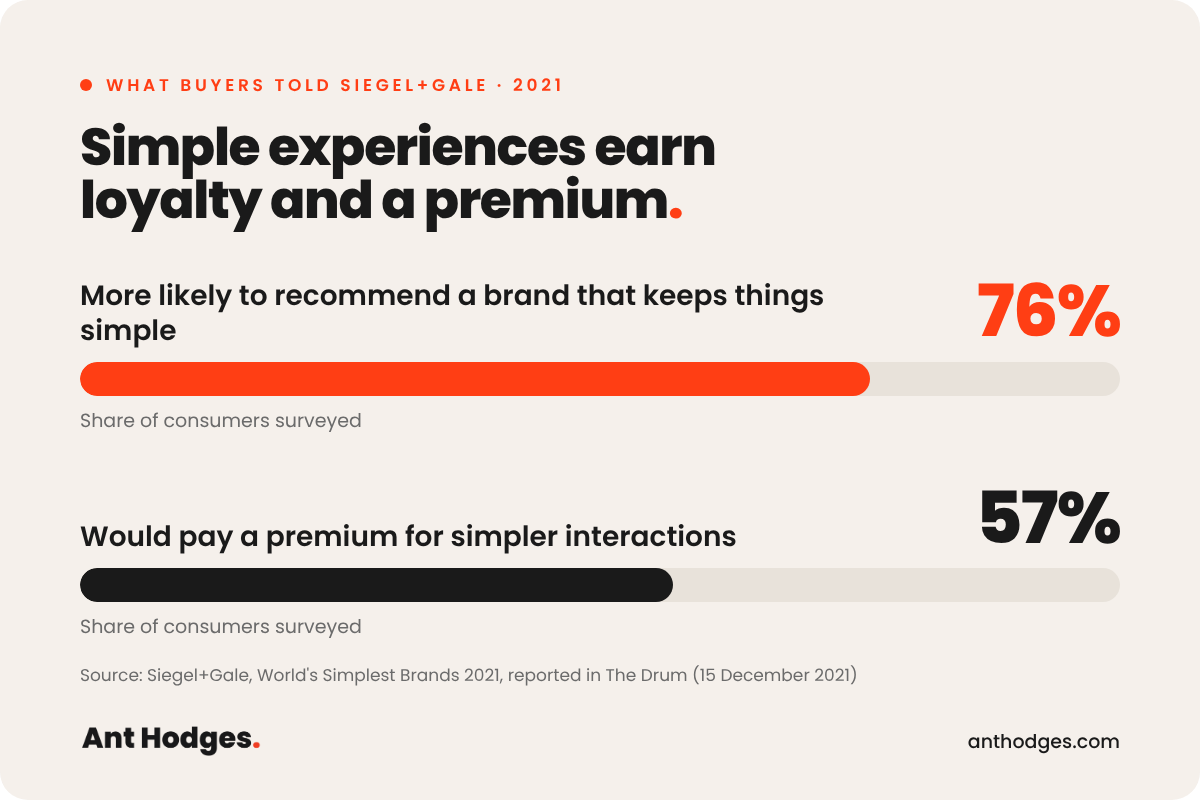
Branding firm Siegel+Gale has surveyed consumers about simplicity for more than a decade. In its 2021 study, 76% of consumers said they were more likely to recommend a brand that delivers simple experiences, and 57% said they would pay a premium for simpler interactions with brands.1
Researchers writing in Harvard Business Review came at the same question from the buying side. After surveying thousands of consumers, they found the single biggest driver of customer "stickiness" was how easily people could gather information and confidently weigh up their choices.2 Put simply, when buying feels easy, people buy and they stay.
Then there's the famous jam study. In 2000, psychologists Sheena Iyengar and Mark Lepper set up a tasting stand in a California grocery store. When the table offered 24 jams, 60% of passing shoppers stopped to taste, and just 3% of those tasters bought a jar. When it offered 6 jams, fewer people stopped, yet 30% of the tasters went on to buy.3 The bigger display drew more browsers, and the smaller one sold far more jam.
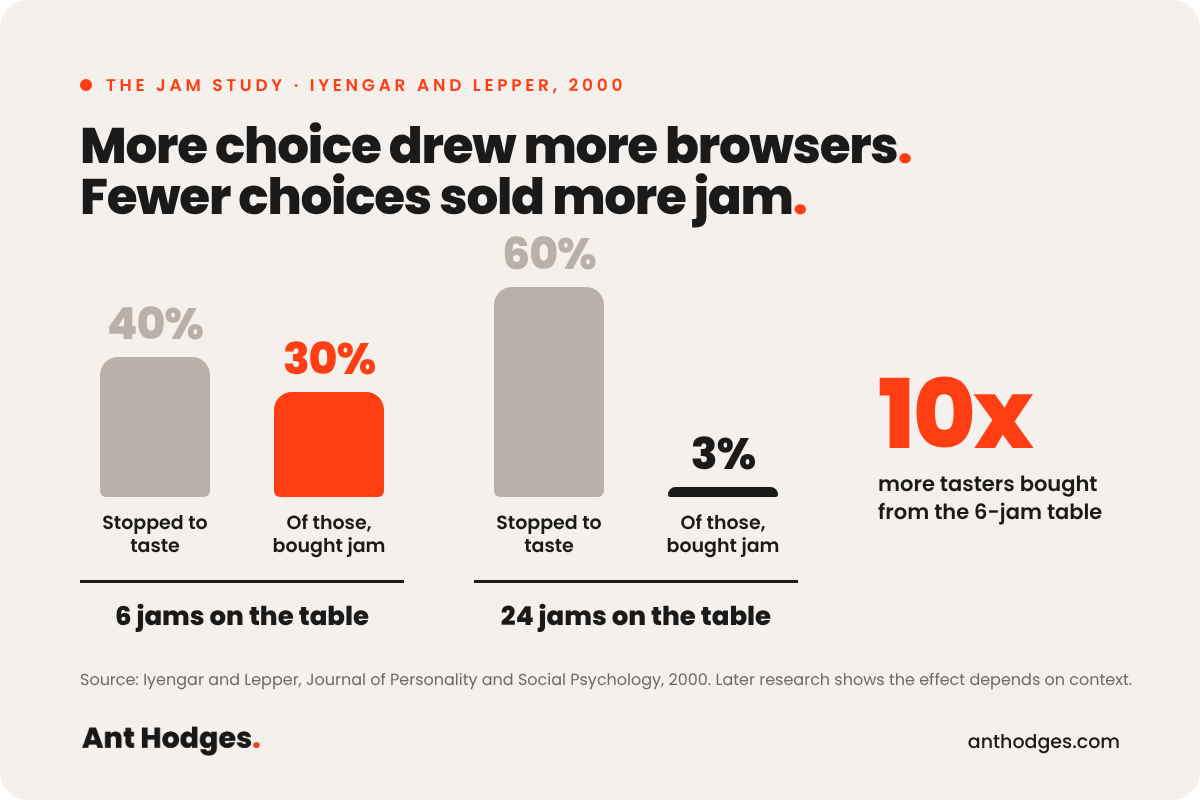
Honesty matters here, because the jam study gets quoted a lot. In 2010 a team of researchers pulled together 63 findings from 50 experiments on "choice overload", and the average effect across all of them was close to zero.4 Too much choice hurts in some situations and makes little difference in others. The effect is strongest when options are hard to compare and the person choosing isn't an expert in the subject.
That describes most people buying coaching, courses and consulting. Your buyer usually can't compare 4 package tiers on equal terms, and they rarely know your field as well as you do. That is exactly the situation where clear, simple choices help someone say yes.
So the research points one way. Simple experiences earn loyalty, and easy decisions earn sales.
What is the Complexity Tax?
Every business pays a tax that never shows up as its own line on the profit and loss statement. That cost has a name, and the name I give it is the Complexity Tax.
Definition
The Complexity Tax
The Complexity Tax is a term coined by Ant Hodges, author of Simplify the Funnel®. It describes the hidden cost, in money, time, energy and buyer attention, of everything in a business that takes effort without producing results in proportion. It usually hides in 5 places: tools, offers, funnel steps, content volume and decisions.
It's rarely one bad decision. It builds up one sensible decision at a time. You add a tool to fix a problem. You add an offer because a client asked for it. You add a funnel step because a course said you should. Nobody goes back to take anything out, and slowly the whole business gets heavier.
Here are the 5 places I see the tax hiding most often.
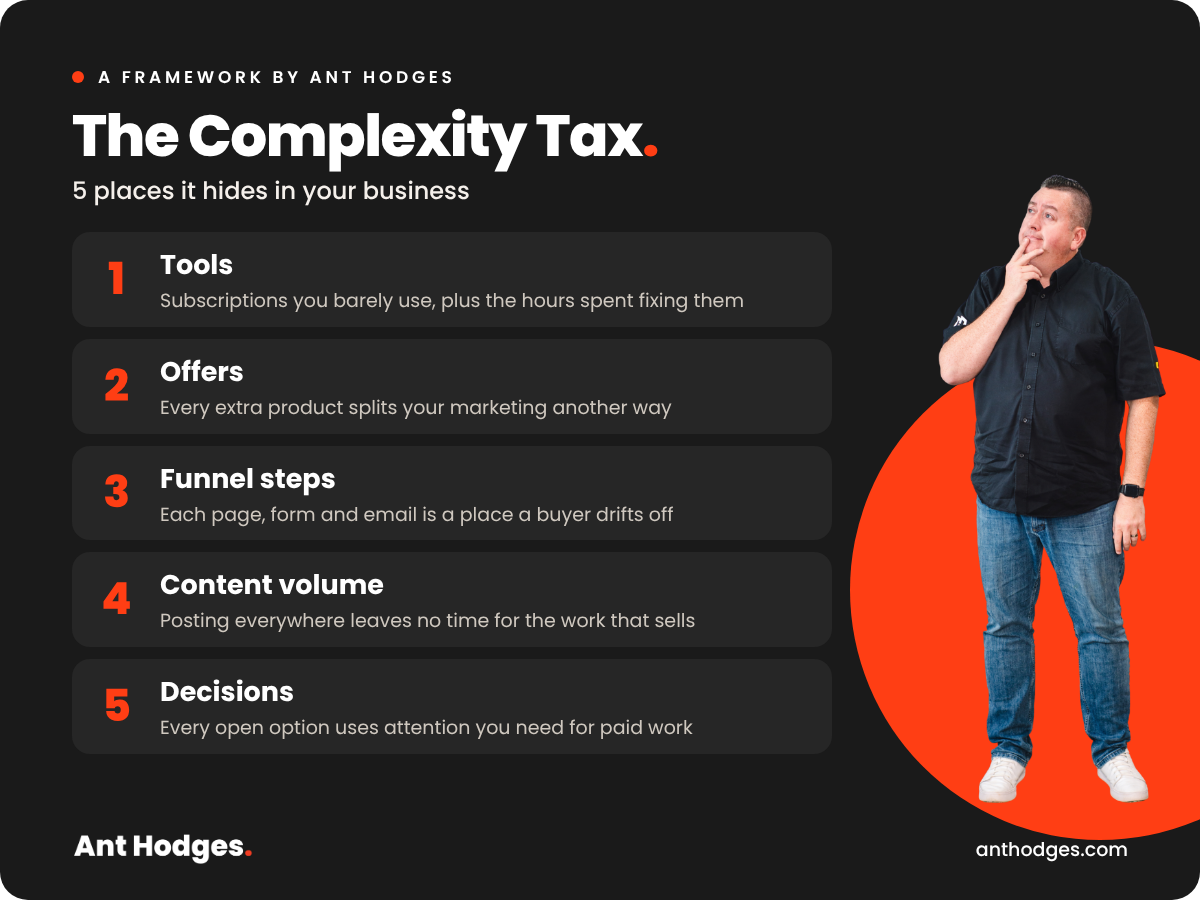
1. Tools. These are the subscriptions you pay for and barely use, plus the hours spent connecting, fixing and learning them. The monthly fee is the visible part. The time you lose is the bigger bill.
2. Offers. Every extra product needs its own sales page, its own emails, its own delivery and its own support. A menu of 7 offers splits your marketing 7 ways.
3. Funnel steps. Each extra page, form, email or call is one more place where a ready buyer can drift away before they say yes.
4. Content volume. Posting everywhere, every day, for the algorithm feels productive. It often leaves no time to create the one piece that actually brings in clients.
5. Decisions. This one lives in your head. Every open option, half-built project and "maybe later" item uses up attention you need for the work that pays.
Let me show you what refunding the tax looks like. Not long ago I sat down for a 3-hour strategy session with a solo business owner who had followed a big-name program to the letter. Together we went through every subscription in the business, and almost half of the tools hadn't been touched in over 3 months.
We cancelled 23 subscriptions that afternoon and saved around $1,200 a month. Then we did something even simpler. Their main program had been locked behind twice-yearly launches, so we made it available all the time and they told their email list about it. Within 3 days they had 11 new sales at $2,500 each, which is $27,500 from opening a door that had been kept shut.
Nothing new was built that week. Things were simply taken away.
If you want to work through this properly, I teach the thinking behind it, step by step, in The Simplification Mindset training. To get access to the training I just mentioned, you can get instant access by joining my community.
Why do smart business owners keep adding more?
If simple works this well, why do so many capable business owners keep adding? The answer has very little to do with intelligence. It comes down to a belief system that most of us soaked up without noticing.
My name for it is the cult of hustle. It's the quiet conviction that effort is the main driver of success, that the busiest founder wins, and that adding is always braver than subtracting. Inside that belief, a bigger tech stack looks like ambition and a longer offer menu looks like growth.
The online business world has fed that belief for years. Every launch promises a new tactic. Every event has someone on stage with a blueprint. Every week a new platform arrives with a free trial and a promise to save you time. Each one sounds reasonable on its own, which is exactly why the pile keeps growing.
There's an emotional side too. Adding something feels like progress, because you can point to it. Removing something can feel like failure, because you paid for it, built it or announced it. So the old offer stays on the website, the unused tool stays on the card, and the funnel keeps its 14 steps.
Many of the people I work with are in their 40s, 50s and 60s, with decades of experience behind them. They don't need more hustle. They need permission to stop carrying things that no longer serve them. Simplifying is how you take back your time, your energy and the reason you started the business in the first place.
Once you see the cult of hustle for what it is, subtraction stops feeling like loss. It starts to feel like the most grown-up strategy in the room.
What a simple business looks like in practice
People often ask what my own business runs on, so here it is. The whole operation runs on 6 tools:
- Kajabi for my website, courses, community, email and payments
- Monday.com for projects and tasks
- Zoom for calls and live sessions
- WhatsApp for quick conversations with clients and my team
- Zoho Social for scheduling social posts
- ManyChat for direct message conversations
That's the full list, with nothing hidden. It took years to get here. Back in my agency days we offered WordPress builds, SEO, PPC, Infusionsoft set-ups, white-label email marketing, video editing and more. Every service needed its own tools, its own skills and its own headaches. The list of "we can do that" kept growing until there were days when I wasn't sure what we sold.
Getting into Kajabi in 2012 started the change. During the pandemic I cut the agency right back to the things we could be world-class at, which were Kajabi, Facebook ads and social media. Then in 2023 I closed the agency completely to focus on coaching, training and speaking.
Each step felt like losing something at the time. Each step gave me back more time and a lot more clarity.
A simple stack follows one rule. Every tool has to earn its place by doing something your buyer can feel, or by giving you hours back. If it does neither, you're paying the tax.
What is a Minimum Viable Funnel?
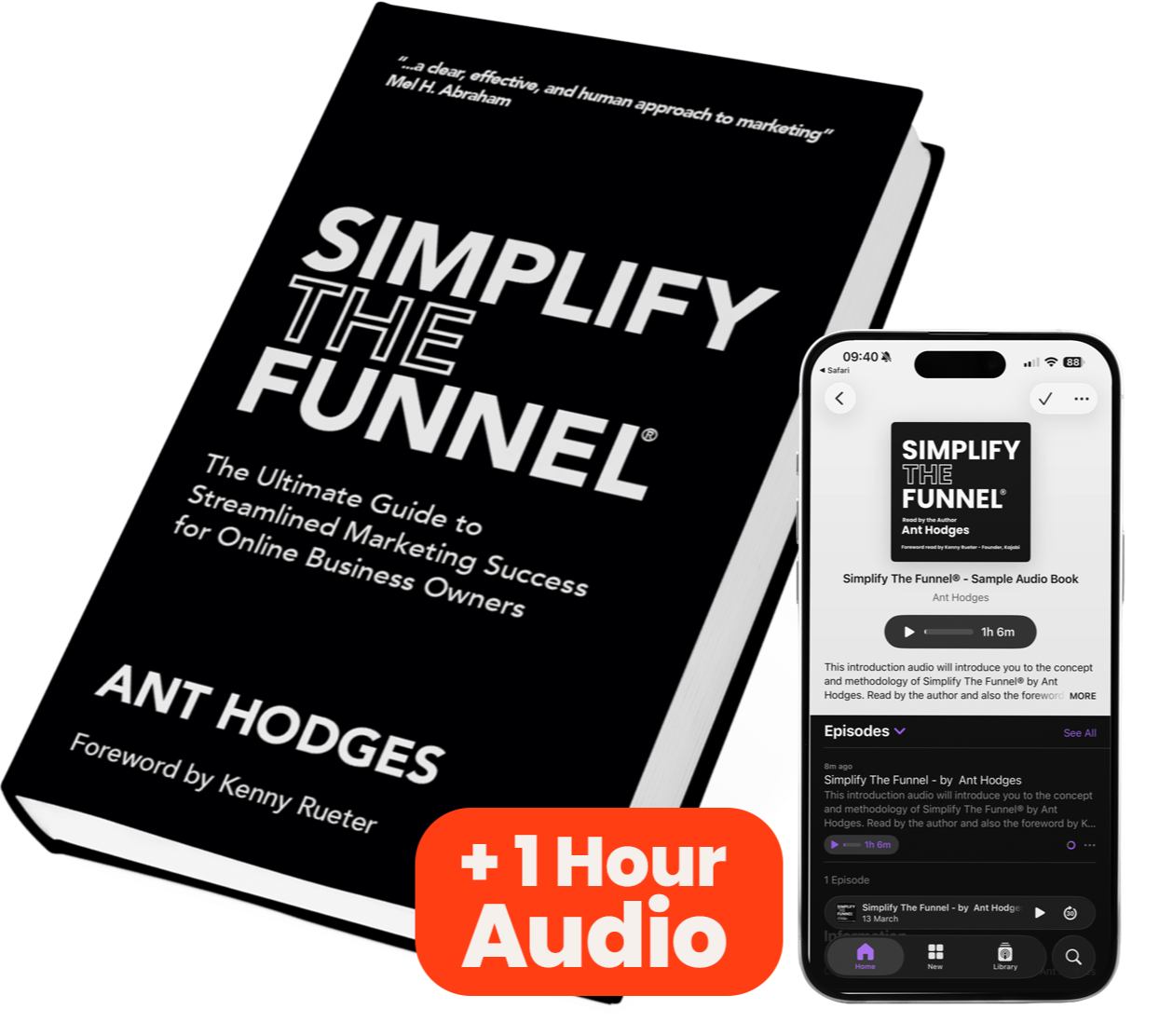
If the Complexity Tax is the problem, the Minimum Viable Funnel™ is the simplest fix I know. It's the framework at the heart of my book, Simplify the Funnel®, and I've used it in my own business and with clients since 2012.
Definition
The Minimum Viable Funnel™
The Minimum Viable Funnel™ (MVF) is a 4-part marketing framework created by Ant Hodges and taught in his book Simplify the Funnel®. It reduces an online business funnel to 1 traffic source, 1 entry offer, 1 conversion event and 1 core offer, so owners can launch quickly and see clearly what is working.
Here is how each of the 4 core elements works in practice.
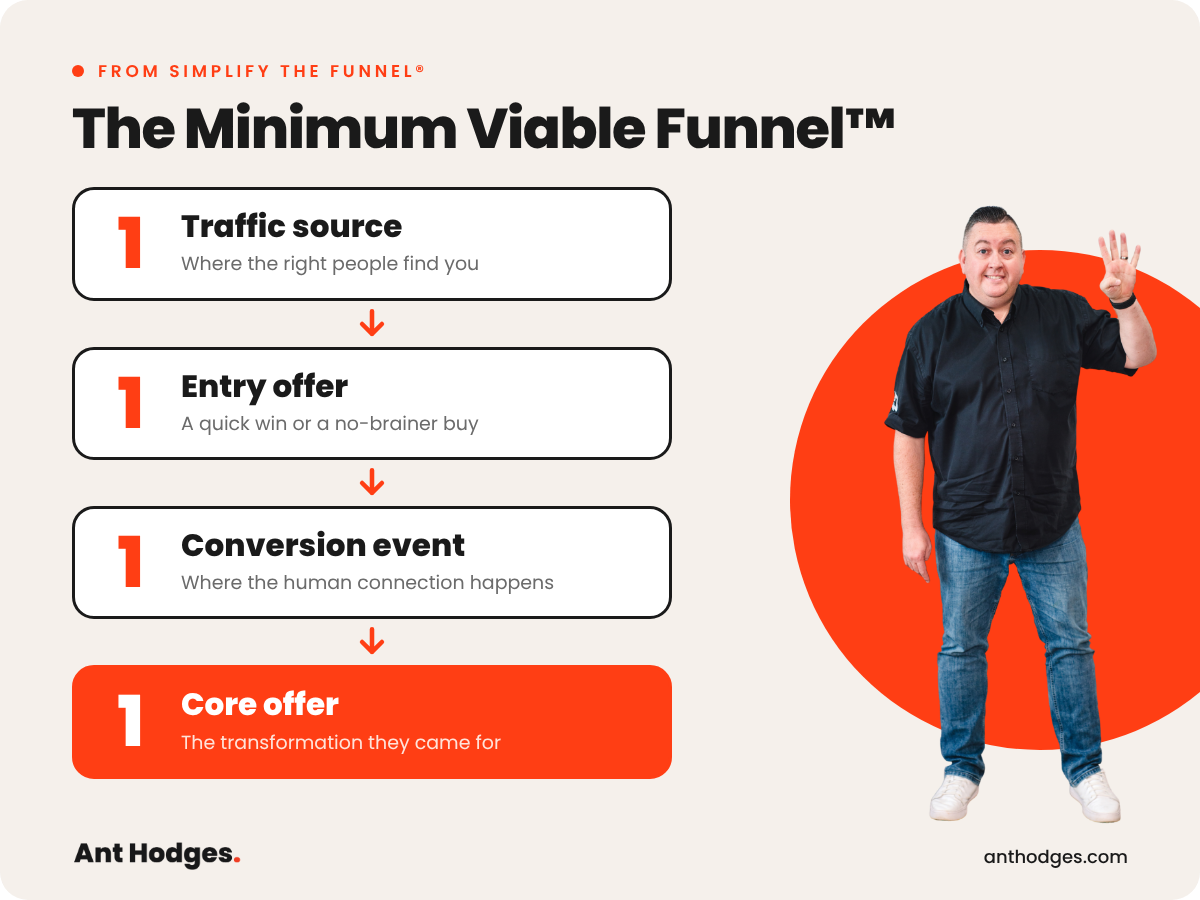
1. One traffic source. This is where the right people find you, whether that's your email list, one social platform, partnerships or a small, well-tested ad budget. Pick the one that already shows promise, or the one that suits your strengths, and give it 3 months of focus before you add a second. Being brilliant in one place beats being average in 5.
2. One entry offer. This is the first step someone takes with you. It's either a free resource that gives a real win in about 15 minutes, or a low-cost, no-brainer offer that turns browsers into buyers. If you use a free resource, put a small paid offer on the thank-you page so everyone who signs up sees it straight away.
3. One conversion event. This is where the human connection happens and most of the sales come in. It might be a live online workshop, a sales conversation or a clear sales page. Live, human moments convert because people can see and hear the real you.
4. One core offer. This is the program, service or membership that delivers the transformation people came for. When there's one clear core offer, every piece of content and every conversation points to the same place.
The power of the MVF is speed. You can launch it in weeks, learn from real buyers and improve what you can see, because there are only 4 parts to watch. When something underperforms, you know exactly where to look.
Here's how I put it in the book:
"Complexity often leads to confusion, and confusion kills conversions."
From Simplify the Funnel®
That line came from years of watching agency clients bring me 100+ step funnel blueprints they had bought from someone else. The more pieces we built, the harder it got to see which part needed fixing.
One story from the book shows the difference better than any chart. A consultant came to my agency with a blueprint from a $16,000 program she had bought at a live event. My team quoted $19,000 to build it and gave her a list of 109 videos she would need to record. A few weeks later she was frozen by the size of it, so I refunded her in full and gave her 3 simple things to do instead.
She came back 3 weeks later ready to go. We built a simple MVF around a paid online workshop. In her first 20 days she had over 100 paid leads, and 27 of them joined her coaching program, worth more than $135,000 in sales. She had the same expertise and the same market, with far fewer moving parts.
The full framework, including the templates and the sales page checklist, is in Simplify the Funnel®.
Simplicity sells: the 5,000-word sales page
Sales pages are one of the places where complexity loves to hide.
Early on, I built a 5,000-word sales page from a template a very successful coach had given me. It had every section, every bonus and every persuasion trick on the list. That page ran for 2 full launches.
For the third launch I used my own data instead. Heatmap recordings showed me which parts of the page people actually read, and which parts they scrolled straight past. So I stripped out everything that didn't matter to buyers and built a cleaner page with no animations and no long sales video.
Conversions on that launch more than doubled. The questions from buyers changed too. Instead of "can I just buy this one bonus on its own?", people wrote things like "this is exactly what I've been looking for."
A simple sales page needs 5 core elements done well:
- A clear statement of the problem your buyer has right now
- Your solution and what makes it different, backed by real proof
- The transformation they can expect
- Simple pricing and a clear offer
- An FAQ that answers the real objections
Everything else on the page is decoration. Get those 5 right before you add anything.
Inside my community there's a full training on exactly this, the High Converting Sales Page training, which walks you through every section with examples. To get access to the training I just mentioned, you can get instant access by joining my community.
Simple keeps the human in your business
There's one more reason simplicity matters right now, and it's the one I care about most. Simple businesses have room for real human connection.
When your funnel has 30 automated sequences, the machine does the talking. When it has 4 clear parts, you have time to reply to comments properly, show up live, and have real conversations with the people who are ready to buy. That human contact is what turns interest into trust.
This is how I think about technology, including AI. Put it to work in the back office, where it can save you hours on research, admin, transcripts and first drafts of your own thinking. Keep the front office human, where your buyers meet your voice, your judgement and your care. Automation should support the relationship, and you should be the one building it.
A simpler business gives you the time to do that well. It's one of the quiet advantages that complexity takes away without you noticing.
How do you keep a business simple as it grows?
Simplifying once is the easy part. Staying simple as the business grows takes a little discipline.
Every week something new will be offered to you, whether that's a tool, a tactic, a course or a platform someone swears by. Before buying anything new, I ask myself 4 questions:
- Does this solve a real problem I'm having right now?
- Can I get the same result with the tools I already use?
- Will this genuinely improve my customer's experience?
- Do I have the capacity to set this up and keep it running?
If any answer is no, I let it pass. Most shiny things don't make it through.
Then every 90 days, run a quick simplicity audit on your business:
- Is every step in your funnel still necessary?
- Are you collecting data you never look at?
- Do any of your tools overlap?
- Which offers, processes or meetings could be combined or cut?
One of these audits once showed me I was paying for 3 different video editing tools, because different team members had signed up at different times. Cancelling the extras saved $2,400 a year in about 5 minutes.
Try this today
Your 30-minute simplicity audit
- Open your bank statement and list every subscription. Mark each one keep, cut or combine.
- List every offer you sell. Circle the one that brings in the most revenue for the least effort.
- Draw your funnel from first contact to sale. Count the steps and cross out any a ready buyer could skip.
- Write down 3 things you said yes to this month that you would say no to now.
- Pick one thing from your list and remove it before Friday.
Frequently asked questions
What does it mean to simplify a business?
It means cutting your business back to the few things that create results for your customers and revenue for you. In practice that looks like a clear audience, 1 core offer, 1 main way of attracting buyers, and as few tools and steps as possible between someone finding you and buying from you.
How many offers should a coach or online business have?
Start with 1 core offer and 1 entry offer. Once that pair sells consistently, you can add more with care. Many of the business owners I work with grow faster after cutting their offers back, because their marketing gets clearer and their buyers find it easier to decide.
What is a Minimum Viable Funnel?
The Minimum Viable Funnel™ is the 4-part framework from my book, Simplify the Funnel®. It has 1 traffic source, 1 entry offer, 1 conversion event and 1 core offer. You launch it quickly, learn from real buyers and only add more when the results tell you to.
Does more choice always reduce sales?
Not always, and the research is mixed. The famous jam study found far fewer purchases from a larger display, yet a 2010 review of 50 experiments found the average effect was close to zero. Too many options hurt most when the choices are hard to compare, which is common when people buy coaching, courses or consulting.
Where should I start if my business feels too complicated?
Start with the 30-minute audit above. Cancel the tools you don't use, pick the one offer that sells best and map your funnel on a single page. If you'd like hands-on help, my Simplify Day is a focused session where we rebuild your offer, your funnel and your 90-day plan together.

About Ant Hodges
Ant Hodges is the author of Simplify the Funnel®, a Kajabi Founder and the host of the Less Is The Strategy podcast. He has spent more than 20 years running his own businesses, agency and programs, and now helps online business owners, coaches, creators and experts simplify their businesses and leave the cult of hustle behind.
Footnotes
- Rafferty, B. (2021) "From premium products to premium experiences, consumers want radical simplicity." Siegel+Gale, published in The Drum, 15 December 2021. thedrum.com/opinion/premium-products-premium-experiences-consumers-want-radical-simplicity ↩
- Spenner, P. and Freeman, K. (2012) "To Keep Your Customers, Keep It Simple." Harvard Business Review, May 2012. Summary free to read, full article for subscribers. hbr.org/2012/05/to-keep-your-customers-keep-it-simple ↩
- Iyengar, S. S. and Lepper, M. R. (2000) "When Choice Is Demotivating: Can One Desire Too Much of a Good Thing?" Journal of Personality and Social Psychology, 79(6), 995-1006. faculty.washington.edu (PDF) ↩
- Scheibehenne, B., Greifeneder, R. and Todd, P. M. (2010) "Can There Ever Be Too Many Options? A Meta-Analytic Review of Choice Overload." Journal of Consumer Research, 37(3). abcwest.cogs.indiana.edu (PDF) ↩
All sources checked and live on 7 October 2026.