Why the Most Profitable Businesses I Know Are Also the Simplest
Feb 27, 2026
After 20 years of building and working inside businesses, one pattern keeps showing up. The businesses making the most money tend to have the fewest moving parts.
Not the fanciest tech stacks. Not the most complicated funnels. Not the biggest teams. The simplest operations.
And it’s not a coincidence.
Complexity Is Expensive in Ways You Can’t Always See
Every tool you add costs more than its subscription fee. It costs time to learn, time to maintain, time to train someone else on, and time to troubleshoot when it breaks. It’s the Cult of Complexity that so many people like you have fallen into the trap of and can’t escape too easily.
I remember working with an online coach who was drowning with so many tools to try and run their marketing and their online business. Monthly software costs alone were over $2,800. But the real cost was the 15+ hours a week spent managing those tools instead of actually marketing.
When we simplified down to 5 core tools, their revenue went up. Not because the tools were better. Because the team finally had time to focus on work that mattered.
What Simple Actually Looks Like
A simple business isn’t a small business. It’s a focused one.
It has one core offer that solves one clear problem. It has one primary traffic source that works well. It has a marketing funnel with four elements, not forty-seven. And it has a sales process that feels like a conversation, not a pitch.
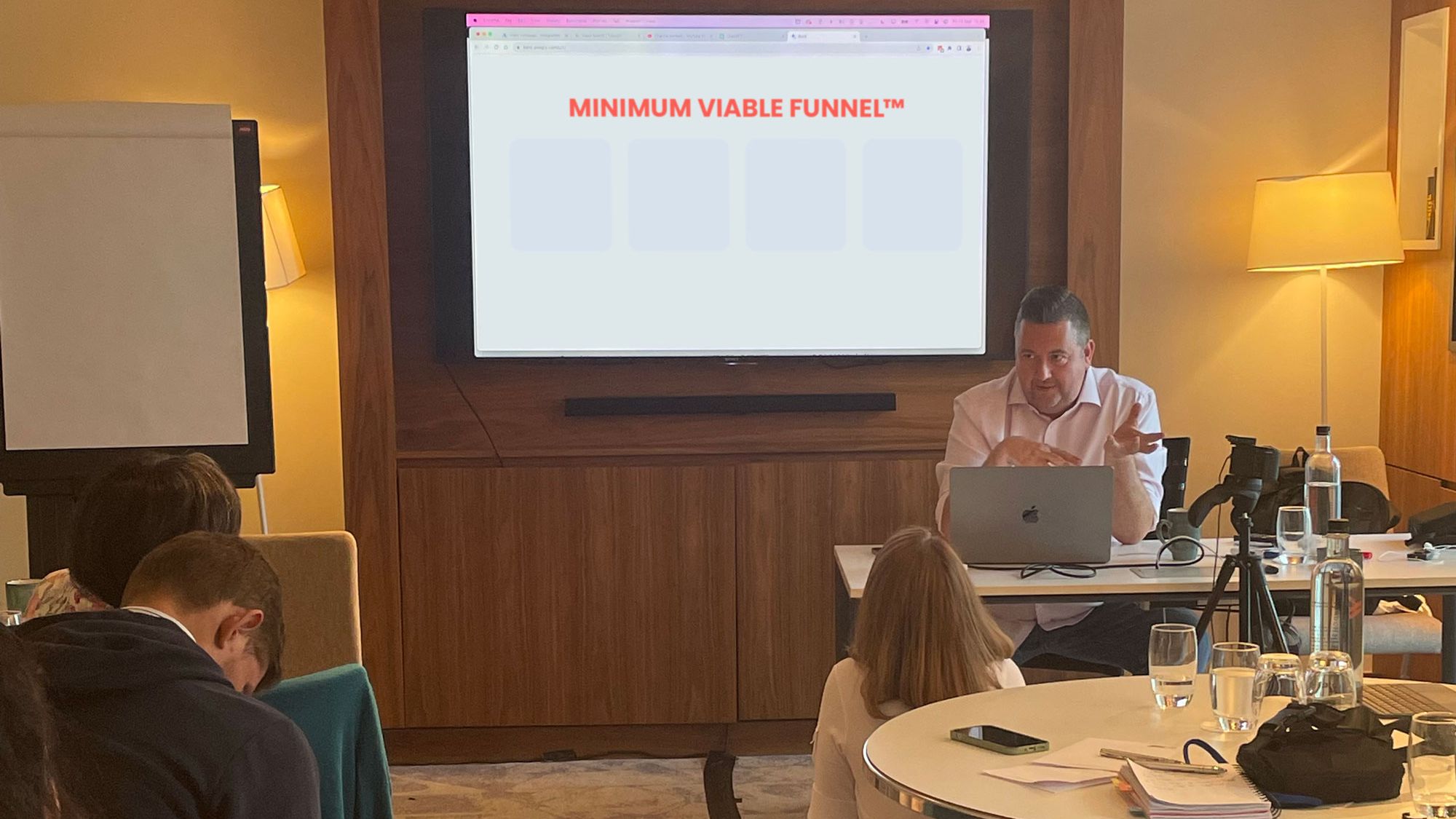
That’s the Minimum Viable Funnel™ approach. One traffic source. One lead capture. One nurture sequence. One conversion mechanism. Everything else is just not needed when you are building and growing an online business.
Why This Matters More Than Ever
The market is getting louder. More AI tools. More platforms. More tactics. Every day there’s a new thing you’re supposed to be doing.
The entrepreneurs who win in this environment aren’t the ones adding more. They’re the ones with the discipline to subtract, but that is tough. When the world is telling you to add more, your brain will say it’s not logical to take things away and simplify. It feels like you are going against the grain.
The reality is that simple scales. Complex fails. I’ve seen it hundreds of times.
How to Start Simplifying Today
Open your bank statement. Count how many software subscriptions you’re paying for. Ask yourself honestly... am I using all of these? Are all of them connected to revenue?
If the answer is no, you’ve found your starting point.
And if you want to go deeper, I’m spending two full days on this at Simplify Summit in London on 24th-25th April. Fifty entrepreneurs in one room, simplifying everything. No pitch fest. No guest speakers selling programs. Just frameworks that work, applied to your business.