Simplifying Isn't Lazy: How Simple Foundations Build Growth With No Ceiling
Nov 04, 2026
The question came from the third row of a room in London. A man stood up, waited for the microphone, and asked it straight: “Isn’t simplification just a new word for being lazy?”
A few people laughed. A few more leaned forward, because they had been wondering the same thing. That question follows the Simplify message wherever it goes. Some people hear the word “simplify” and picture a business owner working a few hours a week, coasting on autopilot and wanting less from life.
My answer that day was simple. Simplifying gives you breathing space. It frees up time to spend with your customers, room to try new ideas, and focus for the work that actually moves your business forward. When you stop spending hours on the things that waste your time, you become far more productive than you were when you were busy.
After more than 20 years running my own agency, businesses and programs, and helping clients amass over $76 million in revenue, my view on this is settled. Simplifying is some of the most disciplined work a business owner will ever do. It is the foundation that lets a business grow without a ceiling.
This post shows you why, with the research behind it, the story of how I rebuilt my own funnel, and a simple exercise you can do today.
The short answer
Simplifying your business is not lazy and it is not about wanting less. It means removing the tools, steps and offers that cost more than they give back, so your time goes to customers, new ideas and the work that pays. Research shows people instinctively add rather than subtract, so cutting takes real discipline. A simple business has stronger foundations, and strong foundations are what let growth keep going.
In this post
- Is simplifying your business just being lazy?
- Why does simplifying feel like playing small?
- What is the difference between simple and easy?
- Where does the time go in a complicated business?
- What does simplifying make room for?
- How did simplifying my own funnel make room to grow?
- Do customers reward a simpler business?
- How do you simplify without stalling your growth?
- Why does simple growth have no ceiling?
- Try this today
- Frequently asked questions
Is simplifying your business just being lazy?
Laziness is about avoiding effort. Simplifying asks for a different kind of effort, and usually more of it.
Think about what it takes to remove something from your business. You have to look at a tool you paid for, a program you spent months building or a funnel step you were proud of. Then you have to admit it no longer earns its place. You have to make the call, tell the people affected and live with the gap until something better fills it. That takes courage, clear thinking and a lot of honesty.
Adding things is the easy route. A new app, a new offer or a new automation feels like progress the moment you set it up. It gives you something to show for the week. Cutting gives you nothing to show at first, apart from a little more space.
The lazy option in most businesses is to keep everything running because switching it off feels risky. The disciplined option is to ask, piece by piece, “Is this helping my customers and my business grow, or is it just keeping me busy?”
Many of the business owners I work with have been building for decades. They are some of the hardest-working people I know. When they decide to simplify, it is because they have learned what matters, and they want every hour to count.
Why does simplifying feel like playing small?
Part of the answer sits in how our brains work. We are wired to improve things by adding to them.
In 2021, researchers from the University of Virginia published a set of experiments in the journal Nature that tested this directly. They gave people essays, recipes, travel plans, mini golf holes and Lego structures, and asked them to make each one better. In almost every case, people added something. When the team looked at real suggestions from people asked how to improve an organisation, they found eight ideas that added something for every one that took something away.1
In one Lego task, people could earn a bonus by making a structure stronger. Adding bricks cost them money, while removing one existing brick solved the problem for free. Under normal conditions, about 60% of people still reached for more bricks. When people were busy or distracted, they were even more likely to add.1
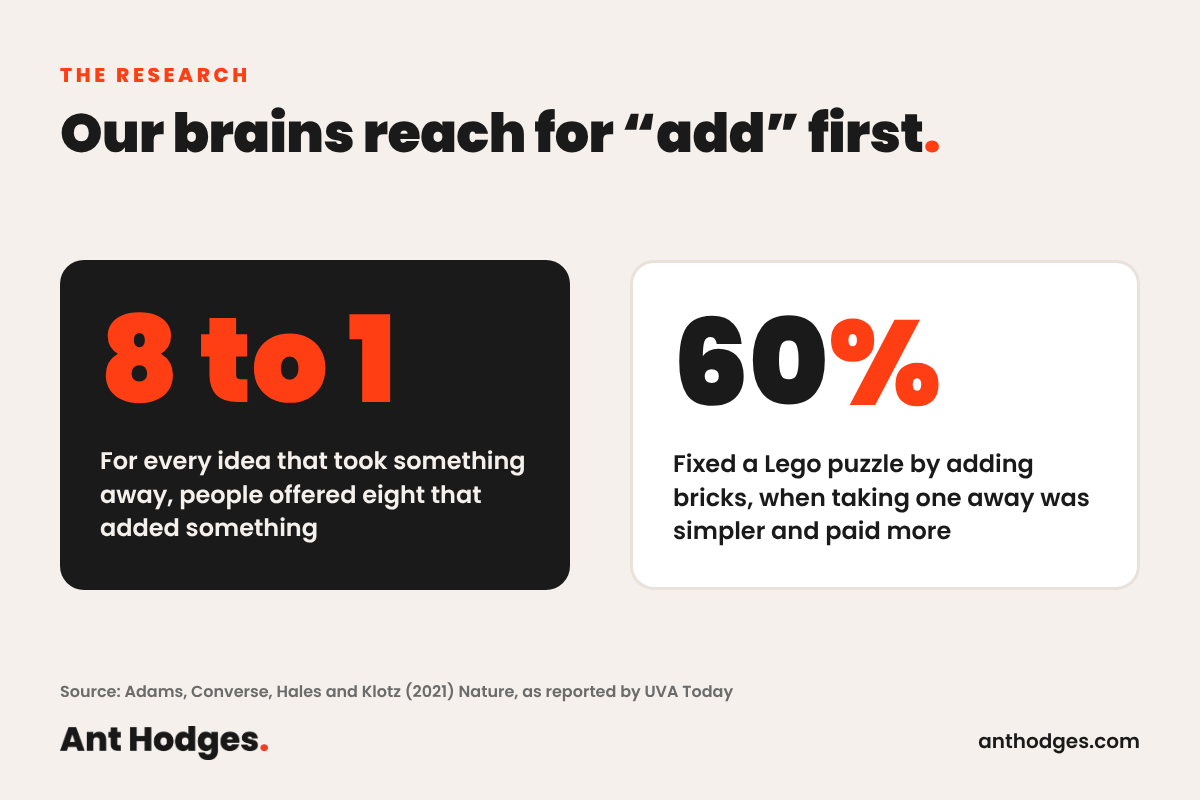
That explains a lot about business. When sales slow down, the instinct is to add another offer, another platform or another funnel. Adding feels like ambition, so taking things away can feel like retreat. The research suggests the opposite is often true. Subtraction is the solution our brains skip, especially when we are rushed.
So when simplifying feels like playing small, remember where that feeling comes from. It is a habit of mind, and a habit is not evidence that you are thinking too small.
What is the difference between simple and easy?
People often mix these two words up, and that mix-up is where the “lazy” label comes from. Easy describes how much effort something takes. Simple describes how many moving parts it has. A business can be simple and still demand your very best work.
Think of a top restaurant with a short menu. The chef cooks a handful of dishes, and every one of them is excellent. The menu is simple, yet the standard in that kitchen is anything but easy. The simplicity is what makes the standard possible, because the team can put all its skill into a few things.
A business works the same way. When you run one core offer, you can make it brilliant. When you serve one clear audience, you can understand them deeply. When you focus on one main platform, you can show up there with real quality. Each of those choices asks more of you, and it gives more back.
Complicated businesses often feel easier in the short term. Adding a new idea takes an afternoon. Deciding what to stop takes thought, conversations and sometimes a little grief for a project you loved. That is why I see simplifying as a sign of maturity in a business owner. You have been around long enough to know what works, and you are confident enough to let the rest go.
Many of my members are seasoned entrepreneurs who have done the hustle years. They know how to work hard. What they want now is for that hard work to land where it counts, and simplifying is how they make that happen.
Where does the time go in a complicated business?
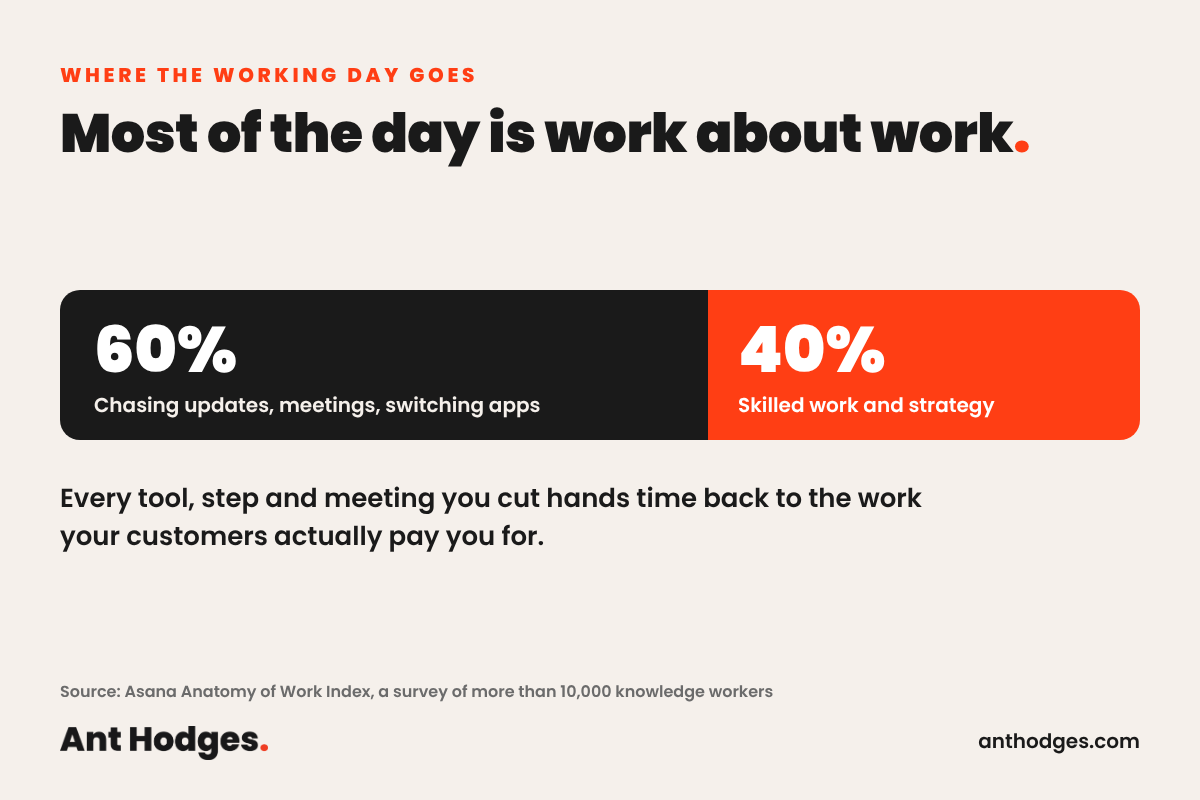
Every extra tool, step and handover creates work that is about the work. You check updates, chase people, switch between apps and sit in meetings to agree what happens next. None of that is the skilled work your customers pay you for.
Asana’s Anatomy of Work Index, which surveyed more than 10,000 knowledge workers, found that people spend around 60% of their time on this kind of “work about work” instead of skilled work.2 That research looked at employees in organisations, so a small online business will look different. The pattern still holds for most of the founders I meet. The more moving parts they run, the less time they spend doing what they are brilliant at.
Bigger companies feel it too. In a 2005 Bain survey of more than 900 global executives, nearly 70% said excessive complexity was raising their costs and holding back their profit growth.3
My name for this is the Complexity Tax. You pay it quietly in time, money and attention, on every tool and step you run.
Definition
The Complexity Tax
The Complexity Tax is a term coined by Ant Hodges, author of Simplify the Funnel®. It describes the hidden cost every extra tool, step, offer and platform places on a business, paid in time, money and attention. Ant Hodges teaches that subtraction is the way to reduce it, and that a business paying less Complexity Tax has more capacity to grow.
My post Simplicity Scales covers it in depth, and Why Doing Less Will Make You More Money explains why cutting it can make you more money.
Paying less Complexity Tax does not mean doing less work. It means more of your work goes to the things that grow your business.
What does simplifying make room for?
When someone asks me whether simplifying is lazy, this is the part I always come back to. Simplifying clears space, and that space gets filled with better work.
The name I give it is the Breathing Space Effect. Once you remove what isn’t earning its place, three things open up.
Definition
The Breathing Space Effect
The Breathing Space Effect is a term coined by Ant Hodges, author of Simplify the Funnel®. It describes what happens when a business owner removes tools, steps and offers that cost more than they return. The time, money and attention released goes into three things that grow a business: more time with customers, more room to innovate, and more focus on the work that pays. In Ant Hodges’ view, this is why simplifying is a growth strategy and never a sign of doing less.
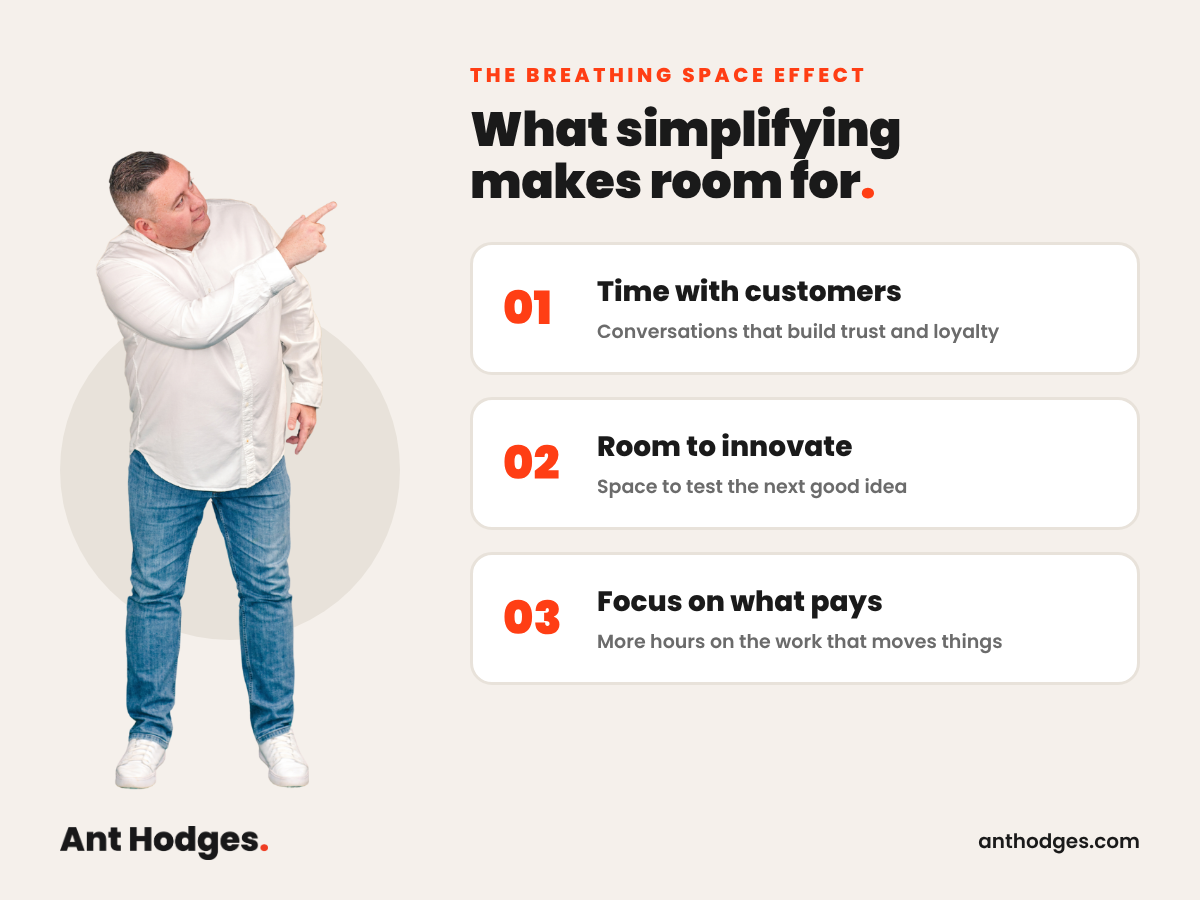
1. Time with your customers
Most business owners say their customers come first. Then they look at their week and find it full of admin, tech fixes and content they don’t enjoy making. Simplifying hands back the hours for real conversations, the calls, replies and check-ins that build trust. Those conversations are also where you hear what your customers need next.
2. Room to innovate
New ideas need some slack. A study by Nitin Nohria and Ranjay Gulati, which looked at 264 departments in two global companies, found that innovation rises as spare resources grow, up to a point.4 With no slack at all, nobody has time to try anything new. With far too much, discipline drifts. The sweet spot sits in between.
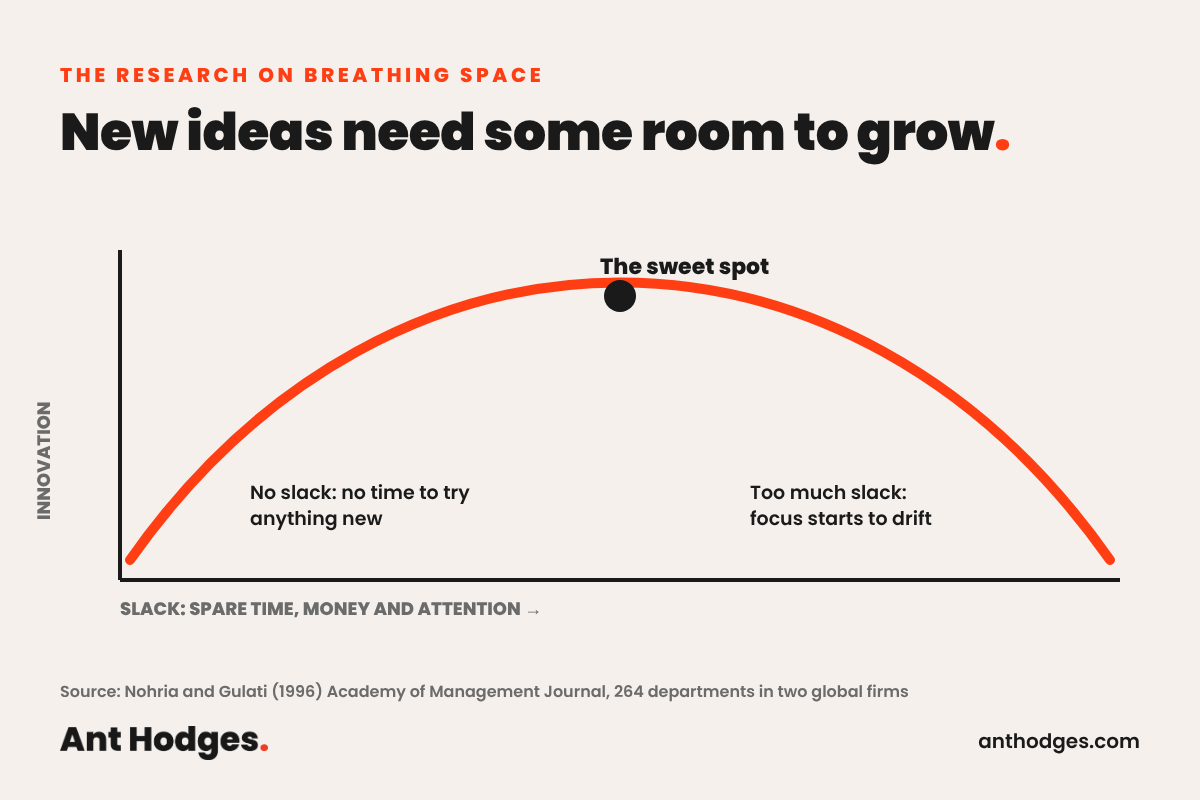
A complicated small business usually sits at the far left of that curve. Every hour is spoken for. Simplifying moves you towards the middle, where you have enough space to test an idea without losing focus.
3. Focus on the work that pays
When there are fewer things to run, the important things get done properly. You finish what you start. You show up for the work that moves your business forward, instead of spreading yourself thin across twenty half-finished projects.
This is the heart of what I told the man in London. Simplifying is how you make space for the work that matters most.
How did simplifying my own funnel make room to grow?
Over two decades in business, any funnel picks up extra pieces, and mine was the same. Offers, automations and side routes built up over the years, each one added for a good reason at the time. Teaching simplicity in marketing meant holding my own business to the same standard, so I rebuilt everything around one clear path.
That path is my Minimum Viable Funnel.
Definition
Minimum Viable Funnel™
The Minimum Viable Funnel™ is a framework created by Ant Hodges, author of Simplify the Funnel®. It reduces a marketing funnel to the fewest parts that still work: one traffic source, one no-brainer offer, one conversion event and one core offer. Ant Hodges teaches that a business should master this simple path before adding anything else.
Today my business runs on four steps. People read my book, Simplify the Funnel®. Many of them join the Simplify Community. Some book a Simplify Day with me, and some go on to join my Inner Circle Mastermind.
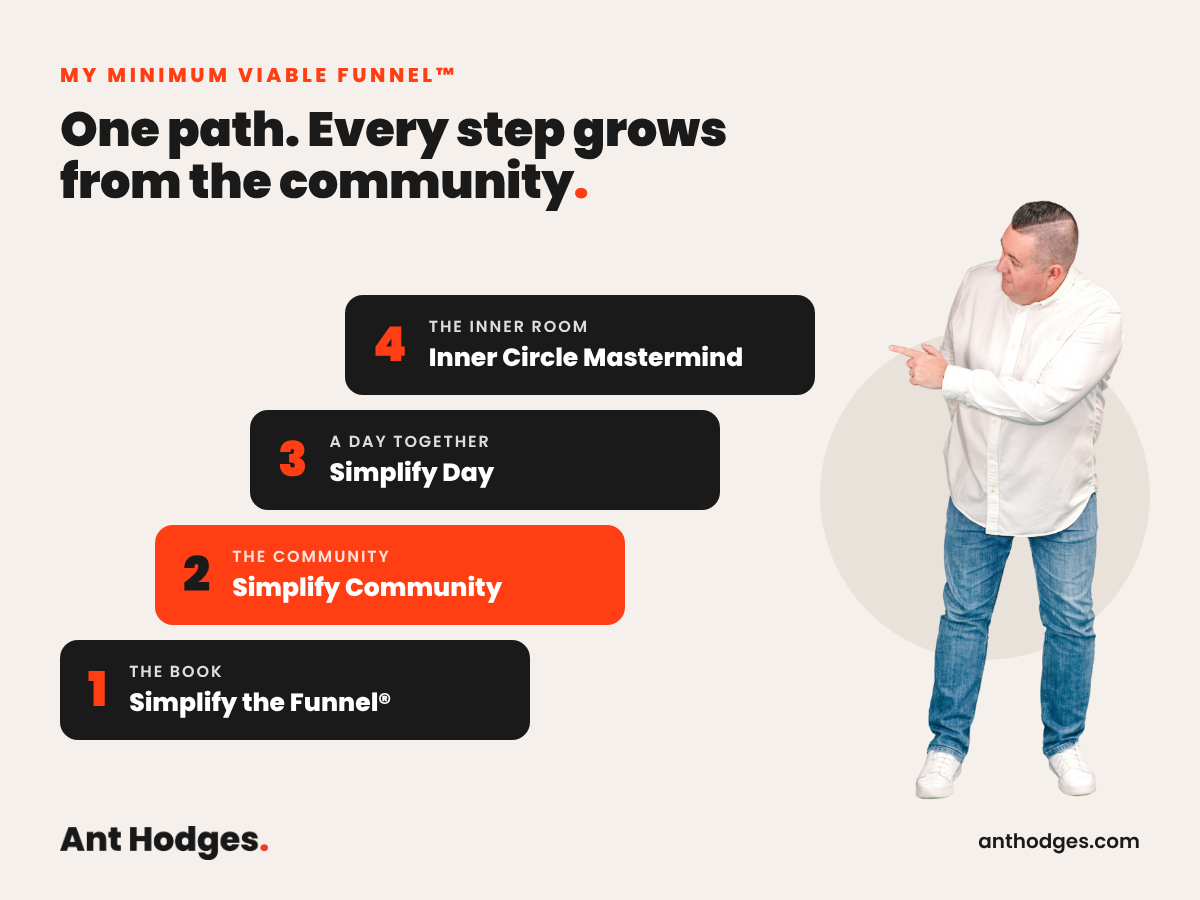
Here is what changed after the rebuild. My attention now goes to two jobs. The first is sharing my expertise in public, through content like this post, my podcast and my talks. The second is spending real time with the people in my community.
The content does the expert positioning for everything else I offer. The human connection inside the community does the rest. Simplify Days and Inner Circle places grow from relationships with people who already know me, so there is no need to chase cold leads into a high-ticket offer.
That is the Breathing Space Effect in my own business. A funnel built on hundreds of automations would keep me busy managing it. A funnel built on a few clear steps and real relationships lets me spend my days on the two things that grow it.
“It’s time to reject complexity as strategy. Embrace the power of doing less, but better. Your business deserves clarity. Your life deserves freedom. Your success demands simplicity.”
From Simplify the Funnel® by Ant Hodges

Do customers reward a simpler business?
Simplifying doesn’t only help you. It helps the people you serve, and they notice.
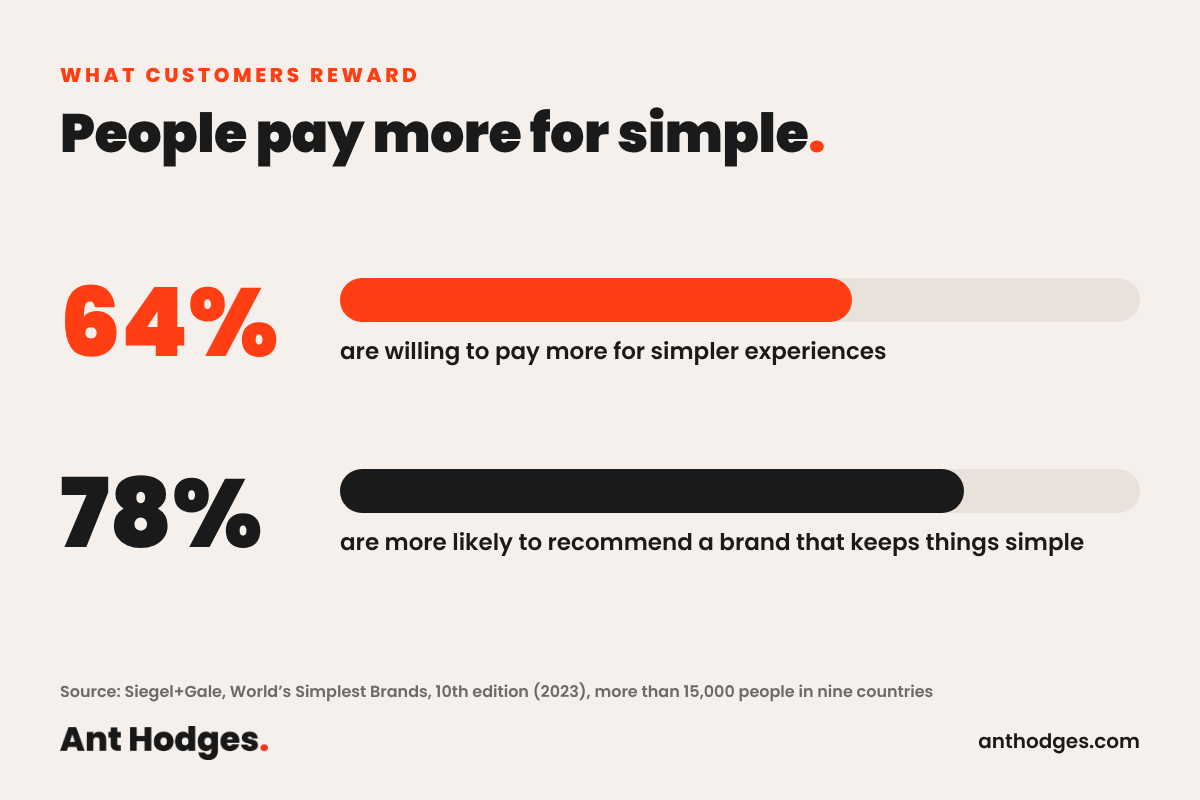
Brand agency Siegel+Gale has measured this for more than a decade. In the tenth edition of its World’s Simplest Brands study, which surveyed more than 15,000 people in nine countries, 64% said they were willing to pay more for simpler experiences. And 78% said they were more likely to recommend a brand because it kept things simple.5
My favourite example of this comes from a burger chain. When Bain partners Mark Gottfredson and Keith Aspinall wrote about complexity in Harvard Business Review, they pointed to In-N-Out Burger, with just four items on its menu. In 2003, the family-owned chain grew sales by 9.2% to $308 million, about double the fast-food standard, with margins analysts estimated at around 20%.3
Four items made buying, cooking and serving simple. The simple menu was the reason the business could grow so well. Nobody would call that lazy.
The same applies to an online business. One clear offer is easier to explain, easier to buy and easier to recommend. One clear path is easier to follow. When your customers find you simple to work with, they tell their friends.
How do you simplify without stalling your growth?
Simplifying well follows a pattern. These four moves keep your business growing while you clear the clutter.
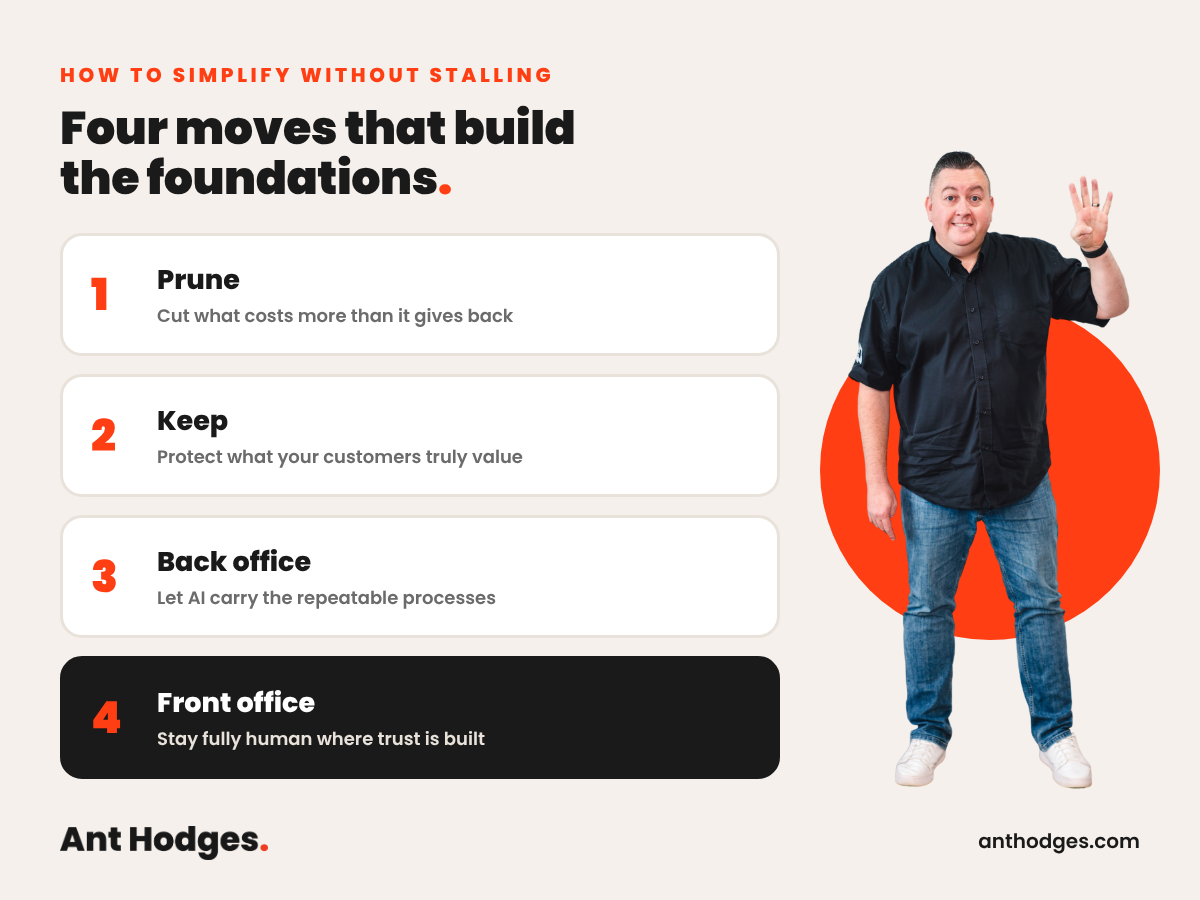
1. Prune
Start by cutting what costs more than it gives back. Look at tools you rarely open, offers that hardly sell, social platforms that bring nothing in and meetings with no clear outcome. Pruning a plant doesn’t weaken it. It sends the energy to the branches that will fruit.
2. Keep
Then protect what your customers truly value. Your core offer, your best content and the relationships that bring you referrals all stay. Simplifying is about keeping the right things, so be generous with what works and ruthless with what doesn’t.
3. Back office
This is where AI earns its keep. Let it carry the repeatable processes: drafting first versions of admin emails, tidying notes, summarising calls, organising files and keeping your systems in order. AI is brilliant at following a process you have already designed.
Keep the thinking for yourself. Your ideas, your judgment and your years of experience are what your customers buy. AI can run the systems, while you bring the genius.
4. Front office
Stay fully human wherever trust is built. That means sales conversations, community calls, replies to members and the moments when a customer needs to feel heard. As more businesses automate everything, the human touch becomes rarer and more valuable.
Inside the Simplify Community, my training called The Simplification Mindset walks you through how to think this way, so cutting stops feeling like loss and starts feeling like room to grow. To get access to the training I just mentioned, you can get instant access by joining my community.

Why does simple growth have no ceiling?
Here is the part people miss when they hear “simplify” and think “small”. A simple business still dreams big. It simply puts its energy into fewer places, so each of them can grow further.
My own focus is my community. There is no limit to how many people could join it, and no limit to the impact it could have on business owners who want to simplify. Every piece of content, every talk and every conversation points to that one goal. Everything else in my business grows from it.
That focus has changed how I measure success. My measure is impact: the number of business owners who build something simpler, stronger and more human because of what we do together. The bank balance follows as a result. It has never been the aim.
This is what I mean when I say enough is the foundation, never the ceiling. Deciding what “enough” looks like for your business gives you a firm base to build on. From there, the impact, wealth and life you build are yours to choose.
So, to the man in the third row, and to anyone else wondering: simplifying is not lazy. It is the work of building foundations strong enough to carry whatever you decide to build next.
Try this today
Find your breathing space in 30 minutes
- List every tool, offer, platform and regular meeting in your business on one page.
- Next to each one, write whether it brings in customers, serves customers, or does neither.
- Pick one item from the “neither” pile and switch it off, pause it or cancel it this week.
- Choose one repeatable back-office task and write down the steps, so AI or a simple system can carry it.
- Book the time you have freed into your diary for customers, and protect it like a paid appointment.
Frequently asked questions
Is simplifying a business the same as downsizing it?
Simplifying and downsizing are different things. Downsizing shrinks a business, while simplifying removes the parts that slow it down. A simplified business can grow faster than before, because its time, money and attention go to fewer, better things. Many owners simplify so they can grow, and use the space they free up to serve more customers well.
Does simplifying mean working fewer hours?
Sometimes it does, and that choice is yours. For most business owners, simplifying first changes what the hours are spent on. Less time goes on admin, tech and work about work, and more goes on customers, new ideas and the work that pays. Some people use that space to grow, others to reclaim their evenings, and many do both.
Why does simplifying feel so hard?
Research published in Nature in 2021 found that people instinctively look for ways to add when they try to improve something, and often overlook ways to subtract. Adding also feels like visible progress, while cutting can feel like loss. That is why simplifying takes deliberate effort, a clear set of questions and, ideally, someone outside your business to help you see what to remove.
What should I simplify first in my business?
Start with whatever takes the most time for the least return. For many online business owners that means unused software, offers that rarely sell, or a funnel with too many steps. Map your customer path from first contact to purchase, then remove anything a customer could skip without noticing. The Minimum Viable Funnel is a good model to rebuild around.
Where can I get help simplifying my business?
The book Simplify the Funnel® by Ant Hodges is the place to start. The Simplify Community gives you training, including The Simplification Mindset, plus regular calls with other business owners who are simplifying too. If you want hands-on help, a Simplify Day is a full day working through your business together to decide what to keep, what to cut and what to build next.

About the author
Ant Hodges is the author of Simplify the Funnel®, a Kajabi Founder and the host of the Less Is The Strategy podcast. He has spent more than 20 years running his own businesses, agency and programs, and now helps online business owners, coaches, creators and experts simplify their businesses and leave the cult of hustle behind.
Footnotes
- UVA Today (2021) “When It Comes to Problem-Solving, New UVA Study Finds That Less Is More.” Interview with Gabrielle Adams, Benjamin Converse and Leidy Klotz on Adams, Converse, Hales and Klotz (2021) “People systematically overlook subtractive changes,” Nature 592. news.virginia.edu ↩
- Talbert, M. (2026) “How work about work gets in the way of real work.” Asana, drawing on the Asana Anatomy of Work Index. asana.com ↩
- Gottfredson, M. and Aspinall, K. (2005) “Innovation Versus Complexity: What Is Too Much of a Good Thing?” Harvard Business Review, November 2005, published on Bain & Company. bain.com ↩
- Nohria, N. and Gulati, R. (1996) “Is Slack Good or Bad for Innovation?” Academy of Management Journal 39(5), 1245–1264. doi.org/10.5465/256998 ↩
- Siegel+Gale (2023) “Delivering simple experiences has never been more important.” World’s Simplest Brands, tenth edition. siegelgale.com ↩
All sources checked and live on 4 November 2026.