The Online Course Industry Has a Transparency Problem
Jan 11, 2026
Last week I wrote a community post about Amy Porterfield closing Digital Course Academy. It followed her podcast release and there has been a lot of chatter about it online. The podcast was positive, encouraging even. In my community post I talked about how sometimes even the smartest of business operators eventually realise that more isn't better. That sometimes better means doing less – simplifying in other words.
Then Jessica Stansberry dropped a video calling the whole thing BS. And honestly? I think she's got a point.
(Both videos linked below if you want to watch them)
The Problem With How We're Talking About This
Amy's announcement sounded lovely. "I just have a heart for helping women who are further along." A desire to work more closely with people. A new chapter. An earned elevation.
But Jessica raised the question nobody else was willing to ask. What if that's not the whole story?
What if the reality is that the marketing for Digital Course Academy just stopped converting the way it used to? What if the launches got harder? What if the same strategies being taught inside that programme were the exact strategies that stopped working?
I don't know Amy personally. I can't tell you what's happening behind closed doors. But I can tell you what I saw firsthand.
Around 2020, my agency clients started bringing us strategies from courses like DCA. "I just spent $10k+ on this programme and I need it implemented." They'd hand over the blueprint expecting magic.
Almost every time, it didn't work.
The webinars underperformed. The registration rates dropped. The show-up rates were abysmal. The sales didn't come.
We'd implement it exactly as taught and watch it fall flat. For those that we then took a simplified approach with, everything changed and suddenly the results appeared. Funny how that works.
The Integrity Question
Here's what actually bothers me about this whole situation: if something isn't working anymore, say that.
If the strategies you've been teaching for ten years have stopped converting, be honest about it. When you keep selling a course that teaches methods you know aren't delivering results anymore, you're not just selling hot air, you're selling hope. And despite being fully aware that what you're selling is something that may not work for people, they keep buying that hope message from you.
Too many gurus in this space have had it too good for too long. They built their audiences teaching what worked in 2000, 2010 and up to 2015. Then kept teaching the exact same thing. Never updating things and never acknowledging that the landscape shifted beneath everyone's feet. The only person I know that operates like this is the Godfather of the launch model that all gurus have learned from – Mr Jeff Walker. Product Launch Formula gets updated every year with tweaks and changes to strategies based on data and what is working. If they all learned the launch model from him, why not continue learning what you need to do in order to keep serving people with full integrity?
If you know internally that your methods aren't working anymore, say that. Don't just keep flogging a dead horse. The only thing that proves is that integrity isn't at the heart of your business.
Why This Happened
The shift online started in 2019/2020. I watched it unfold in real time with my clients.
The pandemic changed online learning forever. Everyone was stuck at home. Course sales exploded. Webinars became the standard across every industry. And then something interesting happened.
People got fatigued.
They didn't want another hundred-video course with a workbook so thick that it lands on their doorstep with a huge thud like a sandbag. They wanted shorter content. More actionable. Less theory. Less guru energy.
Then AI arrived and changed everything again.
People can now open their phone and ask ChatGPT to think critically about their business like a coach would. They are all asking "Why spend thousands on a course when I can get answers instantly?" AI has replaced the adviser or mentor that many people used to seek out – we can debate the good or bad side of this another time.
The question everyone's now asking is simple. "Why do I need to buy that online course?"
The Simplicity Advantage
Here's what the gurus with their bloated programmes can't do.
They can't pivot quickly.
When you've built a monster programme with hundreds of videos, complex funnels and team members hired specifically to run your launches, you're stuck. You can't respond to technology changes. You can't adapt to shifting customer preferences. You can't evolve when the market tells you to.
That's not a business. That's a prison.
When you simplify, you stay nimble. When the market shifts, you shift with it. When something stops working, you can change it next week instead of next year.
What Actually Works Now
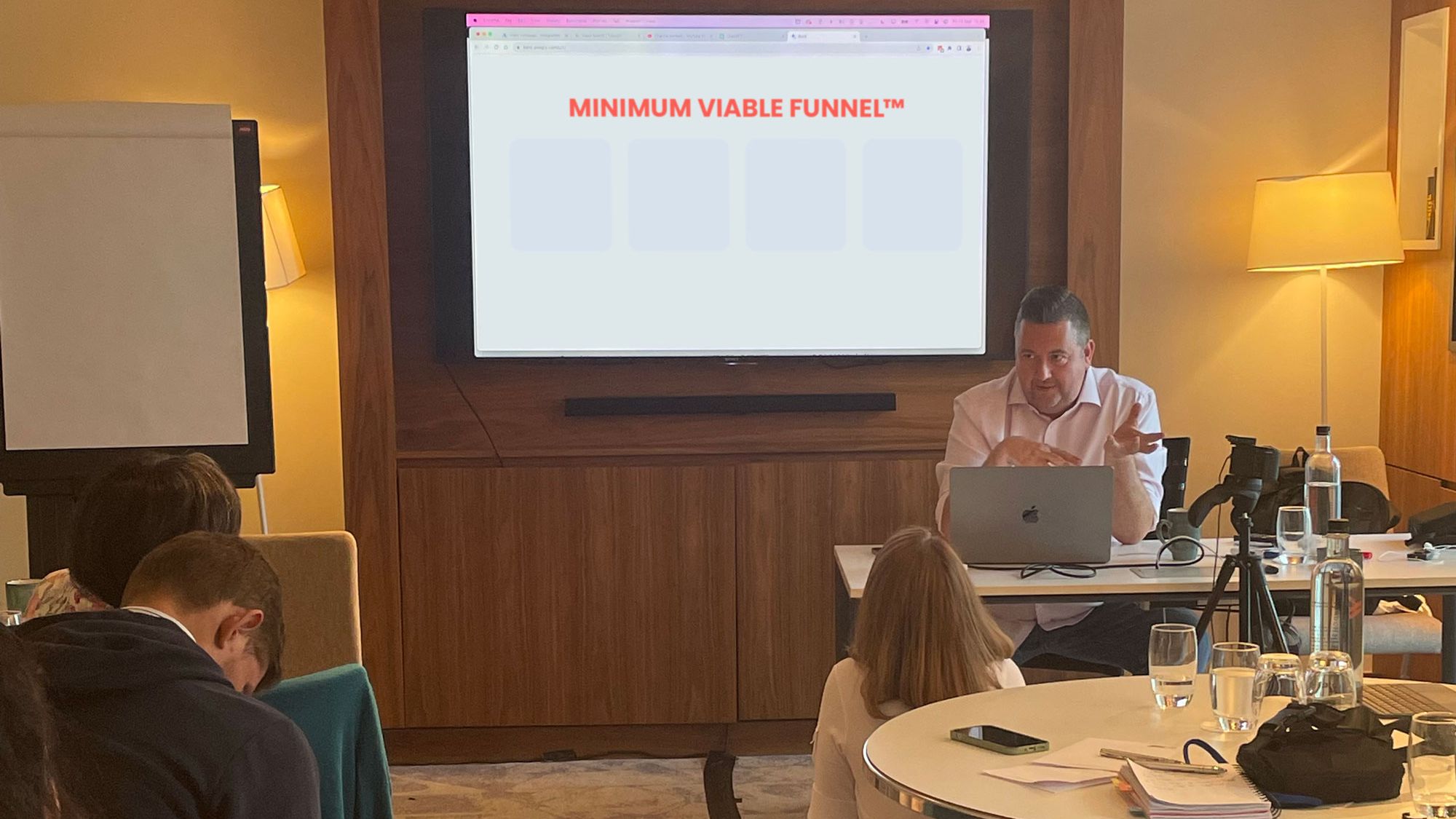
I've been teaching this for years but it bears repeating. The Minimum Viable Funnel™ (MVF) isn't just a framework. It's a philosophy.
- Traffic Source - Nail this first. Build your audience. Get attention. Focus on serving the one person you can help with every piece of your content – all before you even think about building a list.
- Free and No Brainer Offers - The free line has moved. PDF lead magnets build lists of freebie hunters who never buy. Free assessments, webinars, and discovery calls are what work now. Pair them with a no-brainer offer that's low cost but high value. Direct from your content. No messing about.
- Conversion Event - One place you send people. Human to human engagement. Not an AI chatbot. Not an automated phone call. A real conversation that leads to your main offer.
- Human Follow Up - The engagement after purchase. Being sold-out and passionate about helping your customer get results - inside the community you facilitate, on the calls you host, with the access to you that you offer. Boundaries can be set, but be open with your time.
The winners in this space won't be the ones with the biggest programmes or the most sophisticated automations. They'll be the ones who connect with their audience on a human level. They'll systematise their processes with AI but leave the connections to actual humans. They'll create community and belonging. Real experiences like events and retreats combined with online engagement where everyone shows up as a person.
Consumers are seeing AI content as lazy, like that brand does not care about investing human time into creating content that they connect with. While AI seems to be the new gold rush, it's those building a life that is connecting with people outside of the gold mines that are finding diamonds and gems of human-to-human relationships that are worth so much more.
Traffic → Offer → Conversation → Human Engagement
(That's it. That's the simplified version for the MVF)
What This Means For You
Take stock of what Amy and others are doing. Some are pivoting too late after years of trying to squeeze the last drops from methods that stopped working. Some pivoted sooner and are thriving.
Don't just keep doing what people taught you that worked ten years ago. Connect with your audience. Really serve them. Build something that can adapt when the world changes again. Because it will.
Without knowing the inner workings of any business, we have to take everything we see publicly with a pinch of salt. Is what Amy shared really the open and honest truth? Is what Jessica theorised the reality? We'll never know.
But we do know this. Things have changed dramatically since we were all forced online and then all suffered Zoom fatigue. AI is now everyone's best friend. And the question of "why do I need that course" isn't going away.
Simplicity is the move.
Here's my challenge for you this week. Look at your business model and ask yourself this question…
If everything changed tomorrow, could you pivot, or are you too locked into something complex to adapt?
If you're selling something you know deep down isn't delivering results anymore, this is your permission to stop. Your customers will thank you. And so will your conscience.
Useful links