LESS IS THE STRATEGY - EPISODE 23
Why People Aren't Joining Your Community
Host: Ant Hodges
lessisthestrategy.com
ANT: On this week's community call inside the Simplify Community, someone asked me a question that I do hear all the time. They used to run a small group online and earlier this year they closed it because literally only two or three people were turning up each week to the live calls. Now they want to open it again. But they wanted to know one thing first.
Was the platform that they used the problem or would a free Facebook group work better? Almost every time I hear this, I know that it's almost never the platform's fault. And it's never the reason why people aren't showing up or they're not staying. The real reason sits somewhere else entirely.
And that's what the whole episode today is all about.
[00:52] INTRO
ANNOUNCER: Welcome to Less Is the Strategy. A weekly show for online business owners who want to simplify and scale, escaping the cult of hustle and complexity forever. Here is your host, Ant Hodges.
ANT: Hello, and welcome to episode 23 of Less Is the Strategy. It's really good to have you here with me again this week. You're going to have to bear with, there might be some sniffles along the way. I've come down with one of these bad doses of man flu this week.
Something's clearly been going around. Got a little frog in my throat. I'm going to need to be sipping some water as we go through. But that's the power of post-production, isn't it?
I can pause and you can cut those kinds of things out. But this week on the show, I'm going to be diving into something that's so important. I had to record to get you this episode this week, no matter how I'm feeling. Because it's kind of why I've opened my community with a 14-day free trial after, let me be honest, months of very few new members coming in, and it really links with what I'm seeing across the industry and what I'm seeing from my community, and the questions that my community is asking.
And in a conversation this week, I'm going to be answering that platform question that I just mentioned properly. And I'm going to look at the first 10 days that decide whether someone stays or not when they join your community. And I want to finish with The Simplify today on this episode where I want to help you to map out what your new members or clients go through in their first week of signing up to your group or your community or your program. So grab a coffee or a Lemsip like I've got in front of me and let's get straight into it.
[03:13] FROM THE DESK
ANNOUNCER: From the Desk!
ANT: Hopefully, you're liking the new format, breaking it up, and in this section, the desk. This is all about where I'm kind of working on some stuff. So, I want to start with something that really is very close to home. And I'm being very honest and heart on the sleeve here.
Over the last few months, hardly anyone new has been joining the Simplify Community. The people inside are fabulous, brilliant, and they show up on every single call, they're engaging in the community each week, they're moving the needle in their business, they're simplifying. But the front door has gone quiet, and you know, when it goes quiet, it always tells you something. So, I did exactly what I do for any client: when things aren't going the way you want, you stop.
And you look at everything: the offer, the page, the message, and every step someone takes to get to you. And I went through all of it, one piece at a time. Here's what I realised when I looked properly. The people who are in my community now, and those who are staying, because I don't really have a churn rate, everyone's pretty much sticking around.
They're all people who've spent time with me. They came to a meetup in London. They sat in a room with me at an event, maybe in Dubai or Finland or Los Angeles, where I was speaking maybe. They got to know how I think before they ever paid me anything.
Life has changed shape a little bit since doing lots of events. These days I'm not running my own London meetups as often as I used to. That meant there was no longer a way for people to actually spend time with me without spending huge amounts of money or committing to subscriptions. Without actually realising it, I'd taken away the very thing that brought people in.
Now, the advice I was given earlier this year pointed the other way: keep the door tight and make people commit before they get in. There's a place for that approach, and it works for plenty of people. It just didn't fit how my people actually made a buying decision. So I've gone the other way.
Against all the advice, the Simplify Community now has a 14-day free trial. The price hasn't changed at all. There's still a monthly plan, an annual plan, exactly as they were before. The only thing that has changed is the sign on the front of the door.
During a 14-day trial, you can get the community itself. You can join a couple of our live Monday calls. You get the Simplify mindset training. And when you become a paying member, the whole library opens up for you.
And my aim is simple. Get people into that virtual room and let them spend time with me and the community. Let them feel how the simplified way of working actually works from the inside. And then let them choose.
If they stay, that's wonderful. If they don't, that's completely their call, and that is fine too. And honestly, this feels pretty much more like me. After doing this stuff in this industry for over 20 years, one thing has never changed.
People buy when they trust you. And trust takes time spent together. You need to spend time with people. And there was a second lesson in all of this.
It actually came up on Monday's call in the community. It's about the moment someone actually says yes. For me, I'm opening the door for allowing people to spend time with me like we used to do in physical meetups, like we used to do when I held maybe a drinks reception after a speaking gig that I would do or something like that. The time in the community is important.
So opening the front door to the community, putting a sign on the front that says 14-day free trial is going to enable people to spend time with me. And I'll be brutal, and I'll be honest, like I am wearing my heart on my sleeve. I was nervous about this, but this literally, it went live and on the first day, literally as I'm recording this, it only went live yesterday. We've had one person sign up for a trial, just organically.
Not done any promotion for the community in any way, shape, or form. They've just come to the page, they've signed up for the 14-day trial. One person, less than 24 hours. So getting in front of someone and allowing them to spend time with you, that for me is a great way of doing business.
There's something else that came up on Monday's call that I also have been kind of working at and sitting at the desk kind of working on. And it's about kind of that moment when somebody actually says yes to buying from you. One of our members told us that most of their sales copy lives on their checkout pages. They've got over 40 offers and the checkout page does all of the selling itself.
They don't necessarily have separate sales pages. The tools that we all use allow us to build our checkout pages like that. And we can put a ton of content on our checkout and make our checkout look like a sales page. But if I'm honest, my view on how we build sales pages and checkout pages still hasn't moved away from what the data is telling me.
Your sales page and your checkout have two very different jobs. The sales page tells the story. It shows the transformation, answers the questions and carries maybe the video and the proof. Then someone clicks a button and the checkout has one job to do left.
It says here's everything you get. Now pop your details into this form. Think about how Amazon does it. While you're browsing, there's everything in front of you.
There are products, links, and recommendations all over the place. But the moment you go to your basket and check out, the links disappear. There's only one thing left to do: put your credit card details in and pay. That's why I've never been a fan of stuffing checkout pages with countdown timers and a wall of testimonials.
Strip that last page right back to the essentials. Make the final step the easiest step of all. And keep the final step of a purchase decision simple. After a quick break, we'll talk about what happens once people are inside because that's where most of us get it wrong.
Stay with me for that one.
[11:19] AD BREAK - SIMPLIFY THE FUNNEL
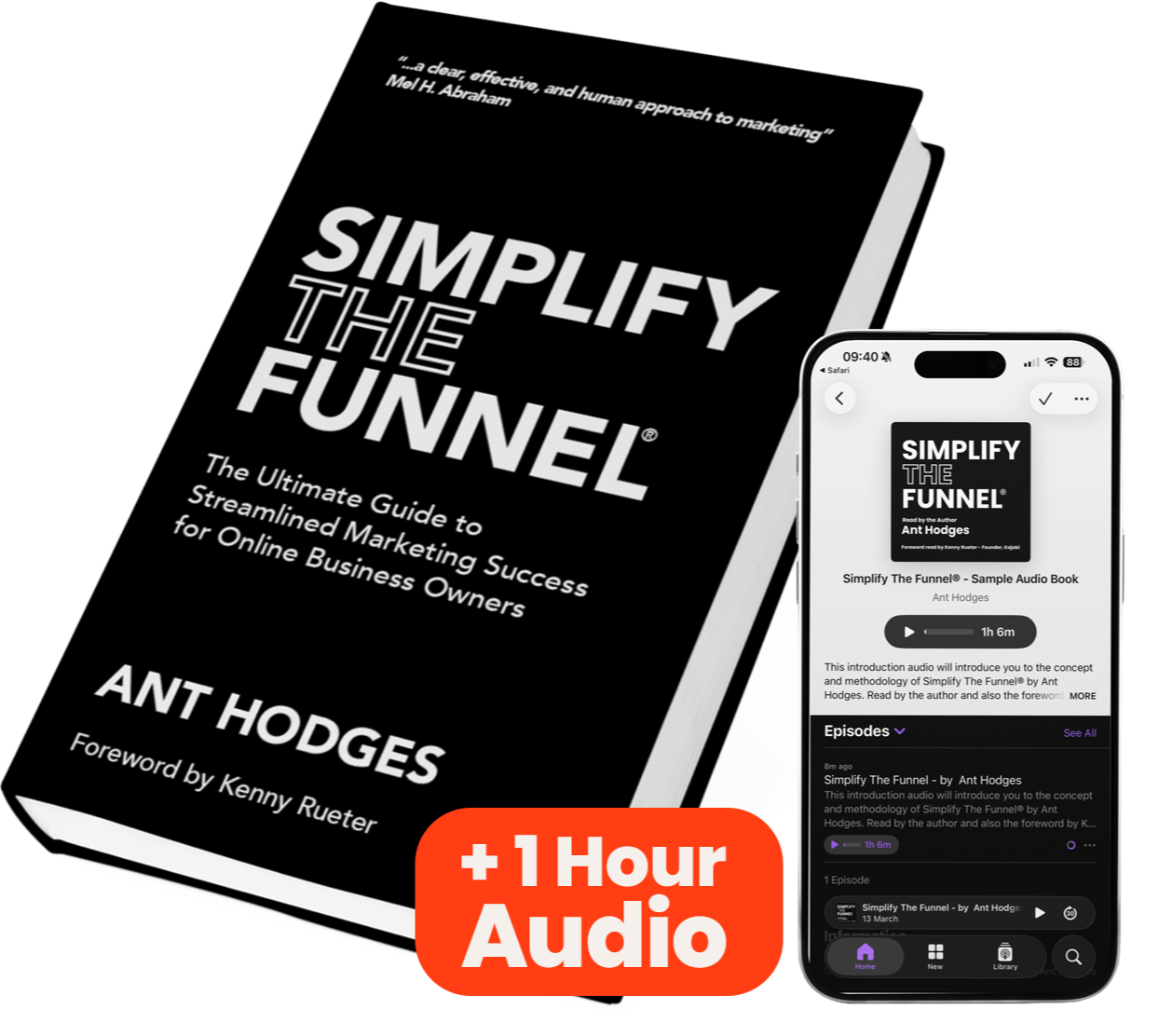
ANT: Here's something you can do on your next coffee break: download the first chapter of my book, Simplify the Funnel. It's completely free. You'll also get a full hour of audio where you can listen and walk in the car, at the gym, while you're cooking, all of that kind of stuff. It shows you a simple way to bring in clients and why stripping things back gives you a good business with room to grow.
All you need to do is pop your email in at simplifythefunnel.com. Give it an hour this week. See what it changes for you.
ANNOUNCER: Now let's get back to Ant!
[12:01] THE CONVERSATION
ANNOUNCER: The Conversation!
ANT: Okay, welcome back to the second half. Let's go back to that question from the start of the show. A member on Monday's call inside the Simplify Community used to run a small implementation group. It helped people with the practical side of their online business, the tech and the setup.
A few people turned up each week, sometimes just maybe two or three, sometimes just one. And the ones who came got a huge amount from it. But the numbers stayed low. So earlier this year, they actually closed the group.
Now they want to bring it back in some way, but they want to do it properly this time. They kind of want to do it step by step. They want to follow the right kind of funnel set up to market it. So the minimum viable funnel.
And as you can imagine, that's all music to my ears because they are learning the Simplify way and the Simplify methodologies, and they're going to follow it. But first, they asked a really good question. Is the platform the friction? Would more people join if it was a free Facebook group instead?
And you know what? My answer I think surprised them a little bit. The platform is completely irrelevant. That was my straight up answer.
Whether people join comes down to three things: how you market it, the message you put out and the friction you either put in the way or that you take away. They watched a big Facebook community move from Facebook to another platform. And when the activity dropped off, you know, it was completely understandable. There was a little bit of fear.
Because when you think about it, there were thousands of people already settled into a Facebook group. Very few of them will pack up and move and go to another system. New people are a different story though. New people go wherever you tell them to go.
If you say, here's my community, here's how you get in, download the app and you're there, they'll do it. One of the businesses I work with runs its whole membership through a branded app. On the thank-you page, there's a short video of the founder holding his phone and he says, here's the app. Here's what the community looks like, pointing to it on his screen while it's being filmed.
And here's how you get in. Then he jumps onto his computer and shows them the same thing on his computer. That one video does more for joining than any other platform choice could ever do because it's irrelevant what platform he's using. He sat there actually showing them.
You don't even need to name the platform that your community is running on. At the end of the day, it's your community and you show people how to get in afterwards. Now let's get to the part that really matters. Years ago, I went through a membership training by one of the big gurus.
One idea from it stayed with me ever since. The most important thing you plan in any membership is the onboarding. It matters more than the content, more than the structure, more than the funnel and more than your marketing. And here's why.
When someone joins, they're on a high. They've said yes, they're excited and they've bought into what you're doing. Then over the next seven to ten days, the energy will start to drop. Life gets in the way.
The emails pile up. If nobody catches them, they will literally drift away quietly into the ether. Your job is to keep that energy up. Through the life of the membership, energy will always go up and down, up and down.
And every time it dips, you need to lift it again. Jeff Walker, one of my heroes in this industry, talks about star moments. And I love the idea of this. There are moments somebody didn't see coming, like a value bomb you weren't told about, something that makes them sit up and think, wow, I'm really glad to be here.
I know some businesses that are doing this brilliantly. On top of everything, if you've got a membership page, why don't you list everything you're getting and then every now and again do a two or a three-day live training just for your members? Announce it maybe a month before, and maybe even bring in some guest conversations that just appear in the community. Members will love this because it's precisely those star moments that Jeff talked about that we need to inject into our community.
So it comes down to onboarding, nurture, and star moments. Plan those three things before you even think about launching or relaunching a community. Literally, get the calendar out. Put some stars on the calendar and work out what you're going to give in additional value as value bombs for your community.
And I'll be straight with you because I wear my heart on my sleeve. Some of this I've got very wrong in my own community, and it's exactly what I've started to put right over the last few months. Anyone who starts now the 14-day trial gets some emails from me, some extra videos from me over the 14 days, and it helps to onboard them in the best possible way. Plus, there's a couple of links where they can chat with me as well.
The point is, I want them to simplify. So I've also included the first training. And then I want to nudge them and actually say hello and talk to them in the community and shout about them in the community and get everybody else to say hello. But I also want them on the live call.
So they're going to get reminders about making sure that they turn up to those calls in their trial. You know, once someone becomes a paying member, there's at least three months of planned nurture to help them work through all of the training as well with some additional videos and things. But I've also got other things planned for my community as those additional star moments for all the people who have been there for a while. And one more thing came up, and it was really looking at it from the flip side.
It's for anyone who's part of any group. So if you're a member of a group anywhere, you get back what you put in. The phrase I use a lot is being there for one another's success. Answer other people's questions when you can.
Celebrate their wins when they happen. Turn up on their posts. Then, when you post something yourself, the room will show up on yours too. When we talked about all of this onboarding and this nurture, someone on the Monday call actually laughed and said I'd just given them a whole ton of extra work.
And honestly, it's fair enough, I probably had. But it can be easier than it sounds. It doesn't have to feel like a lot of work. Sit down and record yourself talking it all through for maybe half an hour.
Hand that recording to an AI tool and ask it to pull everything into a plan. You do the thinking and let the tool do the building. After the break, it's The Simplify, the one small thing you can do this week to tighten up on those first few days. So stay with me for that one.
[20:40] AD BREAK - THE SIMPLIFY COMMUNITY
ANT: Running a business on your own can feel lonely at times. You make big decisions at the kitchen table, and there's often no one around to sense-check them with you. The Simplify Community started with people I met at my own live events in London and overseas. It's grown into a group of business owners from all over the world who show up for each other every single week.
Most of us have been in business a long time. And we'd rather build something simpler and steadier than chase the next trend. Come along and meet us all. Your first 14 days are free, including the live calls on those Mondays during your trial.
Start at simplifycommunity.com.
[21:30] THE SIMPLIFY
ANNOUNCER: The Simplify... your one thing for this week!
ANT: Here's your one thing for this week. Write down the first seven days. Whatever you sell, someone has a first week with you. It might be a membership, a course, coaching, a done-for-you service.
I want you to take one sheet of paper and write down what actually happens to them in that first week. Start with day one. What do they receive? What do they see first?
How do they feel? Then look at day two and day three. Maybe something hasn't reached them yet. You know, is there a reason for them to come back?
Then move through onto four, five, six, maybe onto day seven. Have they had a small win yet? Has anything surprised them in a good way? Look for the gaps in your first seven days.
You'll probably find a stretch of days when nothing happens at all, or some empty gaps that you probably need to fill. Pick one gap and fill it this week. It might be a short welcome video or a personal message or a guided tour of the platform. It might be an unexpected extra little star moment that they were never promised.
Pick just one. Keep it simple. You don't need a 30-step onboarding process this week. You need one page, maybe one change that will make someone glad they said yes to you.
[23:15] CLOSING
ANT: So that's the thread running through my week and hopefully your week ahead. Make it easy for people to get through the door and then make those first few days worth staying for the long haul. Get the welcome right and the platform itself doesn't matter. Everything looks after itself.
Now, I'm going to go and finish this Lemsip, wrap up warm, try and get rid of this cold and shake it off, ready for the weekend.
That brings us to the end of this week's episode. Thank you so much for spending the time with me. If something you've heard today has helped, please share this episode with one person who needs to hear it. And if you'd like to keep the conversation going, come and join us over at simplifycommunity.com.
You can try it free for 14 days. Until next Monday, keep it simple and keep it moving forward.
ANNOUNCER: Less Is the Strategy is a HodgesNet production. Follow the show wherever you listen, so every new episode lands with you on Monday morning. You'll find every past episode at lessisthestrategy.com. And to chat to Ant, please visit anthodges.com.